The Strait the World Is Ignoring Is More Dangerous Than Hormuz
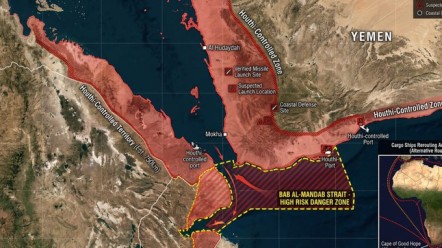
Bab el-Mandeb and Houthi's controlled region (Image Nestor Siruana on X)
While markets watch the Strait of Hormuz, Iran and the Houthis have quietly activated a second chokepoint — Bab el-Mandeb — in a coordinated move that could freeze global trade faster and wider than anything this conflict has produced so far.
By TRH World Desk
New Delhi, March 30, 2026 — Energy markets are watching the Strait of Hormuz. They may be watching the wrong strait.
Two thousand kilometres to the west, at the Bab el-Mandeb — the narrow passage connecting the Red Sea to the Suez Canal — a carefully timed escalation is unfolding. And according to Djoomart Otorbaev, former Prime Minister of the Kyrgyz Republic and a close observer of Eurasian geopolitics, this is not opportunism. It is doctrine.
The Houthis Were Not Quiet. They Were Waiting.
For four weeks, Yemen’s Houthi forces were conspicuously absent from direct confrontation. Analysts split between two readings: decline, or restraint.
Both were wrong.
“They were actually conserving their strength,” wrote Djoomart Otorbaev, in a post on LinkedIn.
The pause ended with a ballistic missile launch toward Israel — a signal, not yet a full offensive. The message, Otorbaev argues, was strategic rather than symbolic: the Houthis are back, they are intact, and they have chosen their moment.
The Two-Chokepoint Strategy: How It Works
Iran and the Houthis are, Otorbaev contends, executing a coordinated doctrine with a specific objective: engineer simultaneous pressure on two of the world’s most critical maritime passages.
The logic is compounding. Hormuz under pressure triggers fear in energy markets. Bab el-Mandeb under pressure does something more severe — it stops global trade.
Approximately 10 to 12 per cent of worldwide trade passes through Bab el-Mandeb, along with a substantially larger share of Europe-Asia container traffic. Unlike Hormuz, where tankers can theoretically reroute around the Arabian Peninsula at significant cost, Bab el-Mandeb offers no practical short-term alternative. Closure — even partial or temporary — means delay, congestion, and cost spikes with no immediate relief valve.
“The key point is that while the West might keep Hormuz open, a partial or temporary closure of Bab el-Mandeb could lead to faster, wider, and more destabilising economic effects than anything experienced so far in this conflict,” Otorbaev added.
Israel–Somaliland Recognition Sparks Horn of Africa Powder Keg
Kharg Island: Rhetoric or Roadmap?
Tehran’s warnings regarding Kharg Island — Iran’s primary crude oil export terminal — should not be read as bluster, Otorbaev argues. They reflect an operational doctrine.
Any US strike on Kharg, he warns, risks triggering a chain reaction that shifts the centre of conflict from the Persian Gulf to the Red Sea region — a far more complex and globally exposed battlespace.
The reason is immediate and structural. A Red Sea disruption simultaneously threatens European supply chains, Asian manufacturing schedules, energy flows, and food shipments. The costs become visible globally and instantly, rather than being contained within a regional energy market.
The Strategic Asymmetry the US Cannot Ignore
The United States retains the naval capacity to protect shipping routes — but doing so now requires it to extend forces across two separate maritime theatres simultaneously.
Saudi Arabia, meanwhile, occupies an increasingly uncomfortable position. Riyadh is locked in a fragile détente with the Houthis and has limited appetite for a confrontation that could collapse it.
“This is not an escalation for symbolism. It is an escalation for leverage. The Houthis are not aiming to secure a traditional victory in war. Instead, they seek to increase the overall costs of conflict for all parties involved. And they are succeeding,” he added.
The Houthis have demonstrated over the past two years — through hundreds of drone and missile launches — that they can sustain disruption to commercial shipping lanes at scale. The capability is established. The question now is how far they choose to exercise it.
At a Glance
| Factor | Detail |
| Strait in focus | Bab el-Mandeb (Red Sea → Suez Canal) |
| Share of global trade at risk | ~10–12% of worldwide trade; larger share of Europe-Asia containers |
| Rerouting option? | None practical in the short term |
| Houthi pause (prior 4 weeks) | Strategic conservation of capacity, not decline |
| Re-entry signal | Ballistic missile launch toward Israel |
| Iran’s doctrine | Two-chokepoint crisis: Hormuz (energy fear) + Bab el-Mandeb (trade halt) |
| Kharg Island threat | Operational doctrine, not rhetoric — a US strike could shift the conflict westward |
| US constraint | Must extend naval forces across two separate maritime theatres simultaneously |
| Saudi position | Fragile détente with Houthis; limited appetite for escalation |
| Houthi objective | Not military victory — cost maximisation for all parties |
| Assessment | Bab el-Mandeb is now the conflict’s centre of gravity, not a secondary theatre |
Follow The Raisina Hills on WhatsApp, Instagram, YouTube, Facebook, and LinkedIn




About The Author