‘Bhiksha Nahi, Shiksha’: Ahmedabad Steps Up Drive Against Child Begging
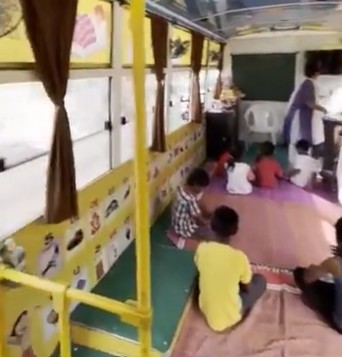
Ahmedabad’s Signal School mobile classrooms bring education to children at traffic signals. (Image X.com)
By NIRENDRA DEV
The multi-agency campaign combines child rescue and enforcement with Ahmedabad’s Signal School model aimed at moving vulnerable children from traffic junctions into education.
Ahmedabad, September 16, 2026 — As Ahmedabad prepares for a larger international sporting and urban-development role, the city administration has intensified action against child begging, forced street activities and the exploitation of vulnerable children.
The latest multi-agency drive has brought the issue back into focus, combining enforcement with rehabilitation and education rather than treating begging only as a law-and-order concern.
Earlier this month, authorities in Ahmedabad rescued 72 children who were allegedly being forced into begging and dangerous street stunts on busy roads. Twenty-four people were booked for allegedly forcing the children into illegal activities. Officials said 10 children were shifted to a Child Welfare Home, while the remaining children were handed over to parents or guardians after verification and warnings.
In another operation, teams working across 41 major hotspots rescued 44 children from traffic junctions and markets. Four minors were moved to protection homes under the guidance of the Child Welfare Committee, while 40 were returned to verified parents under conditions aimed at preventing them from returning to begging.
The enforcement drive has added urgency to an initiative that Ahmedabad began several years ago — ‘Bhiksha Nahi, Shiksha’, or education instead of begging.
Signal Schools take education to traffic junctions
The Signal School initiative was launched in March 2022 by the Ahmedabad Municipal Corporation and Municipal School Board, with support from the Gujarat State Legal Services Authority and the state government. The project was designed for children found at traffic signals who were out of school or vulnerable to dropping out.
Ten discarded Ahmedabad Municipal Transport Service buses were converted into mobile classrooms. The buses were equipped with blackboards, tables, chairs, LCD screens, Wi-Fi and drinking-water facilities. Children were also provided educational support, meals and access to health-related services.
The programme initially focused on children living or working around major traffic junctions. Classes were conducted during working days, with the objective of eventually moving children into the formal school system.
In June 2022, 139 children had been enrolled in the 10 Signal Schools. The programme was subsequently discussed as a mechanism for helping children transition into mainstream education.
The idea was based on a simple principle: if children were spending their days at traffic signals, education had to reach those locations rather than waiting for the children to enter a conventional classroom.
An official involved with the project, Ashutosh Patel, recalled the response of parents when the buses began operating. He described parents waiting to see their children board the yellow buses that had been converted into Signal Schools.
The buses were also designed to make the learning environment attractive to children, with colourful drawings and messages promoting good habits.
From rescue to rehabilitation
The Ahmedabad model reflects a wider policy approach in which rescue is only the first step.
The Union government’s SMILE — Support for Marginalized Individuals for Livelihood and Enterprise — includes a dedicated component for comprehensive rehabilitation of people engaged in begging. The scheme provides for measures including medical support, counselling, education, skill development and livelihood linkages, with implementation involving states, local bodies and other organisations.
The Ministry of Social Justice and Empowerment has also stressed stronger monitoring, inter-departmental coordination and post-rehabilitation support under the scheme.
For children, the challenge is more complex because begging can intersect with migration, poverty, lack of schooling, family vulnerability and, in some cases, organised exploitation.
That makes the distinction between removing children from traffic junctions and providing a sustainable alternative particularly important.
Education as the long-term intervention
The Signal School model attempts to address that gap by combining immediate access to education with the eventual transition into regular schools.
The project has also included sports, cultural activities and skill-oriented guidance. Earlier plans envisaged extending the approach beyond children to provide skill training for parents as well.
The Gujarat State Legal Services Authority, Ahmedabad Municipal Corporation and Municipal School Board have played institutional roles in the programme, giving the initiative a structure that goes beyond a temporary rescue campaign.
The Supreme Court has also previously emphasised rehabilitation, education and employment as important elements in addressing begging, particularly in the case of children at traffic junctions.
The continuing challenge is implementation.
Rescuing children from roads can provide immediate protection, but preventing their return to begging requires sustained schooling, family support, livelihood opportunities and regular follow-up.
For Ahmedabad, the current campaign therefore represents two connected tasks: stopping the exploitation of children on the streets and ensuring that the alternative offered to them is education, protection and a route into formal schooling.
That is the practical meaning behind ‘Bhiksha Nahi, Shiksha’ — moving vulnerable children from traffic signals to classrooms.
Follow The Raisina Hills on WhatsApp, Instagram, YouTube, Facebook, and LinkedIn




About The Author