US Blockades Iran Ports: A War No One Wanted Spreads
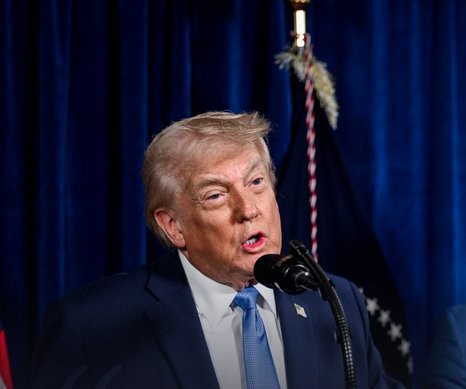
US President Trump delivers remarks on Operation Epic Fury from the White House.
Trump’s naval escalation in the Strait of Hormuz draws China’s warning, market panic and calls for the 25th Amendment — as the world holds its breath
By NIRENDRA DEV
New Delhi, April 14, 2026 — The miracle of a man, it is said, lies in how magnificently he has risen — never in how far he has sunk. By that measure, Donald Trump’s decision to impose a full naval blockade of Iranian ports in the Strait of Hormuz marks a new low in a crisis already defined by miscalculation.
The blockade — announced after the Islamabad talks collapsed without agreement — began at 7:30 pm IST on Monday, when US naval forces moved to intercept shipping routes into Iranian ports. Trump’s stated aim: to seize any ship paying Iran a toll for safe passage and stop tankers reaching Iranian ports. The practical consequence: pulling the United States deeper into a conflict it cannot easily exit, unsettling global markets, and risking a direct confrontation with China.
Netanyahu, Vance and the Explosion in Islamabad
Israeli Prime Minister Benjamin Netanyahu told his cabinet that the US-Iran negotiations in Islamabad did not merely collapse — they “exploded.” He said he had spoken with JD Vance, who briefed him from his plane while returning from Pakistan, explaining that the breakdown came after the US concluded Iran had failed to meet a core ceasefire condition: reopening the Strait of Hormuz to free navigation. Iran, for its part, mocked Washington, asking whether the US and its allies could “endure three months” of Hormuz disruption. The answer, global markets suggest, is emphatically no.
China Draws Its Own Red Line
Chinese Defence Minister Admiral Dong Jun issued a pointed warning to Washington as the blockade began: “We have trade and energy agreements with Iran; we expect others not to interfere in our affairs.” He stated that the Strait remains open for China — a declaration that sets up a direct confrontation between US naval forces and Chinese shipping. The stakes are enormous: the Strait of Hormuz supplies nearly 40 per cent of China’s oil and at least 30 per cent of its LNG needs. Beijing has been pushing hard for a ceasefire precisely to secure this waterway.
The UK took a more cautious line, with Downing Street ruling out sending warships to join the US blockade — a significant signal that even Washington’s closest allies are not prepared to follow Trump into this particular gamble.
Markets, Medicine and Fertiliser
With oil prices rising and stocks falling as soon as markets reopened after the weekend, the IMF’s long-planned Washington meeting morphed into an emergency crisis summit. Global growth forecasts are already being revised downward in anticipation of a prolonged energy shock. Less discussed but equally alarming: a looming shortage of medicines and fertiliser — both heavily dependent on Gulf supply chains — is set to worsen significantly under the new US blockade, with consequences that will fall hardest on the developing world.
‘Unhinged’: The 25th Amendment Conversation
The most dramatic domestic echo of the escalation came from former CIA Director John Brennan, who called publicly for Trump’s removal under the 25th Amendment — the constitutional provision addressing presidential disability and succession. “This person is clearly unhinged,” Brennan told MS Now. “I think the 25th amendment was written with Donald Trump in mind.” Trump’s recent remarks about destroying Iranian civilisation, Brennan argued, demonstrated the president posed a danger to millions of lives. Whether Congress has the appetite for such a move is another matter — but the conversation itself is now part of mainstream American political discourse.
‘J Stands for Jinx’
Social media, meanwhile, has found its own verdict on JD Vance. After the Islamabad talks failed and Viktor Orbán — another Trump-allied leader whom Vance had personally visited to campaign for days before Hungary’s vote — was swept from power in a landslide, the internet reached its conclusion: “J stands for jinx in JD Vance.”
Trump set out to build a world on his own terms. Chaotic, transactional, ungoverned by multilateral norms. He has, it seems, succeeded. The question now is whether anyone — including the United States — can live in it.
FAQ
Q: Why has the US imposed a naval blockade on Iranian ports?
A: After the Islamabad ceasefire talks collapsed without agreement — with the US concluding Iran had failed to reopen the Strait of Hormuz — President Trump escalated by ordering a naval blockade of Iranian ports and threatening to seize ships paying Iran for safe passage.
Q: What is China’s position on the US blockade of the Strait of Hormuz?
A: Chinese Defence Minister Admiral Dong Jun warned the US not to interfere in China-Iran bilateral relations, stating the Strait remains open for China. The Strait supplies nearly 40% of China’s oil and 30% of its LNG needs.
Q: What is the 25th Amendment and why is it being discussed?
A: The 25th Amendment to the US Constitution addresses presidential succession and disability, including procedures for removing a president deemed unfit. Former CIA Director John Brennan invoked it, calling Trump “clearly unhinged” after his remarks about destroying Iranian civilisation.
Q: What does the Hormuz blockade mean for global supply chains?
A: Beyond oil prices and stock markets, analysts warn of a looming shortage of medicines and fertiliser — both reliant on Gulf supply chains — that will worsen significantly under the US blockade, particularly impacting the developing world.
Q: Why is JD Vance being called a “jinx”?
A: After the Iran talks he led in Islamabad failed to produce a deal, and Hungarian PM Viktor Orbán — whom Vance had campaigned for days earlier — was voted out in a landslide, social media concluded that “J stands for jinx in JD Vance.”
Islamabad Talks Fiasco: Why India’s Restraint Was the Right Call
Follow The Raisina Hills on WhatsApp, Instagram, YouTube, Facebook, and LinkedIn




About The Author