US–Iran Nuclear Talks Stall as Warships Mass in Gulf
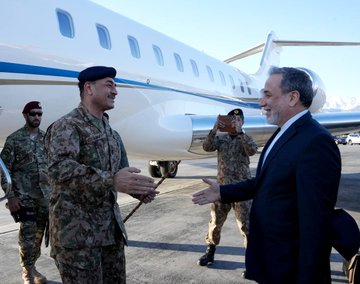
Pakistani Army Chief Asim Munir in Tehran (Image Aragachi on X)
A draft deal offering Iran sanctions relief, asset unfreezes, and a non-aggression pact has failed to move negotiations forward, as Tehran rejects the terms and Washington dispatches a third carrier strike group to the region.
By TRH World Desk
New Delhi, April 20, 2026 — Negotiations between the United States and Iran have effectively ground to a halt, multiple sources confirmed Monday, even as the outlines of an ambitious — and deeply contentious — draft agreement have begun to leak. The proposal, attributed to reporting by Israeli journalist Amit Segal and corroborated by additional sources, would represent one of the most sweeping diplomatic arrangements between Washington and Tehran since the 2015 Joint Comprehensive Plan of Action.
At its core, Iran would agree to suspend uranium enrichment for 15 years — with a narrow carve-out for research reactors producing medical isotopes. Tehran’s existing stockpiles of 60% and 20% enriched uranium would be partially converted into reactor-grade fuel and partially diluted to lower enrichment levels, though crucially, the material would remain on Iranian soil rather than being transferred abroad. The International Atomic Energy Agency would be granted full supervisory access to all Iranian nuclear sites.
Key Deal Terms at a Glance
| Enrichment | 15-year suspension; medical isotope research reactors exempted |
| Uranium stockpile | Partly converted to reactor fuel, partly downblended; remains inside Iran |
| IAEA oversight | Full supervision across all Iranian nuclear sites |
| Strait of Hormuz | Opened, with possibility of Iranian toll collection |
| Sanctions relief | Phased U.S. rollback; $20B+ in frozen assets to be unfrozen |
| Non-aggression pact | Enshrined via UN Security Council resolution and Congressional ratification |
| U.S. military | Full withdrawal of forces from the Persian Gulf |
The US offer to withdraw all military forces from the Persian Gulf is the clause likely to generate the most controversy in Washington, where Congressional ratification of a non-aggression treaty would face a steep path. In exchange, Iran would open the Strait of Hormuz — through which roughly a fifth of the world’s oil supply flows — and could collect tolls on passage.
US Naval Buildup — Persian Gulf Region
While diplomats talk, the US Navy is moving. The USS Gerald R. Ford carrier strike group, accompanied by destroyers USS Mahan and USS Winston S. Churchill, is heading to the Middle East, according to CBS News. It will join the USS Abraham Lincoln, already operating in the northern Arabian Sea. A fourth carrier, the USS George H.W. Bush, is also en route and is expected to arrive before the end of April — giving the United States an unusually large concentration of naval power in the region.
- USS Gerald R. Ford (CVN-78) — En route to Middle East
- USS Mahan (DDG-72) — Accompanying Gerald R. Ford
- USS Winston S. Churchill (DDG-81) — Accompanying Gerald R. Ford
- USS Abraham Lincoln (CVN-72) — Already in northern Arabian Sea
- USS George H.W. Bush (CVN-77) — En route; expected before end of April
Iran’s Rejection
Iran, meanwhile, is signaling deep skepticism about the diplomatic track. Tehran is reportedly unlikely to send delegates to U.S.-led talks proposed for Pakistan, with Iranian officials viewing the current proposals as one-sided and ultimately designed to serve American and allied interests rather than serve as a basis for genuine compromise.
“Iran views the proposals as recycled, one-sided and designed to serve Washington and its allies,” Prof. Mostafa Khoshcheshm, Iranian academic, told Al Jazeera.
The dual signals — a sweeping draft on paper, growing naval presence on the water, and Iranian resistance at the table — reflect the fragile and contradictory state of US–Iran relations as both sides navigate domestic political pressures and mutual distrust accumulated over decades.
Iran-US Talks: Ghalibaf Says Progress Made But “Gaps Are Wide”
Follow The Raisina Hills on WhatsApp, Instagram, YouTube, Facebook, and LinkedIn




About The Author