US Diplomat in Kathmandu: Is America Eyeing Nepal’s Soul?
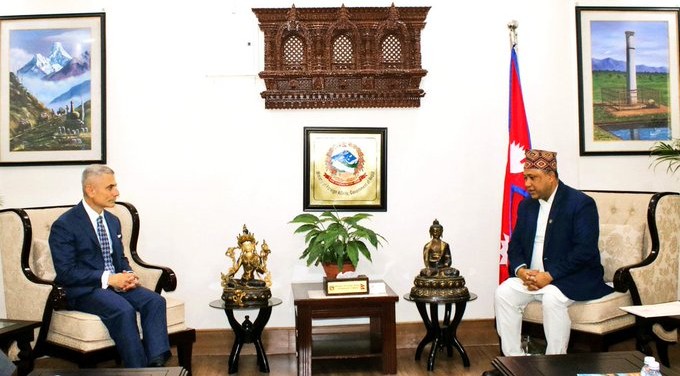
S. Paul Kapur, US Assistant Secretary of State for South and Central Asian Affairs, called on Shisir Khanal, Nepal's Foreign Affairs Minister (Image Nepal MFA)
America just sent its most senior diplomat directly to Kathmandu — skipping India and China.
By TRH Op-Ed Desk
New Delhi, April 21, 2026 — In the quiet choreography of diplomacy, the choice of destination speaks louder than the agenda. When Samir Paul Kapur — the US Assistant Secretary of State for South and Central Asian Affairs and an Indian-American with deep roots in the region — flew directly from Washington to Kathmandu via Istanbul this Monday, it was a pointed statement. He did not stop in New Delhi. He did not stop in Beijing. He landed straight in Nepal’s capital for a three-day visit, making himself the highest-ranking foreign diplomat to arrive in Kathmandu since Balendra Shah’s government assumed office on March 27.
The symbolism was not lost on geopolitical observers. Neither India nor China has yet dispatched a comparable senior envoy to court the new Shah administration. Washington got there first.
‘America Has Arrived’ — The Signal to New Delhi and Beijing
“Neither India nor China has sent a major diplomat to Nepal after the new government was formed. But America has arrived. That itself tells you the significance of this visit,” Manish Anand, geopolitics analyst, said in a monologue for The Raisina Hills YouTube channel.
Anand framed the visit as a structural shift — not a one-off courtesy call. Kapur’s schedule in Kathmandu includes meetings with Finance Minister Swarnim Wagle, Foreign Minister Shishir Khanal, business leaders, and representatives of the Nepal-US Chamber of Commerce. The agenda reportedly covers American corporate access to Nepal’s market, the expansion of Starlink-style connectivity projects, and a revival of the MCC (Millennium Challenge Corporation) compact that Trump’s foreign aid cuts had previously strained.
A Three-Way Contest — and Nepal Sitting in the Middle
To understand why Washington is suddenly this interested, Anand reaches back to a thread of continuity in American foreign policy that transcends party lines. The Biden administration’s engagement with Tibet concerns drew the US deeper into Himalayan affairs. Trump’s second term, despite slashing foreign aid in ways that damaged US credibility in Kathmandu, is now trying to rebuild those bridges under a new government.
“Whether it is China or America — both can trap Nepal in a debt web and then use Nepal’s geography for their own geostrategic advantage. That pattern has been seen with both powers. More than 65 countries are already caught in China’s debt trap — and Nepal is one of them,” added Anand.
China’s presence in Nepal is pervasive and long-established. Beijing’s embassy in Kathmandu is among the most diplomatically active in the region, with deep involvement in infrastructure, political outreach, and BRI projects. Nepal is a signatory to China’s Belt and Road Initiative, and a China-Nepal rail connectivity project has already received preliminary approval. For years, Nepal’s politics revolved around a revolving door between Nepali Congress and the KP Sharma Oli-led coalition — both broadly manageable for both India and China per observers.
But the Gen Z-inspired uprising that swept Balendra Shah — a political outsider and former Kathmandu mayor — into the prime ministership has broken that mould entirely. Anand notes that American interest in the Janaandolan movement that propelled Shah is an open secret in diplomatic circles, drawing parallels to US engagement in Bangladesh’s political transition after Sheikh Hasina’s ouster.
India’s Dilemma: Active but Outpaced
“America is now clearly signalling that South Asia will not remain a bilateral affair between India and China. Washington intends to establish its own presence — and that is a new diplomatic challenge New Delhi must now factor in,” noted Anand.
India has not been idle. Modi invited Shah to New Delhi on the same day he was sworn in, and Foreign Minister Shishir Khanal met EAM S. Jaishankar on the sidelines of the Indian Ocean Conference in Mauritius, where both sides agreed to activate bilateral mechanisms and ground any high-level visit in concrete deliverables. New Delhi has also appointed Dinesh Trivedi — a politician rather than a career diplomat, and a Bengali — as its ambassador to Dhaka, signalling that India understands the geopolitical centrality of its eastern neighbourhood.
Yet the optics of Kapur’s arrival cut through: on the question of who was quickest to Kathmandu after the Shah government took power, it was America — not India, not China.
The Road Ahead: Nepal’s Balancing Act
For Prime Minister Balen Shah — young, untested in national governance, and inheriting a country caught between three major powers — the coming months will define Nepal’s diplomatic posture for a generation. His forthcoming India visit, date yet to be confirmed, will be watched as the first real test of whether he can honour centuries-old ties with New Delhi while managing an increasingly assertive Washington and an ever-present Beijing.
As Anand concludes on Raisina Hills: “The diplomatic challenges are only growing. Which way Nepal navigates — that is something only the coming time will tell.”
Follow The Raisina Hills on WhatsApp, Instagram, YouTube, Facebook, and LinkedIn




About The Author