‘Ghas-Phul’ Vanishes: TMC Loses Its Name and Symbol as Bengal Politics Enters a New Phase
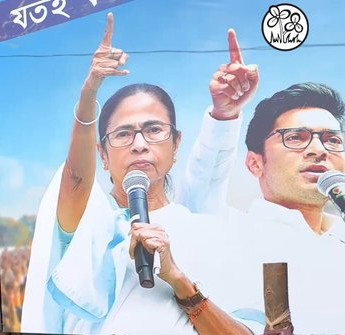
Mamata Banerjee hoarding in Kolkata (Image AITMC on X)
By NIRENDRA DEV
Election Commission gives rival TMC factions separate names and symbols as Mamata Banerjee and Arup Roy camps contest the party’s identity.
Kolkata, September 18, 2026 — For decades, the ‘Jora Ghas-Phul’ — twin flowers on grass — has been one of the most recognisable political symbols in West Bengal. Now, ahead of the October 6 Assembly bypolls, the familiar identity of the Trinamool Congress has been temporarily taken off the electoral battlefield.
The Election Commission has barred rival factions of the Trinamool Congress from using the party’s established name, All India Trinamool Congress, and its traditional ‘Flowers and Grass’ symbol for the upcoming bypolls. The decision followed a dispute between rival groups led by Mamata Banerjee and Arup Roy, with both claiming the party identity.
The group led by Arup Roy has been allotted the name “Democratic Trinamool Congress” and the “Envelope” symbol, while the faction led by Mamata Banerjee has been allotted the name “Mamata All India Trinamool Congress” and the “Football Player” symbol.
The development marks an unusual moment in Bengal politics. Whether it also signals a deeper change in the state’s political culture, however, remains a question for the electorate and the political process.
The Election Commission has said the dispute requires a substantive determination under Para 15 of the Election Symbols (Reservation & Allotment) Order, 1968. Until that process is completed, the two factions will contest the relevant bypolls under separate names and symbols.
On Friday, the Commission allotted ‘Mamata All India Trinamool Congress’ to the Mamata Banerjee faction, along with a football-player symbol. The Arup Roy faction was allotted ‘Democratic Trinamool Congress’ and an envelope symbol for the bypolls.
From ‘BJP finish’ to a changed political landscape
There was a time when Mamata Banerjee’s political rhetoric was built around the confidence that the BJP could be stopped in Bengal. The slogan “2019, BJP finish” became part of the political vocabulary around the Lok Sabha election.
Politics, however, took a different course.
The BJP made significant gains in West Bengal in the 2019 Lok Sabha election, turning the state into one of its principal political battlegrounds. The subsequent contest between the BJP and the TMC reshaped Bengal’s electoral politics.
The latest TMC split adds another layer to that transformation.
When ‘Congress’ disappeared from the logo
The evolution of the Trinamool identity itself offers an interesting historical marker.
Mamata Banerjee broke away from the Congress and formed the Trinamool Congress in 1998, following differences with the party’s approach to the then ruling CPI(M). Twenty-one years later, in March 2019, the party removed the word ‘Congress’ from its public logo.
The new logo carried the word ‘Trinamool’ in green alongside the twin flowers against a blue background. The party continued to remain registered with the Election Commission as Trinamool Congress.
That change was more than a graphic redesign. It reflected the political evolution of a party that had spent two decades building an identity distinct from the Congress from which it had emerged.
The symbolism of ‘Jora Ghas-Phul’
The twin flowers emerging from grass became closely associated with the grassroots identity of the Trinamool Congress. The symbol has also been linked in political accounts to Mamata Banerjee, who has said that she sketched it herself.
The imagery of two flowers on one stem has an obvious resonance with a famous line from Kazi Nazrul Islam: “মোরা এক বৃন্তে দু’টি কুসুম হিন্দু-মুসলমান…”
The line, broadly translated, evokes two flowers or buds growing from the same stem and has historically been associated with the idea of communal harmony.
That symbolism now acquires a different political context as rival factions seek separate electoral identities.
Congress questions the Election Commission order
The Election Commission’s move has triggered criticism from opposition parties.
Congress general secretary K C Venugopal described the freezing of the TMC name and symbol as a “late night birthday gift” to Prime Minister Narendra Modi and alleged that the BJP and the Election Commission were acting together against the Mamata Banerjee-led faction.
Congress leader Rahul Gandhi also criticised the interim decision, referring to earlier disputes involving the Shiv Sena and NCP and alleging a similar pattern in the TMC case.
These are political allegations by Congress leaders and have not been established as findings of the Election Commission.
The Commission’s interim order, meanwhile, stated that it had identified two rival groups, one led by Mamata Banerjee and the other by Arup Roy, with both claiming to be the All India Trinamool Congress. It said the competing claims require substantive adjudication under the Election Symbols Order.
The immediate political test will come with the October 6 Bengal bypolls, when the rival camps will have to campaign without the traditional TMC name and ‘Jora Ghas-Phul’ symbol.
The Mamata faction’s new identity retains the word Trinamool, while the rival faction has also chosen a name containing the same word. The Election Commission’s interim arrangement is intended to remain in force while the larger dispute over the party’s identity is considered.
For West Bengal, the disappearance of the familiar ‘Ghas-Phul’ from the ballot is therefore not simply a change in election symbols. It is also a reminder of how party organisations, electoral symbols and political identities can become contested when a major political organisation splits.
The final question is not merely which symbol voters will see on October 6. It is whether the TMC’s traditional political identity can remain intact amid the organisational dispute now before the Election Commission.
Follow The Raisina Hills on WhatsApp, Instagram, YouTube, Facebook, and LinkedIn




About The Author