No Brahmin Candidate in TN Polls: Even BJP Blinked, Says Analyst
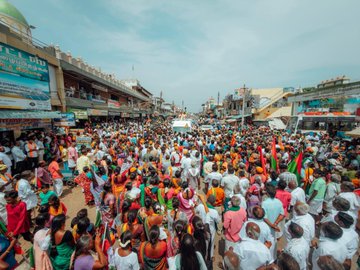
A BJP roadshow in Tamil Nadu Assembly elections (Image BJP on X)
For the first time in 35 years, not a single major political party — including the BJP — has fielded a Brahmin candidate in Tamil Nadu’s Assembly elections, raising pointed questions about electoral exclusion, Dravidian politics, and the limits of Hindutva’s reach in the south.
By TRH Op-Ed Desk
New Delhi, April 11, 2026 — Political analyst Manish Anand, in a special episode of the YouTube channel of The Raisina Hills, has flagged a striking electoral anomaly that has gone largely unnoticed in national political discourse: in Tamil Nadu’s Assembly elections, no major party — not the DMK, not the AIADMK, not Congress, and not even the BJP — has fielded a single Brahmin candidate.
“This has happened for the first time in 35 years,” Anand noted, pointing out that the silence around this exclusion is itself remarkable.
The 3% Question
Brahmins constitute approximately 3% of Tamil Nadu’s population. To contextualise that figure, Anand drew a sharp contrast with Bihar, where the Kurmi community — comprising roughly 2.75% of the population — has produced Chief Minister Nitish Kumar, dozens of sitting MLAs, and exercises political influence far exceeding its numerical share.
“The same 3% figure, two completely different political realities,” Anand observed. “In Bihar, a 2.75% community holds the Chief Ministership for two decades. In Tamil Nadu, a 3% community cannot find a single candidate across all major parties,” he wondered.
BJP’s Candid Admission
Most striking was the response Anand received when he directly questioned a senior BJP strategist — described as having access to the party’s top brass — about why the self-proclaimed party of Sanatan Dharma had also chosen not to field even one Brahmin candidate across its 27 contested seats in Tamil Nadu.
The answer, Anand said, was blunt and unambiguous: “Are we supposed to lose the election? We know that fielding a Brahmin candidate means losing. So why would we do it?”
Anand’s commentary on this response was pointed: “The party that raises the Sanatan flag across the entire country is bowing before Dravidian politics in Tamil Nadu. That is now clear.”
SC Tamil Nadu Verdict: Can Judiciary Usurp Legislative Powers?
Dravidian Politics and Anti-Brahmin Narrative
Tamil Nadu’s political identity has long been shaped by Dravidian ideology, which analysts in the state sometimes describe as “anti-Brahmin politics” in its electoral expression. The DMK, led by Chief Minister MK Stalin — who is seeking a historic third consecutive mandate — has historically operated within this framework. Even the late J. Jayalalithaa, herself a Brahmin, rarely fielded more than one or two Brahmin candidates during her tenure at the helm of the AIADMK.
Congress, despite its historical presence in Tamil Nadu and its alliance with the DMK, has also fielded zero Brahmin candidates this election cycle — silently aligning itself with the dominant Dravidian political current.
The only exceptions this election are two smaller parties, including actor Vijay’s newly floated political outfit, which has fielded a handful of Brahmin candidates.
A Democratic Concern, Not a Casteist One
Anand was careful to frame his concern in democratic rather than communal terms. “This is not about casteism. This is about whether a deliberate, systematic effort to exclude an entire community from electoral politics is acceptable in a democracy,” he said.
He drew a parallel with the controversial UGC regulation attempted by the Modi government — subsequently stayed by the Supreme Court — arguing that the campus-level exclusion it could have enabled mirrors what is already happening electorally in Tamil Nadu.
“Historical injustice cannot be addressed through revenge politics,” Anand stated, adding: “You cannot punish today’s community for wrongs committed centuries ago. That does not constitute justice — it constitutes a new injustice.”
FAQ
Q: Why are there no Brahmin candidates in Tamil Nadu 2026 elections?
Major parties including DMK, BJP, AIADMK, and Congress have avoided fielding Brahmin candidates in Tamil Nadu, citing the dominance of Dravidian political ideology which has historically marginalised Brahmin electoral participation across the state.
Q: How many Brahmins are there in Tamil Nadu’s population?
Brahmins comprise approximately 3% of Tamil Nadu’s total population, yet no major political party has fielded a single Brahmin candidate in the 2026 Assembly elections.
Q: Has BJP fielded any Brahmin candidates in Tamil Nadu 2026?
No. Despite contesting 27 seats and advocating Sanatan Dharma nationally, BJP has not fielded any Brahmin candidate in Tamil Nadu’s 2026 Assembly elections, with a senior party strategist privately citing electoral losses as the reason.
Q: What is Dravidian politics and how does it affect Brahmin candidates?
Dravidian politics, rooted in the ideology of Tamil cultural identity and social justice, has historically carried an anti-Brahmin political narrative, making Brahmin candidates electorally disadvantageous for parties competing in Tamil Nadu.
Follow The Raisina Hills on WhatsApp, Instagram, YouTube, Facebook, and LinkedIn




About The Author