Leading Scientists Converge at Hindu College for STFAS 2026
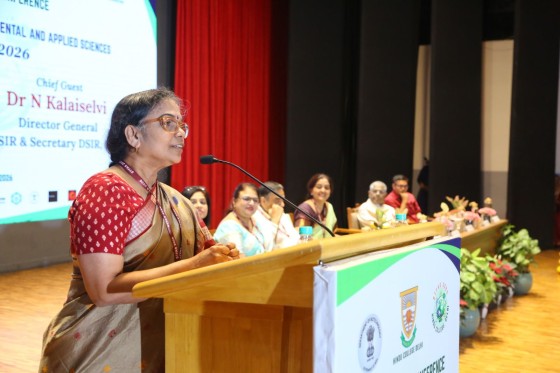
STFAS 2026 Scientists Converge at Hindu College Delhi (Image special arrangement)
Over 300 researchers, academics and students from India and abroad gather at University of Delhi’s Hindu College for landmark interdisciplinary conference on sustainable development
By TRH News Desk
New Delhi, April 7, 2026 — Hindu College, University of Delhi, today inaugurated its three-day International Conference on Sustainability through Fundamental and Applied Sciences (STFAS-2026), drawing together eminent scientists, academicians, researchers, and students from across India and abroad in a landmark convergence of scientific thought and sustainable innovation.
The conference’s Chief Guest, Dr. N. Kalaiselvi, Director General of CSIR and Secretary, DSIR, delivered the keynote address, tracing India’s remarkable scientific transformation — from a nation once dependent on others for essentials like food and vaccines to one that is now self-reliant and globally competitive.
Dr. Kalaiselvi urged students to immerse themselves in research, describing exposure to the world of science as gaining the “fragrance and flavour of research” — an experience that builds confidence, fuels successful startups, and drives innovation. She underlined that sustainability is the defining focus of India’s national development agenda, with modern technologies now empowering not just large industries but also small farmers and rural communities for long-term socio-economic growth.
Principal’s Vision: Science, Sustainability and NEP 2020
Prof. Anju Srivastava, Principal of Hindu College, welcomed delegates and underscored the urgent imperative of integrating fundamental and applied sciences to address today’s most pressing global challenges.
She stated that academic institutions must play a pivotal role in nurturing “responsible, innovative, and sustainability-oriented future leaders,” and positioned STFAS-2026 as “a vital international platform that brings together scientific insight and applied research to develop sustainable solutions, in alignment with the vision of the National Education Policy 2020.”
Landmark Publications Released at Inauguration
The inaugural ceremony also witnessed the release of several significant publications:
- Book of Abstracts — STFAS 2026
- “Art of Instrumentation: From Basic to Brilliance” — a landmark scientific handbook
- TATVA — Annual magazine of the Chemistry Society, Hindu College
- EUREKA — Annual magazine of the Physics Society, Hindu College
The release was presided over by a distinguished gathering including T.C.A. Rangachari, Chairman of the Governing Body; Sant Sanganeria, Founder, Chairman and Managing Director of Ultra International Limited; Prof. Reena Jain, Convenor; and Prof. N. Santakrus Singh, Co-convenor of the conference.
Three Technical Sessions Cover the Full Arc of Sustainability Science
Session I — “From Earth Resources to Advanced Biomaterials: Pathways to Sustainability”
Chaired by Prof. Vivek Kumar, Head, Centre for Rural Development and Technology, IIT Delhi, this session featured:
Prof. Dinesh Mohan (JNU) on biochar and its role in building sustainable futures
Dr. S.K. Dhawan (Vikas Lifecare Limited) on waste plastic management and the circular economy
Dr. Abhishek K. Singh (Freie University of Berlin, Germany) on smart biomaterials for biomedical applications
Dr. Khushbu Kushwaha (Wiley) on geodiversity initiatives across India
Session II — “Sustainable Technologies: From Rural Innovation to Advanced Materials”
Chaired by Prof. Dinesh Mohan (JNU), this session brought together:
Prof. Vivek Kumar (IIT Delhi) on sustainable development and circular economy in the Indian context
Dr. Rohan D. Erande (IIT Jodhpur) on sustainable approaches to natural products and drug discovery
Prof. Vijay Kumar Thakur (University of Edinburgh, UK) on nanocomposites designed from bio-renewable resources
Session III — “From Concept to Contributions”
The third session showcased oral and poster presentations by over 300 participants — a testament to the vibrant research culture and innovation energy among India’s young scholars. Topics spanned the full breadth of sustainability science, from environmental technology to material innovation.
Why STFAS-2026 Matters
As India accelerates its journey toward its 2047 Viksit Bharat vision and its international climate commitments, conferences like STFAS-2026 serve as critical bridges between laboratory research and real-world sustainable solutions. Hindu College’s initiative signals the growing role of India’s academic institutions in shaping the country’s science and technology future — from the classroom to the global stage.
Follow The Raisina Hills on WhatsApp, Instagram, YouTube, Facebook, and LinkedIn




About The Author