South Korea Margin Call Crisis 2026: 1.2M Accounts Hit
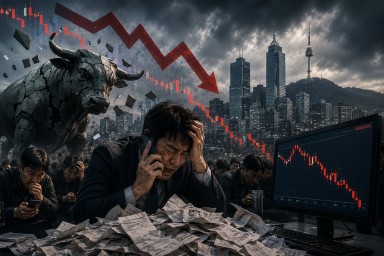
A representative image.
By S. JHA
South Korea’s Leveraged Bull Market Unravels: 1.2 Million Retail Accounts Face Margin Calls as Liquidation Rates Surge
Mumbai, July 17, 2026 — South Korea’s red-hot, AI-stoked equity rally has hit a wall — and retail investors who rode it up on borrowed money are now paying the price. As of July 13, more than 1.2 million leveraged retail accounts across the market had triggered margin calls, according to the country’s Financial Supervisory Service — roughly one in every 30 working-age adults.
Between 320,000 and 460,000 of those accounts have already been forcibly liquidated by brokerages, with some traders reportedly left owing money even after their positions were wiped out.
From Boom to Bust in Six Months
The scale of the reversal is jarring. The KOSPI started the year near 4,500 points and, stoked by a semiconductor-driven AI boom, tore through 5,000 in January, 6,000 in February, 7,000 in May, and briefly touched 9,000 in June — a run that saw Samsung Electronics gain roughly 170% and SK Hynix surge around 300% in six months.
Since peaking above 9,300 in mid-June, the index has since corrected by more than 25%, formally entering bear-market territory.
The unwind has been anything but orderly. On July 16, the KOSPI tumbled 6.37% to close at 6,820.60 — just a day after it had jumped 6.24%. That came on the heels of a brutal July 13 session in which the index plunged nearly 9%, triggering both a sell-side “sidecar” trading halt and a Level 1 circuit breaker. SK Hynix fell 15.37% that day, its worst single-day drop on record, while Samsung Electronics dropped 10.7%.
Leverage Concentrated in Two Stocks
What makes the sell-off so dangerous is how narrowly the leverage is concentrated. Samsung Electronics and SK Hynix alone accounted for roughly 9.1 trillion won in combined margin financing balances as of mid-June — more than a third of the entire market’s financing balance — while the two stocks together make up over half of the KOSPI’s index weight.
When both fell sharply on the same day, the resulting wave of forced selling overwhelmed the market’s ability to absorb it, even as retail investors tried to buy the dip, net-purchasing 4.5 trillion won worth of shares that day alone.
According to South Korea’s Korea Financial Investment Association (KOFIA), the forced-liquidation ratio — the share of unsettled margin trades converted into actual forced sales — has climbed steadily all year: from around 1% in January, to 5.1% in June, to over 10% in early July. Securities firms generally treat a 5% ratio as a warning sign.
Seoul Economic Daily, citing KOFIA data, reported that the share of margin trades ending in forced selling has climbed since single-stock leveraged ETFs launched, with analysts pointing to rising volatility in semiconductor stocks as the driver.
Maeil Business Newspaper put a number on the damage, reporting that forced liquidation of unsettled brokered trades reached 425.8 billion won between July 1 and 10, with 142.2 billion won sold off on July 9 alone.
Yonhap News, in its coverage of the sell-off, noted the KOSPI plunged more than 6% intraday on July 12, falling below the 7,000 mark for the first time in about two months — a level it would go on to breach again just days later.
Young Investors Bear the Brunt
Traders in their 20s and 30s have been hit hardest, accounting for an estimated 62% of accounts facing full forced liquidation. Much of the borrowed money stoking the rally reportedly migrated from crypto into equities as the AI-driven bull run gathered steam, with Reuters reporting that borrowed investment in Korean equities hit a record 60 trillion won by the end of May.
Retail investors’ cash reserves have fallen sharply as a result, dropping by roughly 34 trillion won in a single month — from 139.7 trillion won to about 105 trillion won, the lowest level since February.
The human toll has also surfaced in darker ways: unverified social media rumours circulated of an investor considering suicide over stock losses, a claim that went largely unchallenged online — a sign, commentators say, of just how numb sentiment has become after weeks of relentless volatility.
Regulators Step In, but the Unwind May Not Be Over
South Korea’s Financial Services Commission has already moved to contain the fallout, banning new single-stock leveraged product listings and raising margin requirements. The Bank of Korea also raised its benchmark interest rate by 25 basis points to 2.75% on July 16 — its first hike since early 2023 — tightening liquidity just as leveraged investors are scrambling for cash.
Yet analysts caution the deleveraging cycle is far from finished. Retail credit channels are also drying up: more than 85% of household loan quotas at Korea’s five largest commercial banks had already been used in the first half of the year, closing off one of the last remaining sources of fresh buying power.
Speaking to Bloomberg TV, Lombard Odier’s Asia chief investment officer John Woods said he’d long worried about the speculative frenzy among Korean retail investors, warning such episodes “rarely end well.”
With margin balances, credit financing, and investor deposits all continuing to shrink, South Korea’s market appears locked in a self-reinforcing loop — falling prices triggering forced sales, which in turn drive prices lower still.
Whether the KOSPI’s violent swings settle into a floor or continue unwinding may depend less on sentiment than on how much leverage is left to flush out.
(This article is for informational purposes only and does not constitute investment advice.)
Mrs Bectors Food Specialities Shares Surge on Abakkus Bulk Deal
Follow The Raisina Hills on WhatsApp, Instagram, YouTube, Facebook, and LinkedIn




About The Author