South China Sea at 10: Why the Hague Ruling Still Haunts China
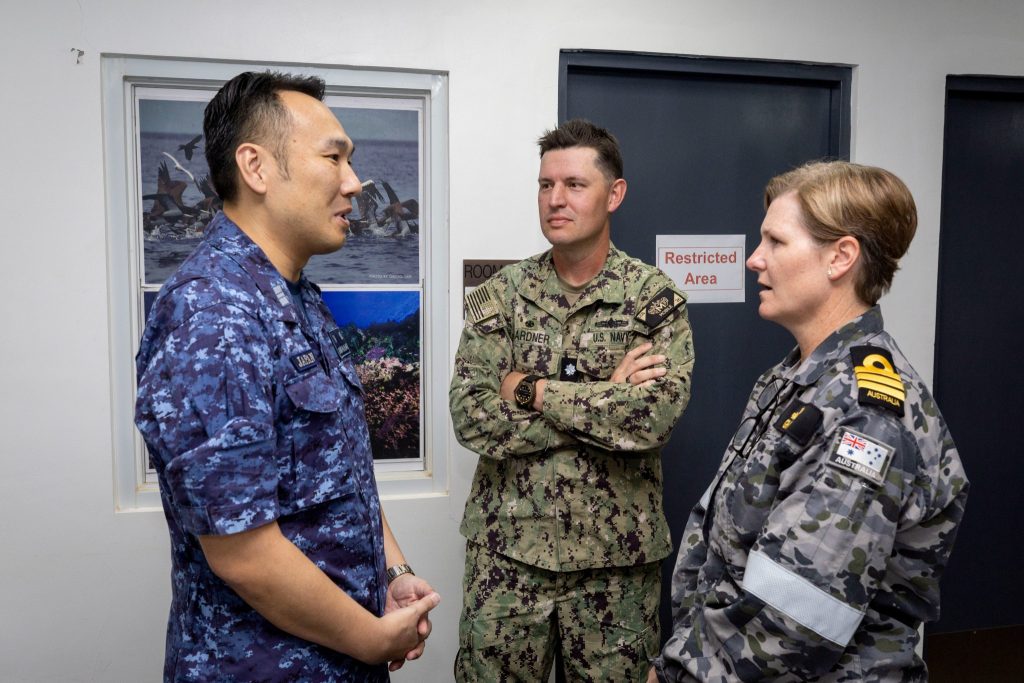
South China Sea (Image credit X @USAmbJapan)
By TRH World Desk
On the 10th anniversary of the landmark arbitration ruling, 14 countries reaffirm that China’s sweeping maritime claims have no legal basis, highlighting why the South China Sea remains one of the world’s most volatile geopolitical flashpoints.
New Delhi, July 12, 2026 — A decade after an international arbitration tribunal delivered one of the most consequential legal judgments in modern maritime history, the South China Sea remains as contested—and as strategically important—as ever.
On Sunday, Japan, the Philippines, the United States and 11 other countries jointly reaffirmed the landmark 2016 arbitral ruling that invalidated China’s sweeping claims over nearly the entire South China Sea. “The coordinated statement, released on the ruling’s tenth anniversary, declared the award ‘final, legally binding, and definitive,’ renewing international pressure on Beijing to comply with international law,” reported NHK World of Japan.
The tribunal, constituted under the United Nations Convention on the Law of the Sea (UNCLOS), ruled in 2016 that there was no legal basis for China’s expansive “nine-dash line” claim. The case had been initiated by the Philippines after years of maritime confrontations.
China rejected the verdict then and continues to reject it today.
The joint statement reaffirmed that there is “no legal basis for China’s expansive maritime claims” and opposed unilateral actions that threaten regional peace and stability. It also criticized the use of coast guard vessels, military assets and maritime militia to harass or intimidate lawful activities conducted by other states in the South China Sea.
Japanese Foreign Minister Motegi Toshimitsu, per NHK World, said China’s refusal to accept the arbitration ruling runs contrary to the principle of peaceful dispute settlement and undermines the rule of law in the international community.
Why the South China Sea Still Matters
The dispute extends far beyond competing maps and legal arguments. The South China Sea has become one of the world’s most consequential geopolitical fault lines because of its strategic, economic and military importance.
Roughly one-third of global maritime trade passes through these waters every year, making the sea a critical artery for global supply chains connecting East Asia, Europe and the Middle East. Any disruption can have ripple effects on energy markets, manufacturing and international commerce.
The region is also believed to contain significant reserves of oil and natural gas beneath its seabed, while its rich fishing grounds support millions of livelihoods across Southeast Asia. Control over these resources has intensified competition among claimant states.
From a military perspective, Beijing has transformed several disputed reefs into fortified artificial islands equipped with airstrips, missile systems and surveillance infrastructure. These installations significantly expand China’s ability to project power across the western Pacific and monitor one of the world’s busiest sea lanes.
The dispute involves multiple claimants—including the Philippines, Vietnam, Malaysia, Brunei and Taiwan—but increasingly reflects a broader strategic rivalry between China and the United States. Washington regularly conducts Freedom of Navigation Operations (FONOPs), arguing that excessive maritime claims threaten international navigation rights guaranteed under UNCLOS.
Law Versus Power
The renewed statement by the 14 countries underscores a broader debate shaping the Indo-Pacific: whether international law or military power will define the future regional order.
While the arbitration ruling settled important legal questions, it lacked an enforcement mechanism. Beijing has instead continued to expand its coast guard presence, deploy maritime militia vessels and strengthen its military footprint around disputed features.
For Southeast Asian countries, the challenge is balancing economic ties with China against concerns over sovereignty and maritime security. For Japan, Australia and the United States, the issue has become central to maintaining a rules-based Indo-Pacific.
A Flashpoint That Could Shape Asia’s Future
As geopolitical competition intensifies across the Indo-Pacific, the South China Sea has evolved into more than a territorial dispute. It is now a test of international law, freedom of navigation, alliance credibility and regional deterrence.
Ten years after the Hague tribunal’s landmark ruling, the legal position remains unchanged. What has changed is the strategic environment. China’s growing naval capabilities, more frequent encounters between coast guards and military aircraft, and deepening security cooperation among the United States and its regional partners have made the waters more heavily contested than ever.
The anniversary statement serves as a reminder that while the arbitration award remains legally binding, its practical impact will ultimately depend on whether the international community can uphold the rules it continues to endorse.
China bullies Philippines with Galwan 2.0 in South China Sea
Follow The Raisina Hills on WhatsApp, Instagram, YouTube, Facebook, and LinkedIn




About The Author