‘Already Itna Gire Hue Ho…’: When Shikhar Slammed Afridi
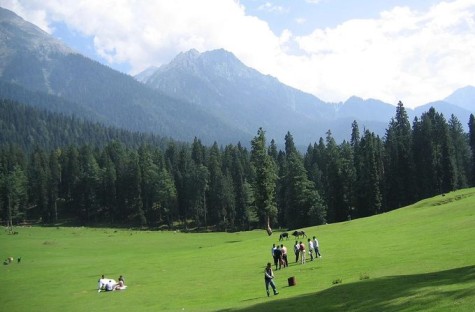
Pahalgam meadow where terrorists killed tourists (Image credit Kerala Congress)
From the 2025 Pahalgam terror attack to India’s diplomatic offensive, a look back at rising tensions and Dhawan’s viral remark
By NIRENDRA DEV
New Delhi, April 21, 2026 — The fallout of the Pahalgam terror attack continues to echo in India’s strategic and public discourse, marked by decisive state action and sharp public reactions — including a viral remark by Indian cricketer Shikhar Dhawan targeting former Pakistan captain Shahid Afridi.
In the immediate aftermath of the April 22, 2025 attack, Prime Minister Narendra Modi moved swiftly, granting full operational freedom to India’s armed forces to determine the timing, targets and mode of response against terror networks and their backers across the border.
A series of high-level security meetings followed, involving Defence Minister Rajnath Singh, National Security Advisor Ajit Doval, and the top defence brass, including the three service chiefs. The message from New Delhi was unambiguous: the fight against terror is a national resolve.
PM Modi had asserted that India would pursue those responsible and their supporters “to the ends of the earth,” signalling a shift towards a more assertive counter-terror posture.
Diplomatic Offensive Against Pakistan
India also launched a strong diplomatic offensive against Pakistan. Measures included downgrading bilateral ties, expelling Pakistani military attaches, and shutting down the Attari-Wagah border crossing. New Delhi also paused the Indus Waters Treaty, a significant escalation in bilateral relations.
In retaliation, Pakistan suspended the Simla Agreement and closed its airspace to Indian aircraft, prompting reciprocal measures from India.
At the global stage, India worked to consolidate support. At the United Nations Security Council, key partners like the United States and France backed New Delhi’s position, preventing Pakistan from inserting the term “disputed” in reference to Jammu and Kashmir in the official statement.
India also highlighted remarks by Pakistan’s Defence Minister Khawaja Asif, who acknowledged his country’s past links with terror groups — a statement India used to bolster its “rogue state” narrative.
However, diplomatic hurdles remained. With Pakistan serving as a non-permanent member of the UNSC till 2026, and with support from China, India could not secure the explicit naming of The Resistance Front in the council’s statement, despite the group initially claiming responsibility for the Pahalgam attack before retracting.
Dhawan vs Afridi: Cricket Meets Geopolitics
Amid the tense backdrop, a war of words also erupted in the cricketing world. Responding to controversial remarks by Afridi on the Indian Army and media, Dhawan posted a sharp rebuttal on social media platform X.
“Kargil mein bhi haraya tha, already itna gire hue ho aur kitna giroge… bewajah comments pass karne se acha hai apne desh ki taraqqi mein dimag lagao,” Dhawan wrote, invoking India’s victory in the Kargil War.
He added, “Humein hamari Indian Army par bohot garv hai. Bharat Mata Ki Jai! Jai Hind!”
Afridi, who represented Pakistan in 27 Tests, 398 ODIs and 99 T20Is, had criticised India’s response to the attack, drawing backlash from Indian players and fans alike.
A Defining Moment
The Pahalgam attack marked a critical moment in India-Pakistan relations, triggering not just military preparedness and diplomatic recalibration, but also a surge in national sentiment. From strategic corridors to social media exchanges, the episode underscored how deeply geopolitics and public discourse remain intertwined in the subcontinent.
Follow The Raisina Hills on WhatsApp, Instagram, YouTube, Facebook, and LinkedIn




About The Author