Akhilesh Yadav’s Big Bet on Jobs, ₹5,000 Allowance and Welfare in SP’s 2027 UP Manifesto
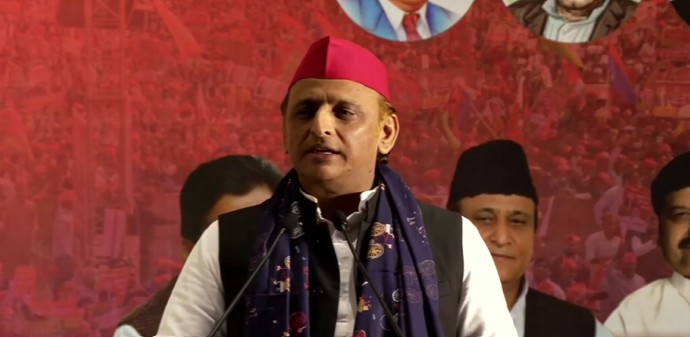
Samajwadi Party chief Akhilesh Yadav unveils the party's employment, welfare and governance promises for the 2027 Uttar Pradesh elections. (image SP on X)
By AMIT KUMAR
The Samajwadi Party promises 25 lakh government jobs, annual financial assistance for women, free healthcare and restoration of the Old Pension Scheme. Akhilesh Yadav is also seeking to counter the BJP’s law-and-order narrative with a tough message against mafias and criminals.
Lucknow, November 26, 2026 — With the 2027 Uttar Pradesh Assembly elections approaching, Samajwadi Party president Akhilesh Yadav has unveiled an expansive manifesto built around employment, education, social welfare and a promise of tougher law enforcement. The message is clear: the SP wants to turn its appeal to young people, women and disadvantaged communities into a broader electoral challenge to the BJP.
The party has promised 25 lakh government jobs over five years and a monthly unemployment allowance of ₹5,000 for graduates until they secure employment. It has also proposed free schooling, reopening closed primary schools and better salaries and permanent employment for Shiksha Mitras, the state’s contractual teachers.
The employment package is politically significant in a state where government recruitment and unemployment remain major concerns among young voters. But the scale of the promise raises an important question: how will the SP generate 25 lakh government jobs, finance the unemployment allowance and ensure that recruitment is transparent and timely?
Women’s welfare is another major pillar. The party has proposed annual financial assistance of ₹40,000 for women, alongside free healthcare and ambulance services. It has promised to restore the Old Pension Scheme and revive the Yash Bharti awards. Its education and rural development proposals include new villages equipped with Wi-Fi, electricity, streetlights and paved roads.
These promises seek to combine direct financial support with public services and infrastructure. Their electoral appeal will depend not only on the amounts announced but also on the eligibility criteria, implementation mechanism and funding commitments.
Akhilesh’s law-and-order challenge
Perhaps the most politically consequential part of Akhilesh Yadav’s pitch is his attempt to address the BJP’s long-standing criticism of the SP’s record on law and order.
“I promise you that once the government is formed, hooliganism, mafia activities, and crimes against women will not be tolerated at any cost. Criminals, regardless of their caste, religion, or political party, will be sent to prison,” Yadav said.
He accused the present government of allowing land mafias to operate on a massive scale and promised a special Special Task Force (STF) to prevent illegal land seizures. The party has also proposed AI-based policing, stronger measures for women’s safety and fast-track courts to speed up justice.
The language is significant. The SP is not merely promising welfare; it is attempting to challenge the BJP on governance and public security, issues on which the ruling party has built much of its political identity in Uttar Pradesh.
Akhilesh invokes his government’s development record
Yadav also sought to defend the development record of his previous government, arguing that governments should not be judged only by what appears in election manifestos.
“Governments don’t build markets and malls, but when a multinational company was coming in and there was a need for a good mall in the country, the government stepped in, and that’s how Palacio Mall came to be,” he said.
Referring to healthcare, he added that building Medanta Hospital was not part of the party’s manifesto but became possible after the SP government took office and began working on the sector.
The argument is an attempt to present the 2012–17 SP government as one that could facilitate investment and create institutions beyond its formal electoral promises.
The fiscal and political test
The manifesto offers a wide-ranging package of jobs, cash assistance, pensions, education, healthcare and rural infrastructure. It also gives the SP an opportunity to connect its PDA political coalition—Pichhda, Dalit and Alpsankhyak—with broader concerns among young voters and women.
But the challenge will be fiscal credibility. Government recruitment, recurring allowances, pension restoration and free public services require sustained funding. The party will need to explain how these commitments can be financed without compromising investment in infrastructure, education and healthcare.
Akhilesh Yadav is also trying to rewrite the political debate on law and order by promising that criminals will face action irrespective of political affiliation, caste or religion. Whether voters accept this assurance will depend on how convincingly the SP addresses questions about its own past governance.
The 2027 contest is therefore likely to be fought on more than welfare promises. Employment, purchasing power, public services, law and order, and the credibility of competing governance models will all matter. The SP has put its offer on the table. The harder task is persuading voters that it can deliver.
Azam Khan Breaks Silence on Jail Ordeal, Jauhar University and Political Targeting
Follow The Raisina Hills on WhatsApp, Instagram, YouTube, Facebook, and LinkedIn




About The Author