Trump Factor Gives New Meaning to Hosbole’s Pakistan Outreach
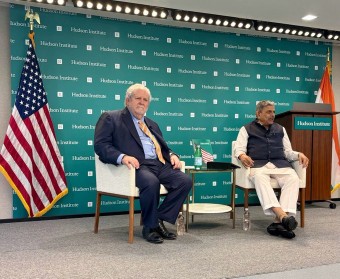
RSS leader Dattatreya Hosbole during his visit to Hudson Institute in the US. (Image RSS on X)
By TRH Op-Ed Desk
RSS’s Dattatreya Hosbole fails to give cogent explanations to restart dialogue with Pakistan while his idea of a nation is abstract.
New Delhi, May 14, 2026 — A senior Rashtriya Swayamsevak Sangh (RSS) leader’s unexpected call for resuming dialogue between India and Pakistan has set diplomatic circles abuzz, raising questions about whether back-channel efforts to normalise ties between the two nuclear-armed neighbours may already be underway.
Dattatreya Hosabale, Sah Karyawah (Joint General Secretary) of the RSS, made the remarks in an interview with PTI, stating that options for dialogue between India and Pakistan must remain open and that people-to-people contacts between the two countries should continue — or be restarted.
He also suggested that the people of India, Pakistan, and Bangladesh constitute “one nation,” arguing that while nation-states may differ, the underlying national identity remains singular.
The timing of the statement has drawn particular attention. India-Pakistan diplomatic relations remain effectively frozen following the deadly Pahalgam terror attack. The Indus Waters Treaty has been suspended, visa services halted, and all formal people-to-people engagement severed.
“Something Is Happening Behind the Scenes”
Geopolitics analyst Manish Anand, in a commentary for The Raisina Hills YouTube channel, described the statement as deeply significant — and deliberately timed.
“There was no trigger, no context that would explain why Hosabale chose this moment to call for dialogue. That absence of an obvious reason is itself the reason to pay attention,” said Anand.
He drew a direct line between Hosabale’s remarks and an earlier controversy involving Ram Madhav, the BJP’s former national general secretary, who during a visit to the Hudson Institute in the United States made pointed remarks about American pressure on India — including claims that India had stopped purchasing oil from Russia and Iran at Washington’s behest and had absorbed steep American tariffs without adequate protest.
Madhav subsequently issued a public apology, calling his remarks “factually incorrect,” though the video was not deleted from his official X account.
“Taken together — Ram Madhav’s America visit, his controversial statements, and now Hosabale’s interview on Pakistan — it feels like a pattern. Something is shifting in India’s geopolitical calculations,” Anand noted.
Energy Security and the Pakistan Geography Factor
Anand pointed to India’s growing energy security anxieties as a possible sub-text. With India’s commitment to the Chabahar Port in Iran now under a question mark, and older proposals for Central Asian energy pipelines routed through Pakistan territory largely shelved as impractical, the analyst suggested a quiet reassessment may be taking place within Indian policy circles.
“There is a school of thought emerging — quietly, not officially — that Pakistan’s geography could serve India’s long-term energy security interests. Old pipeline ideas, Central Asian connectivity through Pakistan, these are being dusted off somewhere,” he said.
He also flagged visible symbolism from within the ruling establishment — ministers and chief ministers publicly posting videos of downsized government convoys — as signals of anxiety around fuel conservation.
The “One Nation” Claim: Idealistic or Irresponsible?
Anand was pointed in his critique of Hosabale’s assertion that Indians, Pakistanis, and Bangladeshis are “one nation.”
“This is an outlier idea with zero practical currency. The RSS map of Akhand Bharat is a dream — not a policy. If Pakistanis and Indians were truly one people, why did India enact the CAA, whose entire premise rests on the persecution of minorities in neighbouring countries?” he argued.
The American Hand?
The analyst stopped short of drawing firm conclusions but raised the question of whether Washington is quietly pushing for India-Pakistan normalisation — particularly the restoration of suspended diplomatic ties and the Indus Waters Treaty.
“No one can say for certain. But empirically, circumstantially, it does appear that something is moving — away from public view — toward a new beginning in India-Pakistan relations,” Anand concluded.
RSS’s Dattatreya Hosabale Signals Reset in India-Pakistan Ties
Follow The Raisina Hills on WhatsApp, Instagram, YouTube, Facebook, and LinkedIn




About The Author