Rishikesh-Karnaprayag Rail Project: 104 Km of Tunnels, Strategic Link Near China Border
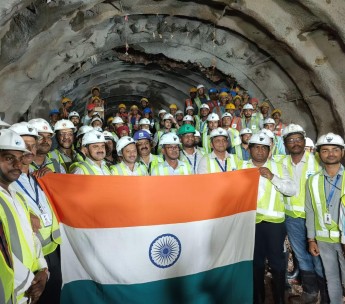
Breakthrough in Longest Transport Tunnel Construction on Rishikesh-Karnaprayag Rail Line (Image credit Ministry of Railways)
By SANJAY SINGH
Railway Minister Ashwini Vaishnaw says the 125-km Himalayan project involves 16 tunnels and 19 bridges, with specialised tunnel-boring technology designed to handle difficult geological conditions.
New Delhi, October 22, 2026 — The Rishikesh-Karnaprayag railway project in Uttarakhand is making progress despite the complex geology of the Himalayas, with around 83% of its 125-km alignment passing through tunnels, Union Railway Minister Ashwini Vaishnaw said in a video statement.
Vaishnaw said the project involves approximately 104 km of tunnels and 19 bridges, making it a technically demanding undertaking through the young Himalayan mountain system, where engineers encounter soft and unstable geological formations.
Unlike solid rock strata, softer material can create a tendency for tunnels to squeeze under geological pressure, complicating excavation. The minister said detailed investigations were conducted before deciding to use tunnel-boring machines (TBMs) for the project.
Engineers modelled the squeezing tendency of the geological formations and modified the TBMs accordingly. Changes were made to the cutter heads, shield assemblies and drive systems to provide additional torque and thrust, Vaishnaw said. These design modifications have helped the machines operate successfully in the challenging conditions.
Tunnel T1 poses the biggest challenge
The minister identified Tunnel T1, measuring 11 km, as the most complex section because of its difficult geology and the presence of habitation in the surrounding area. He said micropiles were being used to stabilise the area.
According to Vaishnaw, progress across the project has been encouraging. Most tunnel sections have made progress, while work on T1 and T5 continues, including excavation activity that the minister said was advancing rapidly.
The project’s planned stations include Shivpuri, Devprayag, Janasu, Maletha, Srinagar, Dhari Devi, Tilani, Gaurdev, Bausal and Karnaprayag.
Once completed, the railway line is expected to improve access to Karnaprayag and Rudraprayag and facilitate journeys for pilgrims visiting Kedarnath and Badrinath.
Vaishnaw also highlighted the project’s strategic significance, saying its terminal station would be located just 123 km from the India-China border.
The railway line is therefore being developed not only as a connectivity project for Uttarakhand but also as an important infrastructure link in a strategically sensitive Himalayan region.
Longest Rail Tunnel Breakthrough on Rishikesh-Karnaprayag Line
Follow The Raisina Hills on WhatsApp, Instagram, YouTube, Facebook, and LinkedIn




About The Author