PM Modi and the Press: A Democracy of Monologues?
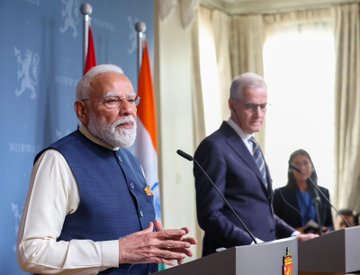
PM Narendra Modi with Prime Minister Jonas Gahr Støre in Oslo. (Image Modi on X.)
By MANISH ANAND
The backlash against Norwegian journalist Helle Lyng has reopened questions about India’s media culture and the shrinking space for direct questioning of political power. After nearly twelve years of largely one-way communication, critics ask whether Indian journalism has adapted to monologues at the expense of accountability.
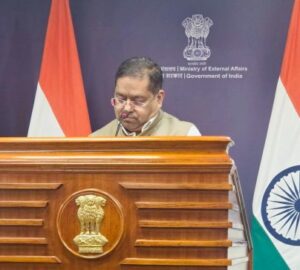
New Delhi, May 20, 2026 — Indian journalism is at a crossroads. If any proof was needed, one just need to scan the magnitude of trolling of journalist Helle Lyng. She is being trolled for her failed attempt to question Prime Minister Narendra Modi during his press conference with Norwegian counterpart Jonas Gahr Støre.
For almost 12 years, Modi has delivered monologues to the Indian media. Having adjusted to the media drill where scopes for questions have long been removed, Indian journalists have diligently reported on monologues of Modi. His posts on X, Mann Ki Baat sessions, statements on inaugural day of parliament sessions, authored articles published in newspapers, and others have been richly reported by the Indian journalists.
Helle Lyng, in her failed bid to question Modi, claimed that Norway has the freest press in the world. India has one of the worst global press rankings.
The Nordic nations, home to strong Indian diaspora, accord high value to rights of the people. Thus, the press in such nations is bold enough to even ask Finland’s then Prime Minister Sanna Marin if she had drugs when her dance video with friends had gone viral. The Finland Prime Minister had also been forthright in saying that she had not had drugs. The press had to ask the question. The Prime Minister had to reply. The matter settled.
Modi’s practice of not taking questions from the press may be explained to his episode of walking out from a live interview session with Karan Thapar, a television commentator. The Indian press looked at Modi through the prism of the post-Godhra riots in Gujarat. Communal riots had engulfed Gujarat in the wake of a burning of a train at the Godhra railway station in Gujarat. Modi was the chief minister of Gujarat. Thus, the press questioned him on alleged administrative slippages as riots spread in the state.
After becoming Prime Minister in 2014, Modi carried his practice of not holding a press conference or taking questions from the media. But he has given multiple interviews to the television media, and a few to the newspapers. Such interviews have largely been aligned with the election schedules.
Late Manmohan Singh, Modi’s predecessor, regularly met the press and he even held press conferences. The press could question him on policies and politics of the day. The Indian media has not been able to ask Modi on some of the burning issues such as energy crisis, rupee crash, and paper leaks in examinations.
With Modi not allowing the press to ask questions, the Indian media has been deprived from the opportunity to question the head of the executive. Compounding the challenges for the media, the Prime Minister’s Office (PMO) also almost remains out of the bound for the media. The information officer of the PMO or the media advisor of the Prime Minister has largely been unknown after Modi assumed charge in New Delhi.
(This is an opinion piece. Views expressed are the author’s own.)
Editors Guild Flags IT Rules: A Tool to Silence Digital Media
Follow The Raisina Hills on WhatsApp, Instagram, YouTube, Facebook, and LinkedIn




About The Author