Pather Panchali: Secrets From 100 Years of a Masterpiece
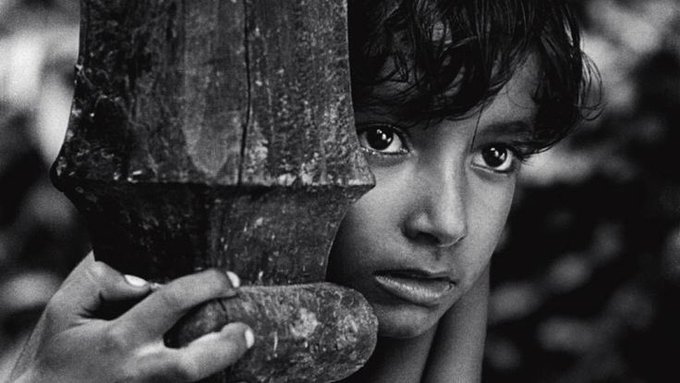
A still from the film Pather Panchali
Pather Panchali turns 100: Bibhutibhushan Bandyopadhyay’s grandson reveals the novel’s original title, three hidden drafts, and a dream that saved the manuscripts.
By NIRENDRA DEV
Kolkata, March 26, 2026 — As Bibhutibhushan Bandyopadhyay’s immortal novel turns 100, a family briefcase unlocks a century of hidden drafts, forgotten titles, and a philosophy of wonderment.
The novel that belongs on any list of the five most influential works in Bengali literature almost had a different name entirely. Pather Panchali — the book that would inspire Satyajit Ray’s landmark film and cement Bibhutibhushan Bandyopadhyay’s place in the literary canon — was originally called Durer Bari: a far away home. The author first put pen to paper in 1924, and it was only when the novel began its serialisation in Bichitra magazine in 1928 — published as a book the following year — that the world came to know it by the title it carries today.
The original name surfaced only last week, when Trinankur Banerjee, the author’s younger grandson and curator of a centenary exhibition, was sifting through manuscripts in preparation for the show. He came upon it while going through material that, by his own admission, much of his own family had never fully read.
“Bibhutibhushan had been writing it for a long time. There are three drafts. My parents possibly did not read it all — my grandfather’s handwriting was terrible,” Trinankur said with a quiet laugh.
A Citizen of the Cosmos
Among the manuscripts, there are diaries in which Bibhutibhushan first sketched his characters — in English. In those early notes, the young protagonist Apu is described as “a citizen of the cosmos.” The underlying spirit of the novel is captured in two phrases: “philosophy of wonderment” and ananda — joy.
It is a description that feels remarkably precise for a book that, on its surface, is simply the story of a poor Brahmin family in a Bengali village.
Horihor Roy lives with his wife Shorbojoya and young daughter Durga in the village of Nischindipur. Into their threadbare household comes Indir Thakrun — an old widow, distantly related, with nowhere else to go. Shorbojoya, proud and sharp-tempered, resents her presence. The old woman is given a tumbledown thatched hut at the edge of the property. Only Durga, six years old and endlessly curious, seeks her out — sitting for hours, listening to fairy tales.
It is from such small, unheroic material that Bibhutibhushan built one of Bengali literature’s great monuments.
Bangladesh’s Forgotten Wounds: Fundamentalism Is Erasing 1971
The Swiss Clock
Trinankur reaches for an unusual metaphor to explain what the manuscripts reveal about his grandfather’s method.
“You get to see only the clock face while the mechanism stays hidden. Bibhutibhushan, too, was showing only the finished product, hiding the inner craft. When we study his plan — which we will put on display — we realise the novel is based on his philosophy of life. There is a structure within: a scaffold of philosophy held together by the straws of technique, over which he put on the clay coat of language.”
The centenary exhibition, Pather Panchali at 100, opens at the Kolkata Centre for Creativity on March 24 and runs through April 19 — every day except Sundays. It will be divided into three chapters: his life, his literature, and his philosophy. Discussions, storytelling sessions, and film screenings will accompany the display.
Preserved Against the Odds
In a country not known for its archival instincts, the Bandyopadhyay family has preserved a remarkable wealth of material. There are manuscripts, personal effects, and — in one of the exhibition’s more arresting details — the syringes and stethoscope used in the author’s final treatment.
Bibhutibhushan died at 56 in Ghatshila. The circumstances were devastating. He had put his younger brother through medical college at considerable personal cost. When Bibhutibhushan fell ill, it was that brother who treated him. And when he died, voices in Calcutta began to blame the brother for it — a cruelty that broke the younger man entirely. Within a week, he was found dead on the bank of the Subarnarekha river, having consumed carbolic acid.
The family left behind comprised two young widows and a three-year-old boy — Trinankur’s father.
That any of Bibhutibhushan’s papers survived this rupture is largely the work of his wife, Rama. As she packed to leave Ghatshila and return to her paternal home in Barrackpore, she had a dream: her late husband appeared and urged her to take his books and papers with her. She did.
“Had she not,” Trinankur said, “none of this would exist.”
A Family Rooted in Bengal
The Bandyopadhyay family traces its origins to Panitar village, near Basirhat in what is now the North 24 Parganas district of West Bengal. The author’s great-grandfather was an Ayurvedic physician who eventually settled in Barrackpore — the same town to which Rama would one day carry her husband’s manuscripts home.
The centenary exhibition will also offer Bibhutibhushan memorabilia — T-shirts, coasters, wall clocks — designed by Trinankur himself. The briefcase in which the author once carried his manuscripts will be among the objects on display.
One hundred years on, Pather Panchali endures. And somewhere inside a battered briefcase, Durer Bari — the far away home it almost was — endures alongside it.
A House with No Name: Nusrat Faria’s film screens at IFFI 53
Follow The Raisina Hills on WhatsApp, Instagram, YouTube, Facebook, and LinkedIn




About The Author