Pakistan-Saudi-Turkey Defence Pact: Is a “Muslim NATO” Rising Near India’s Borders?
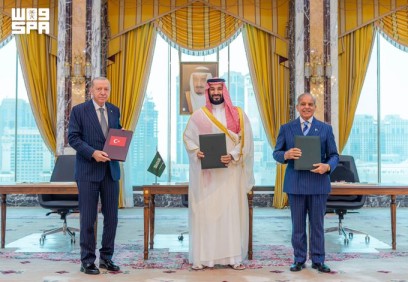
Pakistan-Saudi-Turkey Defence Pact (Image Saudi Arabia MFA)
By TRH World Desk
Geopolitics analyst Manish Anand breaks down why the Mecca-signed mutual defence agreement between Pakistan, Saudi Arabia and Turkey could force India into a faster arms race — on two fronts at once
New Delhi, August 9, 2026 — A newly signed mutual defence cooperation pact between Pakistan, Saudi Arabia and Turkey, inked in Mecca, is drawing intense scrutiny across global capitals — and nowhere more closely than in New Delhi.
Speaking on The Raisina Hills channel, geopolitics analyst Manish Anand called it the first time all three nations have formalized a defence agreement of this scale, built around intelligence sharing, joint defence production, and mutual military cooperation. According to Anand, the timing and structure of the pact raise an uncomfortable question for Indian strategists: has the outline of an informal “Muslim NATO” just been drawn?
Three Powers, No Common Enemy — Yet
Anand’s analysis starts with a paradox. Saudi Arabia, Turkey and Pakistan are each militarily significant in their own regions, but historically their strategic outlooks have rarely aligned — and Turkey and Pakistan, in particular, have long leaned adversarial toward India. Anand pointed out that the three countries don’t actually share a common enemy: Pakistan’s rivalry centers on India, Turkey’s military footprint runs through Syria and Iraq, and Saudi Arabia’s principal security concern is Iran.
That absence of a unifying threat, Anand argued, changes how the pact should be read — less a classic alliance against a shared adversary, and more a convergence of separate national interests that happen to benefit from pooling resources.
Why Each Country Signed On
Per Anand’s breakdown:
– Pakistan brings scale — after China and India, it fields one of the world’s largest standing armies, which gives Islamabad outsized leverage in regional diplomacy.
– Saudi Arabia is seeking military and economic stability amid rising Iran-linked tensions across the Gulf, especially after recent US-Israel-Iran hostilities touched Saudi Arabia, the UAE and Qatar.
– Turkey, a NATO member with a comparatively advanced domestic defence industry, gains a platform to expand its footprint in South Asia and the Gulf simultaneously.
The Operation Sindoor Connection
Anand drew a direct line between the pact and the four-day India-Pakistan military clash earlier known as Operation Sindoor, during which Turkish-made drones were reportedly spotted in Indian airspace. He cited strategic commentators who allege Turkey supplied Pakistan with planeloads of drones ahead of that confrontation — meaning closer Turkey-Pakistan defence ties, Anand said, translate almost immediately into upgraded Pakistani drone and military-technology capability.
A Two-Front Problem for India
Anand framed the consequences for India as twofold:
1. An accelerated arms race. With Pakistan positioned to gain access to Turkish military technology and production capacity, Anand argued India will need to raise its own deterrence and defence spending at a faster pace to keep up.
2. A widening China-Pakistan-Turkey-Saudi arc. Anand noted that Pakistan’s existing “all-weather” military and intelligence alliance with China — including real-time intelligence sharing and the use of Chinese-made missiles during Operation Sindoor, by his account — now sits alongside a second axis through Turkey. That leaves India managing pressure on two strategic fronts rather than one.
Anand also flagged the diplomatic dimension: the Organisation of Islamic Cooperation has long kept the Kashmir issue on its agenda at Pakistan and Turkey’s urging, and he suggested that renewed Sunni-bloc political coordination among the three signatories could bring Kashmir back onto the international stage more forcefully.
Saudi Arabia’s Balancing Act
Notably, Anand was careful to separate Saudi Arabia’s calculus from Turkey’s and Pakistan’s. India-Saudi ties have strengthened economically in recent years, and Riyadh’s own economic-diversification push depends heavily on Indian skilled labour and technical manpower — giving Saudi Arabia strong incentives not to let this pact damage its relationship with New Delhi. Still, Anand noted Saudi Arabia’s decades-long ambition to lead the Sunni Muslim world means it can’t be assumed to stay neutral indefinitely if broader political mobilization occurs.
Not Everyone Sees a Military Bloc
Anand balanced his own concern with a counterpoint from Husain Haqqani, Pakistan’s former ambassador to the United States, who has argued that because the three countries share no common enemy, the pact is unlikely to evolve into a full military alliance — and more likely to stay limited to intelligence-sharing and joint defence production.
Anand’s closing assessment: India now faces a layered challenge — balancing its relationship with Washington (which has drawn Pakistan closer into its own strategic orbit) while simultaneously confronting a strengthening China-Pakistan axis and this new Turkey-Saudi-Pakistan defence arc. He noted that India and Pakistan have historically clashed militarily roughly once every two decades, which he said is reason enough for New Delhi to treat the pact as a serious, not symbolic, development — even as its ultimate shape remains uncertain.
(Commentary and analysis based on comments of Manish Anand, host of The Raisina Hills.)
Operation Sindoor Debate Leaves Ceasefire Question Unanswered
Follow The Raisina Hills on WhatsApp, Instagram, YouTube, Facebook, and LinkedIn




About The Author