Nada Brahma in Delhi: Music for Meditation at Bharat Mandapam
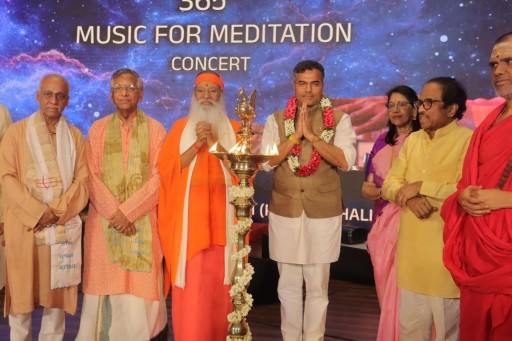
365th Music for Meditation Concert Marks Spiritual Milestone at Bharat Mandapam (Image TRH)
Sri Ganapathy Sachchidananda Swamiji’s landmark performance blends classical music and meditation on the eve of Akshaya Tritiya
By TRH Features Desk
New Delhi, April 20, 2026 — On the eve of Akshaya Tritiya, New Delhi witnessed a rare confluence of spirituality and classical music as the 365th edition of the globally celebrated “Music for Meditation” concert unfolded at Bharat Mandapam.
Led by Sri Ganapathy Sachchidananda Swamiji, the concert—titled Indraprastha Raga Sagara—marked the completion of a symbolic cycle of 365 performances worldwide, each dedicated to the philosophy of Nada Brahma, or the cosmic essence of sound.
A Spiritual Milestone Beyond Performance
Far from being a routine musical evening, the event represented the culmination of decades-long efforts by Sri Swamiji to use music as a medium for healing, meditation, and inner transformation. The idea of completing 365 concerts—mirroring the days of a year—was seen by followers as a full spiritual cycle, with each concert forming part of a larger journey toward inner awakening.
Organised by the Sri Dattatreya Gnana Bodha Satsang Sabha Charitable Trust, the event brought together an influential mix of policymakers, jurists, artists, and spiritual seekers. The organising committee was chaired by former bureaucrat R.N. Choubey, alongside corporate leader K. Narayana Rao, ensuring a seamless and dignified execution.
High-Profile Presence Adds National Significance
The occasion drew attention at the highest levels. C. P. Radhakrishnan shared a video message, praising the initiative for reviving India’s ancient traditions of Nada Yoga and promoting societal harmony through spiritual practices.
The ceremonial lamp-lighting featured a distinguished lineup, including V. Ramasubramanian, Attorney General R. Venkatramani, Delhi leader Parvesh Sahib Singh Verma, industrialist G. M. Rao, and renowned violin maestro L. Subramaniam, along with playback singer Kavita Krishnamurthy.
Their presence underscored the wide cultural and institutional resonance of the event.
Keeravani Sets the Meditative Tone
For the evening’s central composition, Sri Swamiji chose the raga Keeravani, known for its depth and introspective quality. As the first notes filled the expansive hall, the atmosphere shifted palpably—from anticipation to stillness.
The performance unfolded not as entertainment but as an immersive meditative experience. Each phrase carried a contemplative quality, drawing the audience inward. Listeners described the music as both calming and cathartic, blurring the boundaries between performer and participant.
A Stellar Musical Ensemble
The concert featured an ensemble of eminent musicians, enhancing the depth of the experience. Violin maestro L. Subramaniam’s accompaniment added a layer of virtuosity, while percussionists Ramkumar Mishra (tabla) and Shankar Ramesh (mridangam) created a rhythmic foundation that was both dynamic and soothing.
Flute by Pandit Chandan Kumar and violin support from Jaitra Varanasi enriched the melodic landscape, complemented by Prasanna on ghatam and Mani Narasimham on keyboard. Together, the ensemble functioned as a cohesive spiritual unit rather than a conventional orchestra.
Audience Immersion and Emotional Resonance
More than 2,000 attendees filled the Plenary Hall, representing a cross-section of society—from classical music enthusiasts to spiritual seekers. For nearly two hours, the audience remained absorbed in what many described as a transformative experience.
The atmosphere was marked by a rare blend of intensity and calm. Observers noted a sense of collective introspection, with the music acting as a bridge between sound and silence, individual and universal consciousness.
Honouring Contributions and Legacy
The evening also acknowledged key contributors to the Music for Meditation journey. Special mementoes, blessed by Sri Swamiji, were presented to individuals such as S. Chandrasekhar, who helped organise the first concert in 1988, and trustees of Yogasangeeta for their continued support.
These recognitions highlighted the collaborative effort behind a movement that has grown into a global spiritual phenomenon.
A Timely Reminder in a Fast-Paced World
As India continues to balance rapid modernisation with its cultural roots, events like this serve as a reminder of the enduring relevance of spiritual traditions. In an age of constant motion and stress, the concert reinforced the idea that music—when infused with purpose—can offer not just solace, but transformation.
The 365th Music for Meditation concert was not merely a cultural event; it was an experiential journey. As the final notes dissolved into silence, what lingered was a sense of stillness—subtle yet profound—echoing the timeless principle of Nada Brahma.
The Healing Power of Sound: A Journey into The Sacred Sound Path
FAQs:
Q1. What is the Music for Meditation concert series?
It is a global initiative by Sri Ganapathy Sachchidananda Swamiji using music as a tool for healing and meditation.
Q2. Why is the 365th concert significant?
It marks the completion of a symbolic cycle of 365 performances, representing a full spiritual journey.
Q3. Where was the event held?
The concert took place at Bharat Mandapam in New Delhi.
Follow The Raisina Hills on WhatsApp, Instagram, YouTube, Facebook, and LinkedIn




About The Author