MSME Payment Crisis: What the MSMED Amendment Act 2026 Actually Changes
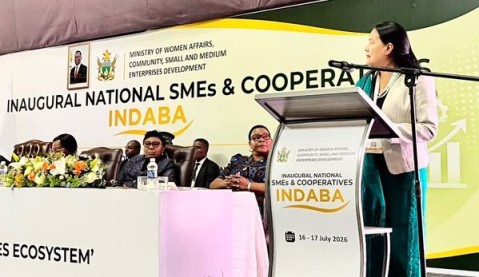
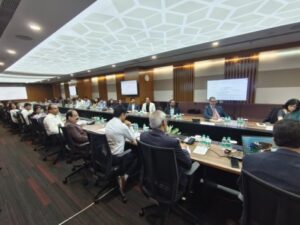
A delegation from Ministry of MSME led by Joint Secretary Mercy Epao attended the Inaugural MSME Indaba. (Image Ministry of MSME)
By P. SESH KUMAR
The 2026 amendment introduces TReDS mandates, faster dispute resolution and new penalties, but the machinery responsible for delivering relief remains largely dependent on State-level institutions.
New Delhi, August 15, 2026 — Twenty years to the month after the Micro, Small and Medium Enterprises Development Act, 2006, came into being, Parliament has given it its first substantial rewrite.
The Micro, Small and Medium Enterprises Development (Amendment) Bill, 2026, was introduced in the Rajya Sabha on July 28, 2026, cleared that House on August 3 and the Lok Sabha on August 7 — ten days from tabling to passage, by voice vote, through a chamber loud with a quarrel about something else entirely, and without a day of committee scrutiny.
What it contains is genuinely useful: statutory recognition of the twin investment-and-turnover test, a permanent digital registration platform, a hard mandate on Central Public Sector Enterprises (CPSEs) to route MSME invoices through TReDS, timelines for mediation and arbitration, recovery of awards as arrears of land revenue, a floor of 50 per cent release to a supplier whose award has been under challenge for over six months, and the replacement of petty criminal fines with graded civil penalties.
What it does not contain is a delivery machine.
The two instruments that actually moved money in the last three years — a tax disallowance from the Finance Ministry and a discounting platform from the Reserve Bank — did not require amending this Act at all.
That, rather than the amendment, is the lesson.
The Twentieth Birthday Present
There is a particular Indian ceremony in which a statute reaches a round-numbered anniversary and is given, in lieu of a working budget or a staffed field office, a set of amendments.
The MSMED Act turned twenty in 2026. The Ministry’s own framing leaned hard on the anniversary: two decades on, the landscape had changed, technology had changed, and the law must follow.
The Statement of Objects and Reasons is more sober and more honest — it lists a digital registration platform, a liquidity fix through TReDS, more Facilitation Councils, timelines, land-revenue recovery, a 50 per cent release to suppliers held hostage by prolonged litigation, and decriminalisation.
The problem the amendment addresses is real and it is enormous.
The Economic Survey 2025-26, as cited by the Department-related Parliamentary Standing Committee on Industry, put roughly Rs 8.1 lakh crore of MSME money in the hands of buyers who had not paid.
The Global Alliance for Mass Entrepreneurship, with FISME and C2FO, had measured the same wound from outside government and found it healing slowly: Rs 10.7 lakh crore locked up in 2022, Rs 8.27 lakh crore in 2023, Rs 7.34 lakh crore by March 2024 — still over 4.6 per cent of India’s gross value added, still a working-capital tourniquet on 6.4 crore enterprises.
Two independent estimates, two different methods, one order of magnitude.
This is not a manufactured problem.
What makes it a scandal rather than a misfortune is the machinery built to solve it.
The MSME Samadhaan portal had, up to December 31, 2025, received 2,56,892 applications involving Rs 55,244.31 crore. Of these, 52,744 applications worth Rs 8,397.25 crore had not even been examined by the Facilitation Councils.
The disposal rate, which stood at roughly a third of complaints in FY 2020-21, had collapsed to 4.07 per cent by FY 2025-26.
And the shining new Online Dispute Resolution portal, launched on MSME Day 2025 with a Rs 189 crore outlay and integrated with Samadhaan from October 15, 2025, disposed of precisely 17 cases in eight months, settling Rs 60.60 lakh.
Seventeen.
Against two and a half lakh pending applications and eight lakh crore rupees of unpaid bills.
That single number is the fact against which every clause of the 2026 amendment must be read.
It tells us that the binding constraint in our delayed-payments regime was never the absence of a legal remedy.
Section 15 of the parent Act has commanded payment within 45 days since 2006. Section 16 has imposed compound interest at three times the bank rate. Section 18 has offered conciliation and arbitration. Section 19 has demanded a 75 per cent pre-deposit from any buyer who wants to litigate. Section 22 has required disclosure of unpaid MSME dues in annual accounts.
The law was already, on paper, one of the more supplier-friendly payment regimes in the world.
It simply did not run.
MSME SRI Fund Under Scrutiny: Why ₹18,773 Crore in Investments Still Lacks Proof of Success
What the Amendment Actually Does
Once we read the Bill rather than the press note, a coherent design emerges.
The classification clause is cleaned up. Section 7 no longer carries the fossilised 2006 thresholds — Rs 25 lakh of plant and machinery for a micro manufacturer, Rs 10 lakh of equipment for a micro service provider — figures that had been overtaken by executive notification years ago and revised again in April 2025.
Instead, the Central Government may classify by notification against two criteria together: investment in plant, machinery or equipment, and turnover.
Statute now describes what practice already did, and the old manufacturing-versus-services duality disappears.
Section 8 is replaced. A national digital platform for free and voluntary filing of the registration memorandum is written into the Act, giving Udyam a statutory home rather than an administrative one. States may notify their own platforms for State benefits, and enterprises registered nationally may still draw State scheme benefits.
Registration becomes voluntary for everyone, including the medium manufacturing enterprise for whom it was previously mandatory.
The heart of the amendment is the new Section 15A.
Every Central Public Sector Enterprise (CPSE) must route the settlement of invoices for MSME procurement through an RBI-authorised TReDS platform.
The Central Government may extend this to any other authority, body or entity. The State Government may extend it to State Public Sector Enterprises and other State entities.
A companion Section 22A requires CPSEs and notified entities to disclose the details of invoices so routed, in a form the Centre prescribes for its entities and the States prescribe for theirs.
Section 18 acquires clocks.
Mediation must finish within 90 days of the date fixed for first appearance, notwithstanding the general limit in the Mediation Act, 2023. Reference to arbitration must follow within 30 days of a failed mediation. The award must issue within 90 days of completion of pleadings.
Jurisdiction is anchored to the supplier’s official address as registered under Section 8, with the buyer reachable anywhere in India.
And the Centre may establish an online mechanism for mediation and arbitration by audio-video means — the ODR portal, retrofitted with statutory authority.
A new Section 18A does two things that lawyers will notice.
A mediated settlement agreement or an arbitral award may be recovered as an arrear of land revenue by the State Government through the District Collector or Deputy Commissioner where the buyer’s assets lie.
And the amount so determined is declared a valid and legally enforceable debt, liable to be recognised under the Insolvency and Bankruptcy Code, 2016.
Section 19, substituted, keeps the 75 per cent pre-deposit and extends it to challenges against mediated settlement agreements, adds the supplier’s home forum as the venue for such applications, and — the genuinely humane innovation — provides that where the setting-aside application has been pending beyond six months, the court shall order release of at least 50 per cent of the awarded amount to the supplier from the deposited sum.
Sections 20 and 21 rebuild the Facilitation Councils.
States shall establish an adequate number of Councils in addition to existing ones. Councils shall meet regularly at prescribed intervals. States may provide adequate infrastructure, digital systems and trained manpower.
Composition is loosened: three to five members, chaired by an officer not below the rank of Joint Director rather than the Director of Industries, with industry-association representation and at least one member from the field of law.
The mandatory banker seat goes.
Finally, Section 27 is rewritten and Section 27A inserted.
Wilful false information in a registration memorandum, or failure to furnish information demanded under Section 26(2), attracts a warning at the first instance and a penalty of Rs 1,000 to Rs 50,000 thereafter.
A buyer who contravenes the Section 22 disclosure duty gets a warning, then Rs 10,000 to Rs 50,000, then Rs 50,000 to Rs 1,00,000.
Minimum penalties rise by 10 per cent every three years, as notified.
The Development Commissioner — now a defined term, and the Member-Secretary of the National Board in place of an unnamed Joint Secretary — becomes the adjudicating officer, with appeal to the Secretary of the administrative Ministry within 30 days, disposal within 60, and unpaid penalties recoverable as arrears of land revenue.
The Strongest Case for the Amendment
It would be lazy to dismiss this.
Let the case for it be put at its highest, because it is a better case than the criticism usually allows.
First, the TReDS mandate is not symbolism.
Invoice discounting on TReDS grew from about Rs 40,000 crore in 2022-23 to Rs 3.47 lakh crore in 2025-26.
That is a genuinely large channel, and putting the CPSE obligation in primary legislation rather than in a Ministry notification of November 2024 changes its legal character entirely: an executive instruction can be diluted by a successor Secretary on a Friday afternoon; a statutory command cannot.
Elevating an administrative nudge to a parliamentary duty is not a trivial act, and those who have watched procurement circulars quietly die will appreciate the difference.
Second, the 50 per cent release provision in the new Section 19 is a real and immediate transfer of bargaining power.
The 75 per cent pre-deposit was always a good idea that a determined buyer could neutralise simply by letting the setting-aside application rot in a docket.
Money sat in court; the supplier died of thirst beside a full well.
A statutory floor of 50 per cent after six months converts delay from a weapon into a cost.
Third, decriminalisation is defensible on its own terms.
Prosecuting a small manufacturer for a defective memorandum was always disproportionate, and a graded ladder that begins with a warning is a better regulatory instrument than a criminal complaint nobody files.
Fourth, loosening MSEFC composition is a shrewd administrative unlock.
The old requirement of a Director of Industries in the chair created a bottleneck of exactly one eligible officer per State department; permitting a Joint Director allows a State that wants many Councils to actually staff them.
The mandatory law member is a real improvement in a body that issues arbitral awards.
Fifth, anchoring jurisdiction to the supplier’s registered address, for both the reference and the setting-aside application, ends a quiet abuse in which a Delhi or Mumbai buyer dragged a Tiruppur or Ludhiana supplier across the country to defend an award.
Taken together, this is a competent, coherent, professionally drafted package.
If the question were “is this amendment better than no amendment”, the answer is unambiguously yes.
The more difficult question is whether it can actually deliver the money that remains stuck with buyers.
(This is the first of the two-article series. This is an opinion piece. Views expressed are the author’s own.)
India’s MSME Crisis Is Not About Policy—It’s About Governance
Follow The Raisina Hills on WhatsApp, Instagram, YouTube, Facebook, and LinkedIn




About The Author