Modi’s Indo-Pacific Tour: Is India Quietly Countering China’s South China Sea Dominance?
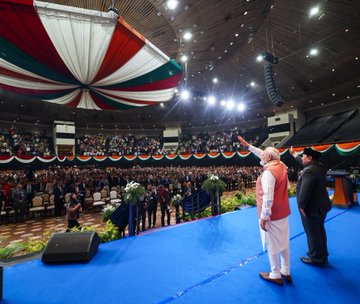
PM Narendra Modi with Indonesian President Prabowo Subianto, at a community programme in Jakarta. (Image Modi on X)
By TRH Op-Ed Desk
As Beijing marks 10 years of defying the Hague ruling, Modi’s Indonesia-Australia-New Zealand trip signals India’s growing maritime security role in the Indo-Pacific
New Delhi, July 16, 2026 — Prime Minister Narendra Modi’s recent three-nation tour of Indonesia, Australia and New Zealand is being read by foreign policy watchers as part of a broader “Indo-Pacific reset,” according to geopolitics analyst Manish Anand, speaking on The Raisina Hills.
The trip comes as the United States under President Donald Trump shows waning interest in the region, even as China’s military capabilities expand rapidly, Anand said. “This should be seen as the beginning of preparations for future military challenges,” he noted, describing the visits as small but meaningful steps toward regional security cooperation.
A decade after the Hague ruling, tensions persist
July 12, 2026 marked ten years since the Permanent Court of Arbitration at The Hague rejected China’s expansive claims over the South China Sea. On the same date, a joint statement was issued by roughly a dozen countries — including Japan, the Philippines, Taiwan and the United States — urging Beijing to respect the ruling and halt its military assertiveness in the region.
Anand pointed out the irony in China’s rhetoric: Beijing frequently criticizes the US for acting unilaterally and ignoring international law, whether in Venezuela, Iran or Cuba — yet, he argued, the same accusation could be levelled at China’s own conduct toward the Philippines, Vietnam and Malaysia in the South China Sea, through which roughly a third of global trade passes.
Militarization of reefs and rising anxiety among neighbours
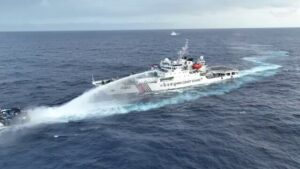
According to Anand, China has significantly built up its military presence on reefs and islands claimed by the Philippines and blockaded areas like Scarborough Shoal, leaving neighbouring nations increasingly uneasy about Beijing’s aggressive posture.
Against this backdrop, Modi’s visits to Indonesia, Australia and New Zealand focused heavily on securing international maritime routes and keeping sea lanes peaceful — with all three nations expected to deepen cooperation with India on this front.
Why Australia, New Zealand and beyond are watching China’s navy
Anand said concerns over Chinese nuclear submarine activity aren’t confined to the South China Sea — they extend across the Indo-Pacific, reaching as far as Australia, Sri Lanka and the Maldives. He noted that improved India-Sri Lanka and India-Maldives ties have somewhat reduced Chinese naval activity near those nations in recent times.
While India is unlikely to get militarily involved directly, its defence exports — particularly the BrahMos missile, already sold to the Philippines and reportedly being offered to Indonesia — could offer a meaningful boost to countries wary of China’s expanding military footprint, Anand said.
Xi Jinping’s tightening grip and a possible fourth term
Anand also flagged China’s internal political trajectory as a factor shaping regional risk. With President Xi Jinping’s third term ending next year, most assessments point to a fourth term running through 2027–2032.
Anand noted that Xi has reshuffled the top leadership of the People’s Liberation Army — including dismantling much of the Rocket Force’s former command — leaving him largely unchallenged within the Chinese Communist Party and military.
“Xi is an expansionist and a military adventurist,” Anand said, warning that a Strait of Hormuz-style standoff could eventually play out in the South China Sea, with major implications for global trade.
India’s balancing act
With India possessing the region’s second-largest military after China, Anand said New Delhi’s role will be significant — not through direct intervention, but through strategic partnerships and joint naval exercises with Indo-Pacific nations.
He pointed to Japanese PM Sanae Takaichi’s India visit, where joint military production was discussed, as part of this wider pattern of coordination among nations wary of Beijing.
“As the Hague ruling marks its tenth anniversary, the future appears to be one filled with concern, not calm, in the South China Sea,” Anand added.
Why Won’t PM Modi Face the Press? Analyst Flags a Widening Accountability Gap
Follow The Raisina Hills on WhatsApp, Instagram, YouTube, Facebook, and LinkedIn




About The Author