Thucydides Trap Theory Is ‘Geopolitical Astrology’: Hudson Scholar
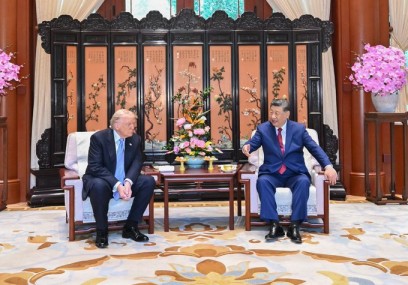
US President Donald Trump with China president Xi Jinping in Beijing. (Image China MFA on X)
By TRH World Desk
Miles Yu of the Hudson Institute argues the Thucydides Trap is intellectually bankrupt, rooted in Marxist-Leninist ideology, and dangerously self-fulfilling for US-China relations.
New Delhi, May 2026 — The so-called Thucydides Trap — the widely circulated theory that war between the United States and China is structurally inevitable as a rising Beijing displaces a declining Washington — is not sober geopolitical analysis. It is, argues Hudson Institute scholar Miles Yu, fatalistic pseudo-history dressed in academic jargon, and one that conveniently serves the ideological interests of the Chinese Communist Party.
In a sweeping essay published by the Hudson Institute, Yu dismantles the theory root and branch, warning that its greatest danger lies not in its descriptive power but in its psychological effect on both sides: feeding Beijing’s revolutionary triumphalism while encouraging Western defeatism.
“The Thucydides Trap is one of the most overhyped and intellectually lazy clichés in modern geopolitics,” Yu writes, arguing that it “flatters Beijing, excites conference panels, and gives foreign-policy pundits the illusion of historical sophistication.”
At the core of Yu’s critique is the CCP’s ideological motivation for embracing the theory. He argues that Xi Jinping’s affinity for the Trap is rooted not in strategic realism but in Marxist-Leninist doctrine — specifically the communist theory of the “Two Inevitables”: the inevitable collapse of capitalism and the inevitable triumph of socialism. For the CCP, every American political division or economic downturn becomes evidence of capitalism’s terminal decline. “Beijing,” Yu writes, “mistakes ideological wishful thinking for historical law.”
The irony, he contends, is striking. While the CCP lectures the world about American decline, it is quietly managing severe structural vulnerabilities of its own — demographic collapse, capital flight, youth unemployment, a real-estate implosion, and mounting debt. The United States, by contrast, retains commanding advantages: the world’s most powerful military, the dominant global reserve currency, the leading innovation ecosystem, and what Yu describes as the strongest alliance network in modern history.
Yu is equally pointed in his critique of the theory’s intellectual foundations. The Trap, he argues, grotesquely distorts Thucydides himself. The ancient historian never posited a deterministic law of power transition — he emphasized fear, miscalculation, poor leadership, and human folly. Yu dismisses the modern repackaging as “the geopolitical equivalent of astrology for international relations graduate students.”
He further notes a glaring irony that Thucydides Trap enthusiasts routinely overlook: Sparta, the established power, defeated Athens in the Peloponnesian War. The rising power did not inevitably prevail. “The historical analogy most beloved by Thucydides Trap enthusiasts,” Yu argues, “actually undermines their argument.”
On the strategic consequences of CCP overconfidence, Yu’s assessment is direct. China’s increasingly aggressive posture toward Taiwan, Japan, India, Australia, and the South China Sea has not accelerated American decline — it has revitalized Washington’s alliances. Japan is rearming. India is aligning more closely with the West. NATO is more alert. Australia has hardened its security posture. Even Europe, once accommodating toward Beijing, is growing more skeptical.
“Beijing has done more to revitalize American alliances than any US president could have dreamed of accomplishing alone,” Yu writes.
The essay concludes with a warning that cuts both ways. For Beijing, the Trap reinforces a hubristic Marxist-Leninist worldview that mistakes revolutionary prophecy for strategic reality. For Western analysts, it encourages the habit of exaggerating Chinese strength while chronically underestimating American resilience.
“Xi Jinping is trapped not by Thucydides, but by Marxism-Leninism,” Yu argues. The real danger, he concludes, is not an inevitable clash — it is CCP leaders convincing themselves that such a clash is both historically ordained and strategically winnable. History, he cautions, offers no such guarantee.
‘Asia minus China’ gains ascendency in Middle East in shadow of Israel-Gaza conflict
Follow The Raisina Hills on WhatsApp, Instagram, YouTube, Facebook, and LinkedIn




About The Author