LIC, EPFO Sitting on ₹16,649 Crore: India’s Unclaimed Money Crisis Explained
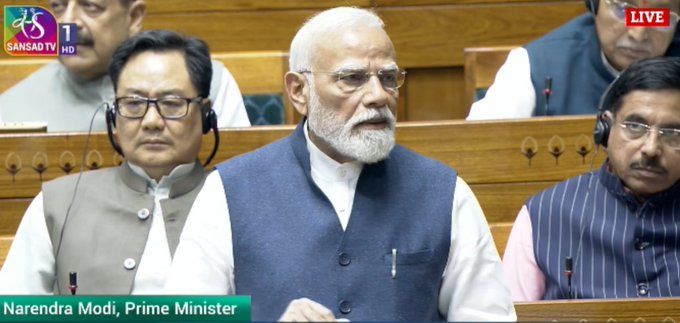
PM Narendra Modi speaks in the Lok Sabha on Women's reservation bill (Image Sansad TV on X)
By P. SESH KUMAR
Rs 7,318 Crore in LIC’s Vaults, Rs 9,330 Crore in Inoperative PF Accounts, and the Missing Architecture of Reunification
New Delhi, July 21, 2026 — On 20 July 2026 the Union Government told the Lok Sabha that the Life Insurance Corporation of India (LIC) was sitting on Rs 7,318.50 crore of unclaimed policyholder money as on 31 March 2026, of which Rs 1,753.95 crore was not principal at all but income earned on other people’s unpaid dues; the Employees’ Provident Fund Organisation (EPFO), in a separate reply, reported Rs 9,330.56 crore parked in inoperative accounts while insisting that it maintains no category called “unclaimed” at all. India’s unclaimed-money problem in life insurance is not principally a problem of forgetful policyholders but of an institutional design that makes claiming an obligation of the citizen rather than a duty of the custodian.
The Arithmetic of Absence
Numbers of this kind arrive in Parliament wearing the flat affect of a written answer, and that is exactly how they escape scrutiny. The Minister of State for Finance told the Lok Sabha that LIC’s unclaimed pile stood at Rs 7,318.50 crore, that Rs 1,753.95 crore of it was accrued income, and that the Government did not know –or at any rate did not say–how many policyholders or nominees the money belonged to. That last omission is the tell. An institution that can compute income on a fund to two decimal places but cannot state the number of human beings behind it has told us precisely where its accounting energy goes.
Set beside it the EPFO answer, which is a small masterpiece of definitional escape. There are no unclaimed accounts at EPFO, the House was informed; there are only inoperative accounts, classified formerly under Paragraph 72(6) of the EPF Scheme, 1952 and now under Paragraph 55 of the EPF Scheme, 2026, holding Rs 9,330.56 crore. The distinction is not fraudulent– the money does remain payable on a valid claim– but it is a distinction that dissolves the moment we ask the only question that matters, which is whether the rightful owner knows the money exists.
A word of fairness before the indictment. Read against history, LIC’s number is not a scandal of growth. As on 31 March 2018 the unclaimed amounts of twenty-three life insurers together stood at Rs 15,166.47 crore, of which LIC alone held Rs 10,509 crore. On that comparison the Corporation’s pile has fallen by roughly a third in eight years, which is what a decade of website search facilities, radio jingles and NEFT-only settlement was supposed to achieve, and partly did. The scandal, if there is one, is not the trajectory. It is that Rs 7,318 crore is what success looks like.
Why the Money Stays Put
An unclaimed amount, in the regulator’s language, is any sum payable to a policyholder or beneficiary–maturity, survival benefit, death claim, premium refund, unadjusted deposit– that remains unclaimed six months after it fell due. The definition is important because it locates the fault line. This is money that has already become payable. Nobody is disputing entitlement. The failure is one of contact, not of contract.
The causes sort themselves into four families. The first is mortality without documentation: the insured dies, no nomination was made or the nominee predeceased, and the family must establish title to the estate– succession certificate, legal heir certificate, the whole probate-adjacent apparatus–for a sum that in LIC’s book averages around Rs 2.4 lakh per death claim. Below a certain amount, the cost of proof exceeds the dignity of pursuit, and the file simply stops moving.
The second is address entropy in a mobile society. A policy bought in 1998 in a district town carries an address that three migrations have rendered fictional. The Corporation writes; the letter returns; the ledger accrues income.
The third is agent churn. The Indian life agency force is a revolving door, and an orphaned policy is an orphaned relationship: the individual who knew the family, knew the maturity date, and would have walked the discharge form to the door has long since left the profession.
The fourth, and the most politically combustible, is mis-selling. It is tempting to draw a straight line from mis-selling to unclaimed money, and the temptation should be resisted, because the causal chain is indirect. What mis-selling reliably produces is lapsation and disaffection: a product sold on a misdescribed premium-paying term, a policy the buyer never wanted and abandons in year three, a paid-up value or premium refund the buyer never troubles to collect because he has written the whole episode off as a loss. The regulator’s own data show unfair business practice grievances against life insurers rising to 26,667 in FY25 from 23,335 in FY24, and their share of all life grievances climbing to 22.14 per cent from 19.33 per cent, with IRDAI itself describing mis-selling as a significant concern and directing insurers to do root-cause analysis rather than case-by-case firefighting.
A senior LIC executive has publicly called mis-selling in the industry rampant. The honest formulation is this: mis-selling does not create most unclaimed money, but it manufactures the psychological condition– indifference to one’s own entitlement– in which unclaimed money is allowed to lie.
And then there is the paperwork, which digitisation has not so much abolished as re-hosted. The claimant must produce a completed discharge form, the original policy bond or an indemnity bond in its absence, a NEFT mandate with supporting proof, fresh KYC, and, where death is involved, a certified extract from the death register, proof of age if not previously admitted, and evidence of title where there is no nomination or assignment. Every one of these requirements is individually defensible. Collectively, for a widow in a district town chasing Rs 80,000, they constitute a deterrent. The online search facility– policy number, name, date of birth, PAN– tells us the money exists; it does not pay it. The screen is digital. The queue is not.
Where the Money Goes
Nothing is confiscated, and it is important to say so plainly. Unclaimed sums remain on the insurer’s books, earning income, individually discoverable on the insurer’s website above a small threshold. Where they remain unclaimed for more than ten years as on 30 September of a year, IRDAI’s Master Circular requires transfer to the Senior Citizens’ Welfare Fund (SCWF) on or before 1 March of that financial year, under the SCWF Act read with the SCWF Rules, 2016. After transfer, the claimant retains the right to come forward for a further twenty-five years; only thereafter does the money escheat to the Consolidated Fund. Thirty-five years is not expropriation. It is, however, a very long time to be someone else’s float.
That float is the quiet governance issue in the Rs 1,753.95 crore of accrued income. The institution holding unclaimed money earns on it; the SCWF, once it receives the money, funds senior citizens’ welfare with it. Neither arrangement is corrupt. Both create an interes– faint, structural, entirely unspoken– that is not perfectly aligned with vigorous tracing. Any reform that does not confront this asymmetry is decoration.
Is There an IEPF for Insurance? Not Really
The question is exactly the right one, and the answer is instructive. For unclaimed dividends and shares, India has built an authority: under Section 124(5) of the Companies Act, 2013, amounts unpaid for seven consecutive years, and the underlying shares, move to the Investor Education and Protection Fund (IEPF), and a claimant recovers them by filing web-form IEPF-5 with the IEPF Authority under the Ministry of Corporate Affairs, verified through the company’s nodal officer.[^12] Whatever its notorious delays, it is a machine with a statutory form, a named adjudicator, a defined verification chain and an appellate temperature. For bank deposits, the Reserve Bank has built UDGAM, a centralised search across participating banks, which has its own challenges.
For insurance, India has built a fund. The SCWF receives money; it does not adjudicate claims, does not maintain a searchable national register of unclaimed policy amounts, and has no equivalent of Form IEPF-5. The claimant, even after transfer, is routed back to the insurer. So the citizen who suspects a deceased parent held policies must guess the insurer, visit each website in turn armed with a policy number she does not have, and repeat the exercise twenty-four times. There is a portal for shares, a portal for deposits, a portal for public-sector dues– and for life insurance, twenty-four separate front doors and no corridor.
What Others Do
The United States solved the incentive problem by inverting the duty. A 2009 market-conduct investigation by the Florida insurance regulator found that insurers were diligently searching the Social Security Administration’s Death Master File (DMF) to stop annuity payments while declining to use the same file to start paying life claims– a finding that triggered a multistate NAIC task force, large settlements, and the National Conference of Insurance Legislators’ Model Unclaimed Life Insurance Benefits Act of 2011. The model act, now widely adopted, requires periodic DMF matching, a documented good-faith effort within ninety days of a match to confirm the death and locate beneficiaries, and payment first to beneficiaries, with escheat to the state’s unclaimed property administrator only if they cannot be found. Alongside it sits the NAIC Life Policy Locator, a single national request point for families who suspect a policy exists.
The United Kingdom solved the disclosure problem by making dormancy a shared civic asset. The Dormant Assets Act 2022 extended the scheme created for bank accounts in 2008 to long-term insurance products, pensions, investments and securities, with an estimated GBP 880 million expected to be unlocked.
Its three principles deserve to be memorised by every Indian regulator: reunification must be attempted first; the owner can always reclaim the full amount at any time; and participation is voluntary.
Reclaim Fund Ltd retains a reserve against future reclaims and releases only the surplus for good causes–the exact opposite of treating the pile as revenue.
Singapore offers the cautionary tale. The Life Insurance Association launched a public Register of Unclaimed Life Insurance Proceeds in 2016 and expanded it in 2018 to accident and health policies, covering proceeds unclaimed for over twelve months; by that update it had reunited 1,437 claimants with their money.
Singapore separately runs unclaimedmonies.gov.sg for public-sector dues and routes un-nominated CPF and intestate estates through the Public Trustee’s Office. But the insurance register has since been withdrawn, reportedly over data-privacy concerns, leaving no central search and obliging families to approach insurers one by one– a claim that rests on a single secondary source and should be verified before being relied upon.
If accurate, it is the sharpest available warning that transparency and privacy will collide, and that the collision must be designed for rather than discovered.
The Case Against Doing More
Steel-manning the incumbent position is not difficult. LIC administers a book of hundreds of millions of policies stretching back decades, much of it pre-digital, with names transliterated inconsistently across four scripts. A residual unclaimed balance in such a book is arithmetically unavoidable, and Rs 7,318 crore against total assets of the order of Rs 55 lakh crore is a rounding error. Nothing is forfeited for thirty-five years. Proactive tracing costs money that ultimately belongs to the participating policyholder fund– that is, to other policyholders. A public register of the dead and their beneficiaries is a gift to impersonators in a country where identity fraud is not hypothetical, and the Digital Personal Data Protection Act, (DPDP) 2023 imposes real constraints on precisely the kind of cross-database matching that the American model presupposes. Singapore’s retreat proves the point empirically.
All of this is true, and none of it survives the counter-question: if the money is genuinely payable and the obstacle is genuinely informational, why is the informational burden placed on the least-resourced party in the transaction?
Inverted Duty Syndrome
The reform agenda writes itself once the duty is inverted. First, a statutory duty to search, on the American model but built for Indian rails: periodic matching of the in-force and matured book against the Civil Registration System death database and, subject to DPDP Act safeguards and a clear legal basis, Aadhaar-seeded identity, with a mandatory documented tracing effort within ninety days of any match and an outcome reported to the board’s Policyholder Protection Committee. LIC does not lack feet on the ground; it has one of the largest agency forces on earth and a branch in every district. A tracing fee payable to the agent who physically reunites a nominee with a lapsed entitlement would cost a fraction of the accrued income now sitting in the Rs 1,753.95 crore line.
Second, a single national search layer. Not another portal, but one federated query– name, date of birth, PAN, Aadhaar-linked– that simultaneously interrogates IRDAI’s insurers, RBI’s UDGAM, SEBI and MCA’s IEPF, EPFO and PFRDA, returning a yes/no signal rather than public data, with actual disclosure gated behind authenticated identity. That design answers the Singapore objection: discoverability without exposure.
Third, convert the SCWF from a fund into an authority. Give it a statutory claim form, a defined turnaround, a nodal officer in each insurer, an appellate route, and an annual published account of receipts, refunds, pendency and ageing. A fund that receives money without a duty to return it is a receptacle; an authority that must account for both is an institution.
Fourth, strip the drill. A small-claims fast track–say, up to Rs 1 lakh– settled on identity verification, a self-declaration and an indemnity, without succession certificates or original bonds. Automatic nominee re-confirmation at every premium renewal and at every policy anniversary, pushed through the app and SMS. Mandatory electronic insurance account onboarding so that a family can see, in one place, every policy the deceased ever held.
Fifth, make it visible and auditable. IRDAI should publish an insurer-wise unclaimed scorecard with ageing buckets, tracing attempts made, and reunification rates- the metric that matters is not the stock outstanding but the proportion returned to human beings each year. And the statutory and supreme audit machinery should treat the unclaimed register as a certification object in its own right: not merely “does the balance tie” but “what was done, by whom, within what time, for how many identified claimants”. Unclaimed money is the one liability that cannot complain about its own accounting, which is precisely why it needs an auditor.
Sixth, close the loop back to mis-selling. Persistency-linked clawbacks on agent and bancassurance commissions convert an intermediary’s incentive from sale to survival, and a policy that survives is a policy whose owner remembers owning it.
Rs 7,318 crore is not a large number in the arithmetic of Indian finance. It is a very large number in the arithmetic of a widow in Guntur who does not know her husband bought an endowment policy in 2004. The gap between those two arithmetics is the whole of the argument.
(This is an opinion piece. Views expressed are the author’s own.)
Follow The Raisina Hills on WhatsApp, Instagram, YouTube, Facebook, and LinkedIn




About The Author