Kerala CM: Satheesan, Chennithala, Venugopal or Wayanad MP?
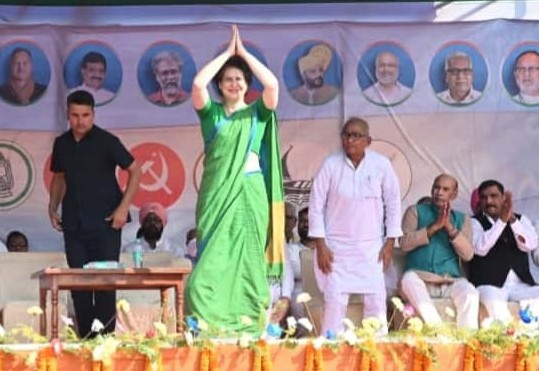
Congress leader Priyanka Gandhi Vadra hold rallies in Bihar on Saturday. (Image INC India)
The debate over Kerala’s next Chief Minister is no longer just about personalities. It reflects deeper questions about democratic leadership, consensus politics and the future direction of the Congress party.
By R. NARAYANAN
New Delhi, May 12, 2026 — Of around 14 Ministers/Important Constitutional dignitaries under whom I worked (in their Personal Staff), I had the fortune of having served under three Kerala Central Ministers — Prof. P. J. Kurien one of the most hardworking Ministers, Mr. A. K. Antony, one of the most honest ministers, and Prof. K. V. Thomas, one of the most considerate, compassionate and helpful ministers. So, I have some experience of Kerala politics and the leaders. The state is in a crucial stage of choosing its Chief Minister.
The discussions on Kerala’s Next CM revolve around V. D. Satheesan, Ramesh Chennithala and K. C. Venugopal.
Satheesan is widely perceived as the public face of the electoral victory of the Congress — a leader who directly contested, who suffered all the pressures and insults poured on him by Left leaders and who aggressively led the opposition campaign and became closely associated with the energy and emotional legitimacy of the mandate itself.
Ramesh Chennnithala was a grassroot worker, who became youngest minister at the age of 28 years. He held the Home Ministry portfolio under the Oomen Chandy government, during 2014-16, as LoP from 2016-21 he exposed Sprinkler data scam, E-Mobility Bus scam, AI Camera scam, etc. and kept the ruling Left under the check. He was also a four-time MP. He directly contested and won the seat. He is considered consensus builder and well experienced.
K. C. Venugopal, in contrast, is viewed more as an organisational strategist with deep ties to the national leadership and strong credibility within the party structure. Public discussions have also occasionally mentioned Shashi Tharoor, alongside the symbolic possibility of a woman leader such as Thulasi, a teacher and an MLA from Palakkad, emerging as a dark horse candidate.
The decision on the next Chief Minister should emerge from an interaction between people’s mandate, constitutional principles, party democracy and larger national political context. In a parliamentary democracy, people vote not only for individuals, but also for parties, alliances, manifestoes and vision of governance. No doubt, the Constitution requires that the Chief Minister should command majority in Assembly, but the Constitutional morality implies that the choice of CM should reflect the spirit of the public verdict rather than internal calculations of power.
In today’s India, state governments are not seen in isolation. They are viewed as political, ideological and administrative counter point within the National landscape.
In the present day, there is a growing concern around centralised personality driven leadership which is seen at national and at state level. The Congress has now an opportunity to demonstrate different democratic culture. Instead of reducing the governance to a single powerful individual, the party should promote a pluralistic and collegiate model of leadership. The Chief Minister would remain constitutionally central but the governance would function through collective leadership. This would be in tune with the Parliamentary Principle that the Cabinet and not merely one individual occupying the top post is the real executive authority.
At a time when democratic institutions are perceived as becoming centralised, such a model could allow the Congress to morally and politically differentiate itself by demonstrating that the leadership can still be collaborative and internally democratic but can be accountable also.
Among the three contenders — V. D. Satheesan, Ramesh Chennithala and K. C. Venugopal — the Congress top leadership should give greater weight to experience in both organisation and government, at the state as well as central levels. The party needs a leader capable of building consensus rather than confrontation, one who commands seniority, enjoys grassroots support that can translate into votes in the 2029 Lok Sabha elections, and possesses the ability to manage coalition politics in the tradition of leaders such as C. Achutha Menon and K. Karunakaran.
Kerala is India’s most literate state and also has one of the country’s highest female literacy rates at 92.7%. The state takes pride in traditions such as the ‘Amma Tharavadu’, where women historically enjoyed prominence and respect within the family structure. Yet, paradoxically, Kerala has never had a woman Chief minister. In contrast, states with comparatively lower literacy levels, such as Uttar Pradesh, have produced women Chief Ministers. Even K. R. Gowri Amma was denied the opportunity to become Chief Minister under circumstances that remain difficult to fully explain.
I believe that the congress leadership will not be able to finalise the choice. The only alternative is that Wayanad MP should stake her claim for chief Minister-ship.
(This is an opinion piece. Views expressed are the author’s own.)
FAQ
Who are the main contenders for Kerala Chief Minister?
The main names being discussed are V. D. Satheesan, Ramesh Chennithala and K. C. Venugopal.
Why is Kerala’s CM choice politically significant?
The decision is seen as important not just for Indian National Congress in Kerala, but also for shaping the party’s national leadership model ahead of the 2029 Lok Sabha elections.
Why is there discussion about a woman Chief Minister in Kerala?
Despite high female literacy and strong social indicators, Kerala has never had a woman Chief Minister, leading to renewed debate over women’s political representation in the state.
Follow The Raisina Hills on WhatsApp, Instagram, YouTube, Facebook, and LinkedIn




About The Author