Embassy in Tehran Operational, Students Relocated: Jaishankar
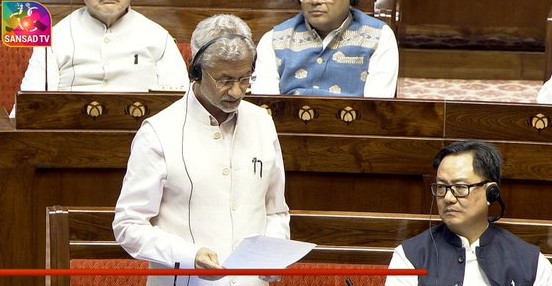
EAM S Jaishankar made a statement in the Rajya Sabha on Iran War (Image Sansad TV)
‘Embassy in Tehran Fully Operational and on High Alert’: Jaishankar Briefs Rajya Sabha on West Asia Crisis — Two Indian Mariners Dead, Students Evacuated
By NIRENDRA DEV
New Delhi, March 9, 2026 — External Affairs Minister S Jaishankar on Monday made a comprehensive statement in the Rajya Sabha on the rapidly deteriorating security situation in West Asia, disclosing that two Indian mariners have been killed in the ongoing conflict, one remains missing, Indian students in Tehran have been relocated, and the Indian Embassy in Tehran remains fully operational and on high alert.
The statement was delivered amid repeated disruptions from Opposition members who raised slogans while the Minister spoke — prompting Union Health Minister J P Nadda to condemn what he called deeply irresponsible behaviour.
Embassy Operations and Evacuation Measures
Jaishankar detailed the concrete steps India has taken to protect its citizens since the conflict broke out on February 28, 2026. “The Indian Embassy has facilitated the relocation of several Indian students in Tehran to places outside,” the EAM told the House. “Indian nationals in Iran on business were facilitated to cross over to Armenia to return to India. Our Embassy in Tehran remains fully operational and on high alert. We are committed to supporting the Indian community at this time,” he added.
The Armenia corridor — a land evacuation route for Indian business travellers stranded in Iran — represents a significant logistical operation, given the disruption to regular air travel across the region.
CCS Met on March 1 Under PM Modi
Jaishankar told the House that the Cabinet Committee on Security met on March 1 under the chairmanship of Prime Minister Narendra Modi — just 48 hours after the conflict began — and was briefed on the airstrikes in Iran and subsequent attacks across several Gulf countries.
“The CCS was concerned over the safety and security of the Indian community in the region,” Jaishankar said, adding: “It also focused on the implications for regional security and for economic and commercial activities.” The committee noted particular difficulties faced by Indian travellers transiting the region and by students appearing for scheduled examinations. All concerned ministries were directed to respond.
“The Prime Minister continues to closely monitor emerging developments,” Jaishankar added, “and the relevant ministries are coordinating to ensure effective responses.”
The Stakes: 1 Crore Indians, $200 Billion in Trade, Energy Security
Jaishankar laid out with precision why West Asia is not a distant crisis for India — it is a direct national interest.
“There are almost one crore Indian citizens who live and work in the Gulf nations,” he told the Rajya Sabha. In Iran, several thousand Indians are present for study or employment. The region, he noted, “is key to our energy security and includes many important suppliers of oil and gas.”
The trade dimension is equally significant. “The Gulf is also a major trade partner, accounting for almost USD 200 billion annually,” he said, adding that the past decade has seen substantial investments from the region flow into the Indian economy. “Serious supply chain disruptions and the climate of instability that we perceive are serious issues,”
he added.
On energy, Jaishankar was direct about India’s consumer-first approach. “In view of the implications of this conflict for our energy security, the Government remains committed to ensuring that it takes into account the availability, cost and risks of the energy markets. The interest of the Indian consumer is and will always be the overriding priority.”
Two Mariners Dead, One Missing — Merchant Shipping Under Attack
In what is perhaps the most sombre disclosure of the statement, Jaishankar confirmed Indian casualties at sea. “These include attacks on merchant shipping where Indian nationals often constitute a large proportion of the crews,” he said. “We have sadly already lost two Indian mariners and one remains missing in such incidents. I know that the House joins me in condoling their deaths.”
India’s Diplomatic Position: Restraint, Dialogue, Sovereignty
India issued its first statement on the conflict on February 28 — the day hostilities began — calling on all sides to exercise restraint, avoid escalation, and prioritise civilian safety. On March 3, New Delhi reiterated its call for dialogue and diplomacy and publicly urged an early end to the conflict.
“We believed and continue to believe that dialogue and diplomacy should be pursued to de-escalate tensions and address underlying issues,” Jaishankar told the House. “It is also imperative that the sovereignty and territorial integrity of all states in the region be respected.”
India’s position — neither condemning nor endorsing any party, while firmly advocating de-escalation — reflects the same strategic autonomy framework that has defined New Delhi’s posture on the Ukraine conflict since 2022.
Iran War’s Economic Bill: A Global Shock, Kyrgyz Ex-PM Warns
Follow The Raisina Hills on WhatsApp, Instagram, YouTube, Facebook, and LinkedIn




About The Author