Is Jaishankar India’s Most Vocal — But Least Effective — Foreign Minister?
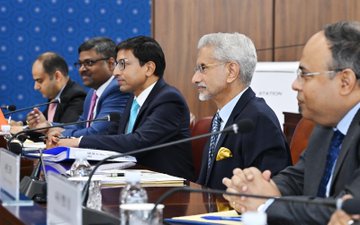
EAM S. Jaishankar during a bilateral meeting in New Delhi (Image Jaishankar on X)
By TRH Op-Ed Desk
Geopolitics analyst Manish Anand argues India’s foreign policy has weakened under S. Jaishankar, from Galwan to Operation Sindoor to US tariff silence
New Delhi, June 25, 2026 — Seven years into his tenure as India’s External Affairs Minister, S. Jaishankar has built a reputation as the most outspoken foreign minister in Indian history. But has all that talk translated into results?
According to Manish Anand, a New Delhi-based geopolitics analyst and host of The Raisina Hills, the answer is an uncomfortable no.
“If you scan the list of India’s foreign ministers, Jaishankar would come out as the one who speaks the most,” Anand said in his latest episode. “But has all that speaking served India’s national interest? That is the question,” he stated in his monologue for the YouTube channel of The Raisina Hills.
Silence on American Strikes
Anand’s sharpest charge concerns India’s muted response after three Indian nationals were killed in US military strikes in the Gulf of Oman. He argues the Ministry of External Affairs’ statements were weaker even than United Nations condemnations — a striking contrast to the UPA era.
“Even under Manmohan Singh, India’s posture toward the US was far more assertive,” Anand said, recalling how Finance Minister Pranab Mukherjee, during a private visit to the US, firmly rebuffed then-Secretary of State Hillary Clinton when she raised the issue of FDI in retail. “That is what protecting national interest looks like. On that test, where does Jaishankar stand today,” asked Anand.
Operation Sindoor and a Diplomatic Vacuum
During the four-day India-Pakistan military confrontation triggered by Operation Sindoor, Anand argues India’s diplomatic machinery failed its biggest test. Rather than rallying global support behind India, the ministry watched as major powers — the US, the UK, and others — counselled New Delhi to calm down.
“If India had projected itself as a strong global power, many countries would have stood with it,” Anand said, adding: “Instead, the world told India to de-escalate. The ministry failed to make India’s case on the world stage.”
Galwan Forgotten?
On China, Anand points to a striking policy reversal. After the deadly 2020 Galwan Valley clashes that froze bilateral ties for nearly four years, India has steadily walked back its punitive measures — restoring air links, reviving the Kailash Mansarovar Yatra, and reopening border trade.
What drew particular criticism was a statement Jaishankar made in an interview. “He actually said: ‘China has grown four times stronger — economically and militarily. Should I pick up a weapon and go fight them at the border?’” Anand noted. “That statement revealed a foreign policy mindset that is not assertive, not strong — it is weak,” he added.
The Tariff Asymmetry
On trade, Anand draws a pointed contrast. When the US imposed tariffs on both China and India, Beijing pushed back hard and won concessions. India, he argues, stayed largely silent — and is now negotiating a bilateral trade agreement from a position of weakness, with higher tariffs still in place on Indian goods even after a US Supreme Court ruling struck down parts of Trump’s tariff framework.
Pakistan’s Diplomatic Comeback
Perhaps most strikingly, Anand argues that India’s long-standing strategy of internationally isolating Pakistan has been quietly abandoned. “Under Manmohan Singh, when US presidents visited India, they did not go to Pakistan. Pakistan was isolated on the global stage,” he said. “Today, Pakistan is back at the centre of American strategic attention — and India has been hyphenated back alongside it,” he added.
Anand sees this as a fundamental reversal of decades of Indian foreign policy doctrine — and squarely Jaishankar’s failure to prevent it.
“Books he has written, speeches he has delivered — but what kind of masterstroke is it,” Anand asked, “when his voice goes silent the moment America is in the room?”
(Manish Anand is a geopolitics analyst and host of The Raisina Hills, a political commentary channel.)
Why India Is Becoming a New Pole of Global Power: Gonzalo Fiore Viani Explains
Follow The Raisina Hills on WhatsApp, Instagram, YouTube, Facebook, and LinkedIn




About The Author