Caste Census 2027: Is Modi Trying to Rewrite Mandal Politics?
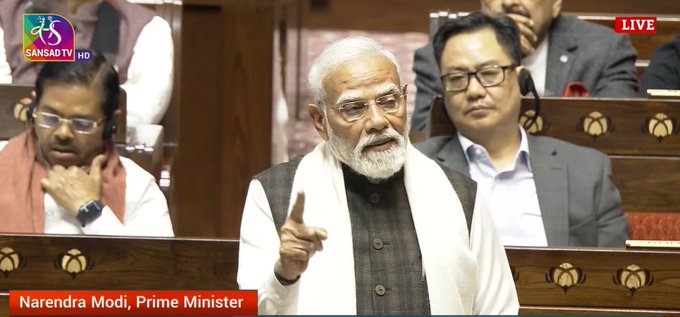
Prime Minister Narendra Modi in Rajya Sabha on Thursday (Image Sansad TV)
India Caste Census 2027: BJP’s Political Gamble and the End of Mandal Politics?
By TRH Political Desk
New Delhi, April 7, 2026 — India’s long-delayed census has formally begun, with the government confirming that a caste enumeration will be conducted in the second phase — expected to commence after August 2026 — marking the first official caste count since 1931.
Political commentator Manish Anand, in a special episode on YouTube channel The Raisina Hills, framed the development as deeply embedded in electoral strategy rather than administrative necessity.
“Prime Minister Narendra Modi has mastered caste politics at a level that even the original architects of Mandal politics could not match,” Anand said, noting that caste considerations have shaped BJP’s choices on everything from presidential nominations to cabinet appointments over the past 11-plus years.
The Cabinet U-Turn
The approval came swiftly after RSS chief Mohan Bhagwat met Prime Minister Modi — the very next day’s cabinet meeting greenlit the caste census, reversing years of BJP resistance to the demand.
Anand attributed the reversal largely to Opposition pressure. “Political observers broadly agree that the cabinet approved the caste census to neutralize the issue from Rahul Gandhi’s hands,” he said, adding that the Congress leader had campaigned aggressively on the demand — including during the recent Bihar elections, where it failed to deliver results for the INDIA bloc.
Bihar Signal: Mandal Politics Losing Steam?
Bihar, long considered the heartland of social justice politics, returned NDA to power despite the Opposition’s caste census pitch. Anand noted that Gandhi has been largely silent on the issue since the Bihar defeat.
“It appears even Rahul Gandhi has concluded that this issue no longer carries the same weight in Indian politics,” Anand observed. “Mandal politics doesn’t have the same force it once did.”
BJP’s Contradictory Caste Strategy
Anand highlighted what he described as a structural tension within BJP’s approach — simultaneously exploiting caste differences while projecting Hindutva as an overarching identity that transcends them.
“A bigger identity can always overwhelm smaller identity issues,” he said, referencing a foundational principle of political science. “BJP believes its upper-caste vote base has no real alternative, so it can afford to simultaneously play OBC politics.”
Central to this strategy, Anand said, is the unpublished Rohini Commission report on sub-categorisation of OBC reservations — a potential trump card that could pit smaller OBC communities against dominant ones like Yadavs, weakening leaders such as Tejashwi Yadav and Akhilesh Yadav.
The 2011 Ghost
The announcement also revived uncomfortable questions about the Socio-Economic Caste Census conducted under the Manmohan Singh government in 2011, whose caste data — collected at a cost of thousands of crores — was never made public, with the government citing data errors.
Anand also questioned the five-year delay in conducting the census that was originally due in 2021, pushing back on the COVID-19 justification. He suggested the timing — launched in April 2026, ahead of several state assembly elections — points to deliberate political sequencing, potentially linked to a proposed special Parliament session on women’s reservation, where delimitation based on 2011 census data may be fast-tracked.
“Caste politics is not ending — it is simply taking a new form,” Anand concluded. “And that new form is being shaped, above all, by the BJP.”
Follow The Raisina Hills on WhatsApp, Instagram, YouTube, Facebook, and LinkedIn




About The Author