“Indian Genes Tagde Hain”: Gurindervir Singh Silences Doubters
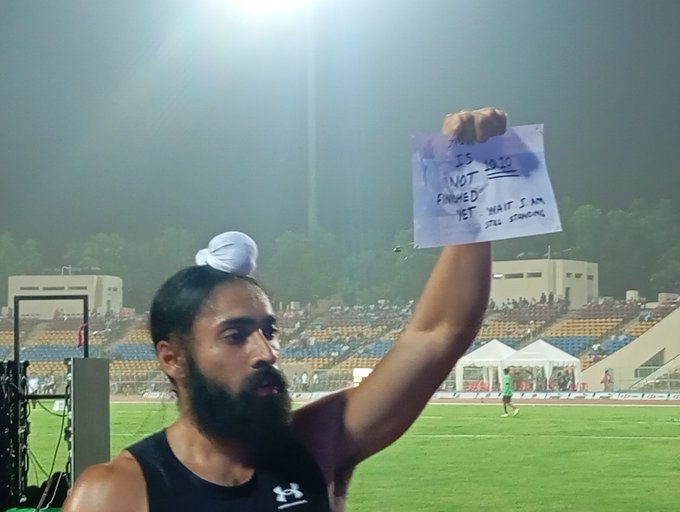
Gurindervir Singh crosses the finish line at the Federation Cup 2026 in Ranchi, clocking 10.09 seconds in the men's 100m final. (Image X.com)
By AMIT KUMAR
A village boy from Jalandhar who was told Indians cannot run the 100m has just proved every sceptic spectacularly wrong — and booked himself a lane at the Glasgow Commonwealth Games in the process.
Ranchi, May 23, 2026 — The Birsa Munda Stadium in Ranchi had already witnessed the extraordinary in the space of twenty-four hours. Two national records in the men’s 100m, broken within five minutes of each other in Friday’s semi-finals. The nation’s athletics community was still processing that when Saturday’s final began.
Then Gurindervir Singh ran 10.09 seconds, and India had a new conversation to have about its sprint ceiling entirely.
The 25-year-old from Punjab became the first Indian man to break the 10.10-second barrier in the 100m, winning the Federation Cup final at Ranchi with a national record time of 10.09 seconds — bettering the mark set just a day earlier in the semi-finals by Animesh Kujur. On the same evening, as if one record were not enough for Indian athletics to absorb, Vishal Thennarasu Kayalvizhi became the first Indian man to break the 45-second barrier in the 400m, storming to a national record of 44.98 seconds. History, it seemed, had booked a double room in Ranchi.
But it is Gurindervir’s ten seconds — nine seconds and nine hundredths, to be precise — that will lodge itself in the memory of Indian sport. Because the story behind that number is not merely athletic. It is deeply personal, forged in doubt and defiance.
“They Said Indians Can’t Run the 100m”
Before any record, before any final, before any lane at the Commonwealth Games, there were the voices. The well-meaning ones, the cynical ones, the institutional ones — all carrying the same message: this event is not for you.
“People discouraged me when I wanted to run the 100m,” Gurindervir has said, adding: “They said run the 400m. They said Indians can’t run the 100m. But I wanted to prove a point. Indian genes tagde hain!”
It is a declaration that lands differently now than it might have even two years ago. For decades, the 100m has been Indian athletics’ great blind spot — a distance where the country’s most gifted sprinters were quietly redirected toward middle-distance events or the longer sprints, the conventional wisdom being that explosive, top-end speed was somehow beyond the physiological reach of Indian athletes. When coaches tried to dissuade him saying “100m was not for Indians, there’s no scope in it, why not try the 400m,” he simply ignored them all. “I was determined even back then that one day I’ll change their mentality,” he told PTI.
Saturday, on the red track at Birsa Munda Stadium, he did exactly that.
The Village, the Navy, and the Long Road to Mumbai
The arithmetic of Gurindervir Singh’s life does not obviously produce India’s fastest man. Hailing from the small Patial village near Bhogpur in Jalandhar, his journey to stardom has been one of perseverance and dedication. Inspired by Usain Bolt’s iconic 2008 Olympic run, Gurindervir began his sprinting career under challenging circumstances. His father, ASI Kamaljit Singh, recognized his potential early and enrolled him in schools with robust sports facilities, despite financial constraints, The Tribune reported. His progress was nurtured by coaches Sarwan Singh and Sarabjeet Singh Happy, who played pivotal roles in shaping his career.
The early results justified the sacrifice. Gurindervir’s impressive list of accolades includes a gold medal at the 2017 Youth Asia Championships, a silver at the 2019 South Asian Games, and a bronze in the 2018 Junior Asia Championships in the relay event. By 2021, still only 21 years old, he had posted a personal best of 10.27 seconds — remarkable for an Indian sprinter at that age, and a sign of things to come.
Then came the years that nearly ended everything.
He was diagnosed with ulcers in his stomach, which made it difficult for him to eat anything, resulting in weight loss and an increase in his timing. In 2022, his 100m best slipped to a dismal 10.93 seconds. He lost 2022 to the digestive issue — the mucous lining of his stomach weakened and thinned out, leaving him unable to absorb nutrition properly — and spent most of 2023 recovering. In 2024, he made an explosive comeback, winning both the Federation Cup and the Inter-State Championship.
The full restoration, however, required an environment that Punjab alone could not provide. Deployed with the Navy, Gurindervir got a shot in the arm when he was picked by Reliance for special training about six months back in Mumbai under English coach James Hiller.
The Reliance Transformation
The Reliance Foundation High Performance Centre in Mumbai changed the texture of Gurindervir’s training in ways that go beyond time splits. His preparations for the record-breaking run were meticulously planned. “I returned after the Interstate Championships last July, but training was inconsistent due to the rainy season. When I came back to Mumbai a few months later, the difference in training was immense,” ESPN quoted him in a report.
It was the environment as much as the coaching. “I was looking for an environment where people would push me. Amlan Borgohain and Manikanta, my training partners, are strong athletes. Amlan’s endurance and weight training are excellent, and as a 200m national record holder, he’s always motivated to defend his title. When they push themselves, I have no choice but to push harder,” The Bridge quoted him saying.
He always had the speed; he just needed a firm base to show it. “This is the result of the facilities I’ve got here,” he told ESPN. “The nutrition, the physiotherapy, the masseurs, the right pattern of training… abhi training ka results aana baaki hain (the results of the training are yet to come).”
That last line should alarm rivals. Because what Gurindervir Singh ran at the Birsa Munda Stadium on Saturday — 10.09 seconds, sub-10.10, a barrier no Indian had crossed in the hundred-metre distance — came with the caveat that the training has not yet fully landed. He is, in other words, still becoming.
The Final: A Record Reclaimed Emphatically
The context of Saturday’s final gave the performance added weight. The opening day of the Federation Cup had already turned into a historic occasion after the men’s 100m national record was broken twice within five minutes. Gurindervir Singh first electrified the track by clocking 10.17 seconds in the first semi-final, shaving time off the previous national record and briefly becoming India’s fastest-ever man over the distance. Then Animesh Kujur sprinted to 10.15 seconds in another heat, reclaiming the national record and also meeting the Commonwealth Games qualification requirement.
In the final, the script flipped definitively. Gurindervir reclaimed the record emphatically, while both sprinters secured qualification for the Glasgow Commonwealth Games, where they will represent India in the men’s 100m. The 0.06-second margin by which Gurindervir bettered Kujur’s mark was not a statistical squeak — it was a statement. There is a hierarchy in Indian sprinting now, and it runs through Patial village, Jalandhar.
What 10.09 Means, Globally
It is worth calibrating the number against the world. The current 100m world record stands at 9.58 seconds — Usain Bolt’s volcanic Berlin performance from 2009. At the Tokyo Olympics, the slowest finalist ran 9.96 seconds. In that context, 10.09 does not put Gurindervir at the door of Olympic finals, and any assessment that says otherwise does him a disservice by misrepresenting the summit.
What 10.09 does represent is the most credible foundation Indian sprinting has ever built from. The gap to genuine global contention is approximately half a second — enormous in physics, but not insurmountable in human terms, particularly for a 25-year-old who has already demonstrated the capacity to recover from serious illness and accelerate through an arc that now shows no sign of plateauing.
Looking ahead to a year featuring the Commonwealth Games and Asian Games, Gurindervir has exuded quiet confidence about hitting elite timings. And at the Glasgow Commonwealth Games in July, where the field will be competitive but not Olympic-grade, India has for the first time sent its 100m representatives on merit so compelling that a podium finish demands serious consideration.
The Broader Sprint Dawn
Gurindervir’s record did not arrive in isolation. The same Federation Cup final produced Animesh Kujur at 10.15 — itself a time that would have been India’s outright record until forty-eight hours earlier. That two Indian men can run within 0.06 seconds of each other at this level, pushing each other to times neither might have reached alone, speaks to the structural health of a sprint programme that has quietly built depth where once there was only a lone record-chaser.
Akal Takht officiating Jathedar Giani Kuldeep Singh Gargaj, noting the achievement, pushed back at narratives about Punjab, while speaking to The Tribune, that have defined its coverage in recent years: “Punjab has been defamed with the tag of ‘udhta Punjab’ (flying Punjab). But Gurindervir has proven that Punjab is still ‘dorhda Punjab’ in ‘charhdi kala’ (full of spirit).”
He ran 10.09 seconds. The doubters, he would say, can run their own race.
Indian genes tagde hain.
Follow The Raisina Hills on WhatsApp, Instagram, YouTube, Facebook, and LinkedIn




About The Author