Arsenal Are Champions Again. But Why Did It Take 22 Years?
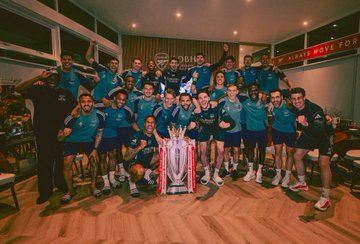
Arsenal players celebrating together after securing the Premier League title. (Image Arsenal on X)
By AMIT KUMAR
The glory, the collapse, the rebuild — and the moment North London finally exhaled.
| Football Feature | May 2026 | 5 min read
Twenty-two years. That is how long Arsenal supporters waited to hear those two words again: Premier League champions. A generation raised on the Invincibles grew up, had children of their own, and still the title did not come. Sunday changed everything. But the more important question is not that Arsenal are champions — it is why it took this long, and what finally broke the cycle.
The Peak That Became a Prison
To understand the drought, you have to understand what Arsenal lost when they won so perfectly.
The 2003–04 Invincibles season was not just a title. It was a statement of footballing philosophy so complete — 38 league games, 26 wins, 12 draws, zero defeats — that it set an impossible benchmark for everything that followed. Arsène Wenger had built something that felt permanent. It was not.
Within three seasons, Patrick Vieira was gone. Thierry Henry followed. Ashley Cole left in acrimony. Robert Pires, Gilberto Silva, Sol Campbell — the spine of that squad dispersed across Europe, and what remained was a club that looked like Arsenal but could no longer perform like them when it mattered most.
The Emirates Stadium, which opened in 2006, compounded the problem. A magnificent 60,000-capacity ground came with a crippling financial cost. For nearly a decade, Arsenal operated under suffocating self-imposed austerity — selling their best players each summer not because they wanted to, but because the mortgage on their own home demanded it. Robin van Persie. Samir Nasri. Cesc Fàbregas. Each departure felt like a retreat.
RPSG Ventures shares surge 36% in five days — full stock analysis
The Wenger Twilight and the Years of Drift
Wenger, so visionary in his prime, stayed too long. The football became predictable. Fourth place — once celebrated as a trophy in itself — became a punchline. Supporters who had witnessed the Invincibles found themselves defending a manager they still loved while watching a team that had forgotten how to win the things that counted.
When Wenger finally departed in 2018 after 22 years, the club he left behind was structurally dysfunctional. There was no clear recruitment strategy, no defined playing identity, and a dressing room that had grown accustomed to mediocrity. Unai Emery steadied the ship briefly before losing the dressing room. Freddie Ljungberg took temporary charge. The club was adrift.
The Arteta Project: Patience as a Strategy
Mikel Arteta arrived in December 2019 as an unproven head coach inheriting a squad in disarray. What followed was not an overnight transformation but something rarer and more durable — a systematic rebuilding of culture, identity, and footballing philosophy from the ground up.
The early Arteta years were brutal. Arsenal finished eighth in 2020. The football was often difficult to watch. There were calls for his removal. The board, to their considerable credit, held firm.
What Arteta was doing, quietly and methodically, was harder to see in a single result than in a pattern across seasons. He was establishing non-negotiables — in pressing intensity, in defensive organisation, in the kind of character he demanded from every player in his squad. Players who did not fit were moved on, sometimes brutally. Those who remained were reshaped.
The recruitment that followed was transformative. Declan Rice arrived as the midfield engine the club had lacked since Vieira. Gabriel Magalhães and William Saliba formed a central defensive partnership of genuine elite quality — Saliba, in particular, emerging as one of the finest defenders in European football. Bukayo Saka, developed through the academy, became a world-class attacker. Martin Ødegaard was converted from a loanee into a captain of genuine authority.
Paris Olympics serves golden message – kick politicians out of sports
Why This Season Was Different
Arsenal had come close before. The 2022–23 season saw them lead the title race for months before Manchester City’s relentless late-season form swallowed them whole. It was a lesson that hurt, and a lesson that was learned.
This season, Arsenal showed what that pain had taught them. They did not freeze when the pressure arrived. They did not surrender leads or wobble in the critical months. The depth of the squad — built painstakingly over five transfer windows — meant that injuries which would have derailed previous title challenges were absorbed. The mentality had changed.
That mentality shift is perhaps the hardest thing to construct in football, and the most important. You cannot buy it in a single window. You cannot install it with a new manager alone. It comes from repeated exposure to high-pressure moments, from a group of players who genuinely believe in the system they are executing, and from a coach who has spent years making that belief feel earned rather than assumed.
What Brought the Change
Three things, ultimately, ended the 22-year wait.
Financial discipline finally paying off. The Emirates debt that crippled Arsenal through the Wenger twilight years was cleared, freeing the club to compete in the market at a level befitting their size. The signings that followed were not panic buys or vanity purchases — they were targeted, purposeful, and overwhelmingly correct.
A coach who refused to compromise on culture. Arteta’s willingness to remove disruptive or underperforming players — regardless of their reputation or contract status — established standards that elevated everyone who remained.
And a generation of players who grew up together. Saka, Gabriel Martinelli, and others who came through the system in the lean years gave the squad an emotional core that no amount of money can manufacture. When the title was confirmed on Sunday, the scenes in the dressing room told that story plainly.
Twenty-two years. A stadium debt, a generational disbanding, a decade of drift, and then — slowly, stubbornly, deliberately — a rebuild. Arsenal are champions not because fortune smiled on them. They are champions because, eventually, they built something worth crowning.
Oh Calcutta! From Pele to Messi: Kolkata Dates Sports Mayhem
Follow The Raisina Hills on WhatsApp, Instagram, YouTube, Facebook, and LinkedIn




About The Author