Moods – A Creation by Gulzar: The Magic of Simple Words
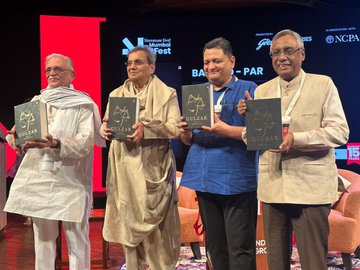
Poet Gulzar the launch of a book on his life (Image Harper Collins on X)
How Gulzar’s timeless words reveal deeper truths about leadership, emotion, and the quiet power of meaningful expression
By NIRENDR DEV
New Delhi, May 3, 206 — “Why should I turn out to be the one… you are looking for?”
At the peak of a charged political season, one question keeps returning—almost every hour: Who is a good politician? Even for those of us who track, dissect, and at times profit from politics, a clear answer remains elusive.
Perhaps the answer lies beyond politics. Perhaps a good politician is not very different from a good poet.
Not the self-styled poet-politicians who occasionally dominate headlines—but the rare kind. The kind whose words resonate, whose expressions strike the right emotional chords with people. By that measure, few embody this better than Gulzar—born Sampooran Singh, a master craftsman of language and a gentleman of rare grace.
The Poetry of Simplicity
Gulzar’s genius lies in transforming simplicity into depth. Consider his timeless line from Bandini (1963), directed by Bimal Roy: Mora gora ang laee ley, mohey shyam rang dei de…
A lyrical expression of love, longing, and identity—written with such elegance that it feels effortless. Many believe Gulzar’s early association with a maestro like Bimal Roy shaped his artistic sensibilities, giving him a foundation few receive.
When Words Become Experience
Whether through songs or dialogues, Gulzar’s work carries a signature—deep yet accessible, layered yet intimate.
Take his evocative line from Khamoshi: “Humne dekhi hai un aankhon ki mehakti khushboo…”
The ability to see the fragrance of eyes—this is not just poetry; it is imagination transcending sensory boundaries. The film itself, shot in Kolkata and based on Ashutosh Mukherjee’s story Nurse Mitra, stands as a reminder of cinema’s literary roots.
Art in Times of Turmoil
In 2002, during the communal violence in Gujarat, Gulzar spoke about a stage production exploring middle-class life amid a burning town. The lines may fade from memory, but the emotional weight remains.
It reinforced a simple truth: every individual carries their own definition of a “good writer”—just as they do for a “good politician.”
The Political Undercurrent
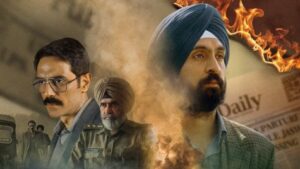
Gulzar’s political voice is subtle yet powerful. It surfaces most sharply in Machis, where a character played by Om Puri delivers a haunting line: “Aadhe ’47 le gaya tha, aadhe ’84 kha gaya.”
A stark reference to the trauma of Partition of India and the 1984 anti-Sikh riots—capturing decades of pain in a single sentence.
Another line cuts even deeper: “I am not fighting for religion or nation; my fight is against the system.”
This is Gulzar at his most political—never loud, never preachy, but piercingly honest.
Poetry That Breathes
Songs like Is Mod Se Jaate Hain from Aandhi and Beeti Na Bitai Raina from Parichay demonstrate his ability to blend narrative with emotion. His words do not impose meaning—they invite interpretation.
Gulzar doesn’t throw ideas at you. He lets them unfold.
Beyond films, Gulzar also brought literary heritage to mainstream audiences. His celebrated television series on Mirza Ghalib reintroduced the poet to a new generation, with music by Jagjit Singh adding timeless depth.
The Poet and the Politician
So, who is a good politician?
Perhaps the one who, like Gulzar, understands people—not in slogans, but in silences. Not in noise, but in nuance.
Because in the end, whether in poetry or politics, the true measure lies in this: Do your words touch lives—or merely fill the air?
Follow The Raisina Hills on WhatsApp, Instagram, YouTube, Facebook, and LinkedIn




About The Author