Aamchi Mumbai Review: Gulzar’s Love Letter to a City That Never Leaves You
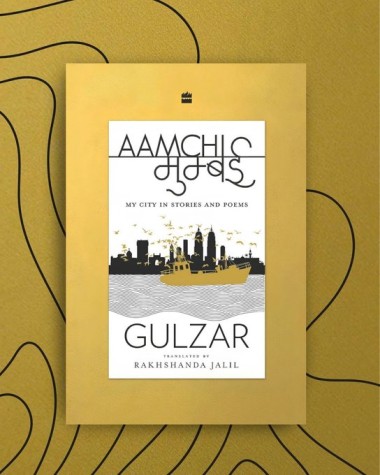
Gulzar's Aamchi Mumbai is a Love Letter Written Across Seven Decades (Image Harper Collins)
By TRH Book Desk
Can a city become part of your bloodstream? In Aamchi Mumbai, Gulzar’s poems and stories reveal why Mumbai is not merely a place but a lifelong companion. Our review explores this beautiful bilingual tribute to India’s greatest metropolis.
New Delhi, June 30, 2026 — When sleep takes over, the mind routinely rejects the high-rise triumphs of adult life and slips backward, dropping you onto the veranda of a childhood home where the scent of orange peels and mulberry trees hangs mid-air. You are suddenly chasing a tennis ball down an alleyway during a game of gully cricket, or walking a coastal road where the salt breeze sticks to your skin.
In Anushka Verma’s reading of Gulzar’s Aamchi Mumbai, this internal geography inevitably leads to one destination: Mumbai. Verma in Harper Collins Editor’s recommendation wrote in glowing terms a concise review of Gulzar’s Aamchi Mumbai, which has been translated by
“Seven decades ago, a young refugee uprooted by Partition boarded the Frontier Mail from Delhi and arrived in Bombay carrying little more than uncertainty. The city welcomed him before the world knew him as a poet, lyricist, filmmaker or one of India’s greatest literary voices. In return, Gulzar spent a lifetime observing Mumbai—not from a distance but from within its pulse,” Verma wrote.
Published by HarperCollins India, Aamchi Mumbai: My City in Stories and Poems is, as Verma argues, the culmination of that lifelong companionship. The bilingual volume brings together twenty-five short stories and thirty-six poems selected by Gulzar himself, with English translations by Rakhshanda Jalil alongside the original Devanagari text.
Rather than functioning as a conventional anthology, the book becomes a literary archive built over seven decades of watching one city breathe.
For Gulzar, this internal geography has always led to one destination: Mumbai.
What distinguishes Aamchi Mumbai from the crowded shelf of books on India’s financial capital is not reportage or nostalgia, Verma wrote, adding: “Gulzar isn’t documenting Mumbai’s skyline; he is documenting its heartbeat.”
The Mumbai in these pages isn’t merely Marine Drive, Bollywood, or the Gateway of India. “It is the local train that compresses strangers into temporary families. It is rain that transforms inconvenience into shared experience. It is mill workers, street vendors, bus conductors, dreamers, artists, lovers, and migrants who arrive carrying impossible ambitions,” she added in her write-up.
History as Warning: Ahamed’s 1873 and the Crash That Made Our World
His famous declaration— “I am a Mumbaikar / Mumbai is mine” —is not possessive but reciprocal. The city owns him as much as he claims it, she added.
“Throughout the collection, Gulzar writes with the confidence of someone who has earned the right to narrate a city’s emotional history. The poems move effortlessly between humour and melancholy; the stories capture fleeting human encounters that somehow become permanent memories,” Verma wrote. Mumbai, she adds, appears quarrelsome, impatient, overcrowded—and yet endlessly generous.
Diasporic writers such as Jhumpa Lahiri and Avni Doshi often explore cities inherited through memory or abandoned across oceans. Karan Mahajan writes about migration carrying old wounds into new countries. Amitav Ghosh, Jeet Thayil and Sarnath Banerjee repeatedly return to the cities that shaped them.
Gulzar, however, represents the opposite trajectory. His is the literature of staying.
Instead of reconstructing a lost homeland, he records the quiet miracle of remaining rooted while everything around him changes. Memory accumulates layer upon layer until poet and city become inseparable.
That continuity is what gives the book its unusual emotional authority.
Checkmate Review: Inside the Magnus Carlsen–Hans Niemann Scandal That Rocked the Chess World
Follow The Raisina Hills on WhatsApp, Instagram, YouTube, Facebook, and LinkedIn




About The Author