Gujarat’s Water Surplus Goal Faces a Difficult Ground Reality
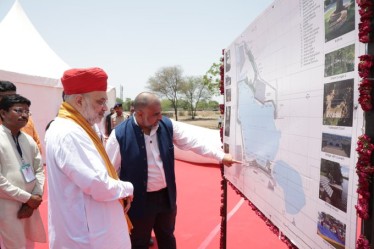
Gujarat is expanding reservoirs, canals and groundwater-recharge measures as it seeks to improve water availability across water-deficit regions. (Image Aravind on X)
By NIRENDRA DEV
Only about 29% of Gujarat has relatively better water availability, while North Gujarat, Saurashtra and Kutch continue to face structural water scarcity.
Ahmedabad, September 21, 2026 — Gujarat is pursuing a long-term goal of becoming a water-surplus state, but the geographical distribution of water remains a major challenge. Only about 29% of the state, largely in South and Central Gujarat, has relatively better water availability, while North Gujarat, Saurashtra and Kutch remain naturally water-deficit regions.
Union Home Minister Amit Shah inaugurated the Gujarat Gaurav Sarovar in Amreli on August 27, 2026. Spread across 21 acres, the reservoir has a capacity of 400 million litres and is intended to support agriculture, drinking-water availability and groundwater conservation, according to the Press Information Bureau. Shah also said water from the Narmada is being stored in around 10,000 reservoirs across North and Central Gujarat.
Gujarat’s water challenge is closely linked to its uneven distribution of rainfall and surface-water resources. A Gujarat government background document notes that around 80% of the state’s surface-water resources are concentrated in Central and Southern Gujarat, leaving much of the remaining area with a substantially smaller share.
The Sardar Sarovar Project and the Narmada canal network have therefore become central to Gujarat’s strategy of transferring water towards areas facing scarcity. The Narmada Main Canal extends about 458 km to the Gujarat-Rajasthan border, while the wider distribution network carries water to different parts of the state.
The state has also relied on check dams, lake deepening, groundwater recharge, the Sujalam Sufalam programme and the SAUNI scheme. The objective is not merely to transfer water but also to retain rainfall and improve groundwater availability. Gujarat’s water-resources planning documents describe inter-basin transfer as a means of moving water from surplus basins to deficit areas.
Drip and sprinkler irrigation and the Per Drop More Crop approach have also formed part of the broader water-management strategy. The Centre established the Ministry of Jal Shakti in 2019, while the Gujarat government has continued to expand drinking-water and irrigation infrastructure.
The scale of the challenge, however, remains significant. Converting a state with substantial regional water disparities into a consistently water-surplus state requires sustained investment, efficient distribution, groundwater management and protection against over-extraction.
There have also been administrative concerns involving rural-development and drinking-water schemes. India Today reported in 2025 that investigations into alleged financial irregularities across schemes in Dahod, Bharuch and Vadodara involved about Rs 204 crore. The report cited allegations involving incomplete or fictitious works, inflated costs and irregular documentation. These matters were subject to investigation and should be distinguished from established findings of guilt.
For Gujarat, therefore, the water-surplus objective is as much about governance and monitoring as it is about reservoirs and canals. The state’s ability to retain rainwater, manage groundwater extraction and ensure that water infrastructure functions as intended will determine how far the goal can be translated into sustained water security.
(This is an opinion piece. Views expressed are the author’s own.)
Follow The Raisina Hills on WhatsApp, Instagram, YouTube, Facebook, and LinkedIn




About The Author