DUSU 2026: ABVP Wins Three Posts as Fractured Opposition Hands BJP Student Wing a Political Talking Point
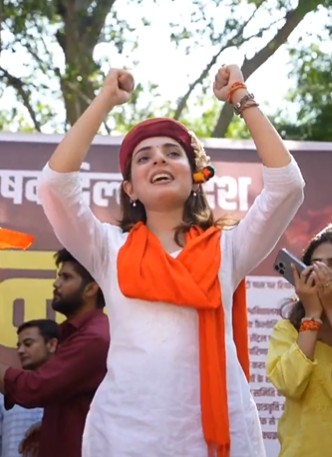
ABVP won the president, secretary and joint-secretary posts in the 2026 Delhi University Students' Union election. (Image video grab)
By AMIT KUMAR
ABVP’s three victories expose the cost of a fragmented Opposition, while the NSUI rebel’s vice-presidential win complicates any simple reading of the DUSU verdict as a BJP-ABVP sweep.
New Delhi, September 19, 2026 — The 2026 Delhi University Students’ Union election results have detonated fireworks on internet with the ruling BJP sympathisers erupting in celebrations while the Opposition has turned brooding over fracture in ranks. The 2026 DUSU election produced a result that is politically significant without necessarily being a referendum on national politics.
The RSS-affiliated Akhil Bharatiya Vidyarthi Parishad (ABVP) has won three of the four central DUSU posts, including the presidency, while an independent candidate who had sought the NSUI ticket captured the vice-president’s post by a substantial margin.
The result gives ABVP a clear organisational victory, but it also exposes the fragmentation of the Opposition space on the campus.
Yash Dabas of ABVP won the presidential election with 24,576 votes, defeating NSUI’s Vijay Shankar Meena, who secured 22,523. The Left candidate polled 5,377, while ASAP received 1,388 votes. The presidential margin was therefore 2,053 votes.
The NSUI, Left and ASAP candidates together secured 29,288 votes, well above ABVP’s 24,576. Yet the opposition votes were divided among multiple candidates, allowing ABVP to emerge with the largest individual share.
That is precisely why the DUSU result can be read in two different ways.
For ABVP, it demonstrates organisational strength and the ability to convert a divided contest into victories. For its opponents, the same numbers point to the cost of political fragmentation.
Three Posts for ABVP, One for NSUI Rebel
ABVP’s Riya Chhawdi won the secretary’s post with 21,650 votes, against NSUI’s 14,869. Lakshya Raj Singh won the joint-secretary election with 16,615 votes, narrowly ahead of Samajwadi Chhatra Sabha’s Vishesh Yadav with 15,778 and NSUI’s Gopal Choudhary with 15,206.
The vice-president’s election, however, produced the most politically interesting result.
Independent candidate Deepanshu Shokeen, a former NSUI member who had sought the organisation’s ticket before entering the contest independently, won with 30,615 votes. ABVP’s Ishu Maurya received 16,910, while the NSUI candidate polled only 4,313.
Shokeen’s margin over the ABVP candidate was 13,705 votes, making the vice-president contest markedly different from the closely fought presidential race.
His victory therefore cannot simply be folded into an ABVP-versus-NSUI narrative. It points to another feature of the election: students could reject an established organisational candidate while simultaneously giving ABVP three other central-panel positions.
The Shokeen result also gives the Opposition an uncomfortable question to answer.
An independent candidate emerging from an organisational dispute and then winning the vice-president’s post suggests that organisational labels did not necessarily determine every contest.
CJP leader Saurav Das highlighted precisely this aspect after the results, arguing that the Opposition remains fractured and that the rebel candidate’s victory should be read as a warning to Congress and its organisational structures.
Das also argued in a post on X that sections of the Left remain too focused on ideological exclusivity and that opposition forces need to address organisational weaknesses rather than concentrate primarily on the CJP.
These are political interpretations, not conclusions established by the DUSU vote itself.
CJP Protest and the Bigger Political Argument
The DUSU election had acquired an unusual significance even before voting because it followed months of youth mobilisation around education, student grievances and the CJP-led protests.
The RSS-affiliated ABVP and Congress-backed NSUI had dominated the DUSU contest historically, while the 2026 campaign unfolded amid debates over the CJP protests, campus infrastructure, education policy and student accommodation.
The result now provides competing political narratives.
For ABVP and those seeking to demonstrate continuing BJP-linked student support, three of four central-panel victories offer a useful counterpoint to claims that the recent youth protests necessarily represent a broad erosion of support for the BJP.
But that interpretation has an obvious limitation.
DUSU is a student election, not a national election. The overall turnout was 40.46%, with more than 1.51 lakh students eligible to vote.
Nagender Sharma, commenting on X, made precisely this argument. He said the result should not be treated as a reflection of either the local or national political mood, pointing to the large proportion of students who did not vote.
Even within the presidential contest, ABVP’s 24,576 votes represented less than half of the votes cast for the post. The combined votes of the other candidates were higher. The result therefore demonstrates plurality within a fragmented field, rather than a majority endorsement of ABVP.
At the same time, dismissing the result altogether would also miss something important.
ABVP has demonstrated that it retains a substantial organisational base inside one of India’s most politically visible universities. Its candidates won the presidency, secretary and joint-secretary posts despite a multi-cornered contest. That is an electoral fact, even if its political meaning beyond Delhi University remains contested.
Follow The Raisina Hills on WhatsApp, Instagram, YouTube, Facebook, and LinkedIn




About The Author