Why India’s Gen Z Isn’t One Voting Bloc, Even as the Cockroach Janta Party Goes National
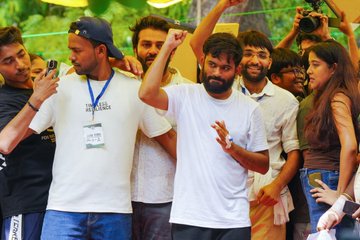
Cockroach Janata Party leaders celebrate resignation of Union Minister for Education Dharmendra Pradhan. (Image CJP on X)
By TRH Political Desk
Political analyst Manish Anand argues caste, geography and income — not age — will decide whether India’s viral youth movement becomes a lasting political force.
New Delhi, August 6, 2026 — The Cockroach Janta Party (CJP), the youth-led movement that forced a Union minister’s resignation and drew millions of followers within days of going viral, has finalised its national organisational structure — naming regional heads and office-bearers across the country. But the group has firmly ruled out contesting elections as a political party, describing itself instead as a pressure group that will use agitation to push the government on specific issues.
That framing — a movement, not a party — is the right call, according to political analyst Manish Anand, host of The Raisina Hills. In a detailed video analysis, Anand argued that India’s Gen Z population is too fractured by geography, caste and income to function as a single political constituency, making a national electoral party a risky bet for the CJP’s credibility.
“Gen Z Is Not a Homogeneous Group”
Anand’s central argument is that treating India’s 15-to-24 age group as one political, social or economic unit is a mistake. A Gen Z resident of Delhi-NCR or Mumbai, he said, lives in an entirely different reality from a Gen Z youth in rural Bihar or Uttar Pradesh — starting with per-capita income levels that run well above the national average in India’s metro regions, driving far greater access to smartphones, social media and political expression.
“Caste remains too dominant an identity across states like Bihar, Uttar Pradesh, Madhya Pradesh and Gujarat,” Anand said, arguing that this cuts across every age group, Gen Z included, making it inaccurate to describe India’s youth as a single social bloc.
He pointed to the CJP-backed protests following the July 20 police crackdown on students as a case where genuine, cross-regional sympathy pushed the movement into the national spotlight. But he contrasted that with the party’s push against ethanol-blended petrol, which he said resonates mainly with urban Gen Z who own cars or two-wheelers — a demographic he noted is a minority when measured against national census data on vehicle ownership. By contrast, he singled out the education crisis as a rare issue with genuine pan-India resonance across income groups and states.
No Single Political Outlook, Either
Anand extended the same argument to politics. Gen Z voting behaviour, he said, varies sharply by state and is often driven more by the presence of a credible political face than by any shared generational ideology. He cited Tamil Nadu’s assembly election, where actor-turned-politician Vijay’s Tamilaga Vettri Kazhagam gave young voters an alternative to the DMK-AIADMK duopoly — arguing that without that option, Tamil Nadu’s Gen Z voters would likely have simply split along the state’s existing political lines rather than voting as a distinct bloc.
He also pointed to Bihar, where he said Gen Z’s overwhelming, near round-the-clock focus on cracking competitive government exams — students studying under streetlights along the Ganga, in coaching hubs, in group-study sessions — leaves little appetite for issues like fuel-blending mandates that dominate urban discourse.
The Verdict: A Pressure Group Is the Pragmatic Choice
Taken together, Anand said, the absence of a single social, economic or political identity across India’s Gen Z population is precisely why the CJP’s decision to remain a pressure group — rather than register as a political party — is the practical one. Formally entering electoral politics, he argued, would expose the movement’s credibility to scrutiny it may not be able to withstand, and could cost it the broad-based public support it currently enjoys.
CJP Protests Force a Reckoning: Has Mainstream Media Failed India’s Public Interest?
Follow The Raisina Hills on WhatsApp, Instagram, YouTube, Facebook, and LinkedIn




About The Author