China’s Rise in the Trump Era: How Beijing Outplayed New Delhi
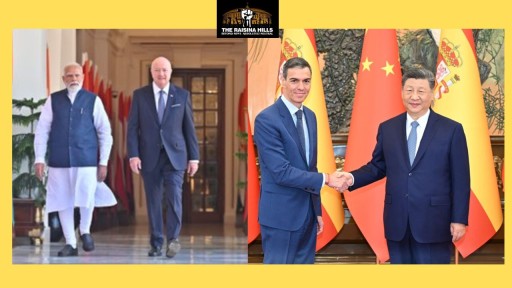
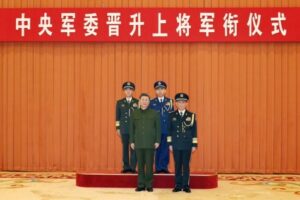
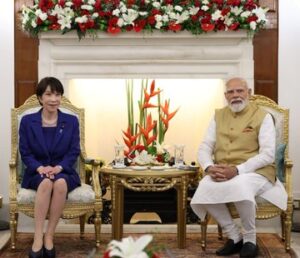
PM Narendra Modi and China President Xi Jinping with state guests. (Images X.com)
As Trump reshapes global order through tariff wars and military brinkmanship, China has emerged as a surprising stabilising force — while India watches from the sidelines
By Op-Ed Desk
New Delhi, April 17, 2026 — In the high-stakes chess game of Trump-era geopolitics, China appears to be winning — and India may be falling behind. That is the blunt assessment of geopolitics analyst Manish Anand, who, in an episode of the YouTube channel of The Raisina Hills, offered a sweeping comparison of how Beijing and New Delhi have each navigated the turbulence of Donald Trump’s second presidency.
“In the Trump era, the question is who has the greater capability and shrewdness in geopolitics, and who has got an opportunity to offer something on the global stage,” Anand said, framing the central argument of his analysis.
China Holds the Line — and Wins
The evidence Anand presents is striking. When Trump launched his aggressive tariff campaign, China did not blink. Beijing responded with equal-measure counter-tariffs on American goods and simply refused to yield. The result: Washington backed down.
The same pattern repeated itself over the Strait of Hormuz. When Trump threatened that no vessel would pass through the critical waterway — through which approximately 20 percent of the world’s oil and gas transits — China flatly rejected the ultimatum. Beijing cited its existing oil purchase agreements with Iran and declared that its tankers would continue sailing through the strait regardless of American pressure.
“China didn’t budge. America had to back down,” Anand stated, adding: “Trump publicly announced he was opening the Strait of Hormuz — which is itself an acknowledgment that China’s position had prevailed.”
Anand draws on an English idiom to explain China’s consistent strategic posture: give them an inch, they’ll take a mile. “China understood Trump as a negotiator and did not concede even an inch in any negotiation,” he said.
Trump Goes to Beijing — Not New Delhi
Perhaps the most telling diplomatic signal, according to Anand, is geography. Trump is headed to China next month at President Xi Jinping’s invitation. Trump and Xi are expected to meet warmly — Trump himself has spoken of greeting the Chinese president with great enthusiasm.
India, by contrast, is waiting. The much-anticipated bilateral visit that was expected in late 2025 has still not materialised. “About four months of 2026 have passed. Whether Trump will come to India or not — there is no clarity,” Anand noted pointedly. “And the Quad, which India is chairing, hangs in uncertainty.”
The diplomatic arithmetic is simple: Trump is travelling to Beijing. He is not travelling to New Delhi. “You can compare India and China’s diplomacy using this one benchmark alone,” Anand said.
The World Is Flowing Toward Beijing
Beyond bilateral ties with Washington, Anand observes a broader global realignment. European nations are flocking to China. Spain’s Prime Minister has visited. Canada’s Prime Minister has made the trip. Leaders from across the continent are choosing Beijing as a destination for strategic engagement.
“The major diplomatic activity is in Beijing, not in New Delhi,” Anand said plainly. China also played a visible role in brokering the two-week ceasefire between Iran and America — a role that Trump himself acknowledged.
“In the Trump era, China’s stature on the global stage has grown considerably. The world is beginning to see China as a stabilising force, as a partner,” Anand observed.
A Message for India
Anand’s analysis carries an uncomfortable but clear message for New Delhi. China’s geopolitical leverage flows directly from its economic capacity — its dominance in chemicals, fertilisers, critical minerals, and supply chains gives it structural weight that India currently lacks.
“Build enough strength in your economy that the world looks at you with respect — and not that you become dependent, so that when someone imposes tariffs on you, anxiety rises at home,” he said.
“In the politics of leverage — geopolitics around leverage — China is far ahead. Ahead of India in many respects.”
(Manish Anand is a geopolitics analyst and host of The Raisina Hills on YouTube.)
China-Iran Military Pact — And What It Means for India-Pakistan
Follow The Raisina Hills on WhatsApp, Instagram, YouTube, Facebook, and LinkedIn




About The Author