‘This Is Not My Paper’: CBSE in Firestorm over Digital Evaluation
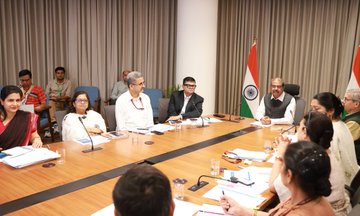
Education minister Dharmendra Pradhan holds review of the progress of various initiatives announced through a series of Budget announcements.(Image Pradhan on X)
By KUMAR VIKRAM
Class 12 students claim uploaded answer sheets did not match their handwriting, raising questions over CBSE’s On-Screen Marking rollout and evaluation safeguards.
New Delhi, May 25, 2026 — On May 23, 2026, a Class 12 student going by the handle @VEDANTSHRIV17 posted a thread on X that would quickly rack up over 2.5 million views. His words were simple, desperate, and deeply alarming.
“I am a CBSE Class 12 student. After receiving unexpectedly low marks in Physics, we applied for photocopies of my answer sheets through the CBSE re-evaluation process. Today we received the copies. And I am shattered because the Physics answer sheet uploaded by CBSE is not mine,” he wrote.
What followed was not just one student’s grievance. It was the trigger for a nationwide reckoning.
Dozens of other students responded with near-identical complaints — answer sheets that didn’t carry their handwriting, questions they had never attempted, pages that appeared to belong to a completely different candidate. Several social media handles initially trolled the student, questioning whether the newly-created account actually belonged to a CBSE student, with some even calling him “anti-national.” Orissa Post reported that his brother stepped in to explain: Vedant did not have a Twitter account because he was busy studying, and the family had created the account specifically to raise the issue publicly because they could not apply for re-evaluation through normal channels.
What Exactly Are Students Claiming?
The complaints broadly fall into three categories, each more disturbing than the last.
Wrong answer sheets entirely: The student alleged that the handwriting style, letter formation, spacing, slant, sentence flow — everything — was different. Not a minor variation, but completely different writing. He questioned whether another student’s answer sheet had been mistakenly uploaded or evaluated under his roll number. “If this is true, then what exactly was evaluated under my roll number? My paper? Or someone else’s? This is no longer just a ‘rechecking’ issue. This may be a serious answer-sheet exchange or tagging error in CBSE’s OSM system,” he wrote.
Cover page yours, inner pages someone else’s: A second student, identified as Sanjana, reported a particularly unsettling variant of the same problem. While the first page of her answer booklet carrying her personal details appeared to be hers, the internal pages did not match her handwriting at all. “Not a single page inside appears to be mine,” she alleged, adding that she had emailed CBSE and tried contacting officials through helpline numbers but had been unable to reach anyone. Her family confirmed: “The first page belongs to her, but the rest of the pages do not belong to her at all. Even the handwriting is different.” Sanjana stated she would not proceed with re-evaluation using the uploaded sheet. “I want my original answer sheet to be checked,” she said.
Blurred scans and unchecked answers: Beyond the mismatch allegations, students reported receiving unreadable answer sheets, unchecked responses, and repeated technical failures on the re-evaluation portal. Others alleged that step marking was either ignored or inconsistently awarded in numerical subjects.
What Is the OSM System — and Why Did It Fail?
At the centre of this storm is the On-Screen Marking (OSM) system — CBSE’s ambitious leap into digital evaluation, introduced for the first time at full scale for Class 12 board exams in 2026.
Under the new system, Class 12 answer sheets are scanned and evaluated digitally. The OSM model was designed to eliminate totalling errors, minimise human intervention, and accelerate the declaration of results. Teachers would assess copies remotely from designated school facilities, reducing logistical delays and transportation costs.
On paper, the intent was sound. In practice, the rollout appears to have been critically under-prepared. The Delhi Government School Teachers’ Association (GSTA) had already urged CBSE to hold implementation of the OSM system and roll it out from the next session instead, warning that implementing a fully digital evaluation system without adequate preparation and structured training presented significant practical challenges.
Those warnings went unheeded.
“Not Out of Syllabus”: CBSE Chief Defends Class 10 Maths Paper
A Chain of Systemic Failures
When CBSE results were declared this month. Students began accessing their scanned answer sheets. The system buckled under scrutiny at every level.
The re-evaluation portal repeatedly crashed during payment and application submission, senior journalist Deepak Kumar Jha posted several messages on X, sharing screenshots, while tagging the CBSE. Students complained that money was deducted from their bank accounts but application statuses remained unsuccessful or failed to update.
Subjects worst affected included Physics, Chemistry, Mathematics, Accountancy, Economics and Biology — precisely the high-stakes papers that determine university admissions.
Following the initial backlash, CBSE reduced the fee for obtaining scanned answer sheets and re-evaluation requests to ₹100 per subject — an acknowledgement of distress, if not of fault.
CBSE’s Response: Denial, Then Silence
CBSE stated that all stages of the digital evaluation process were conducted under established guidelines and continuous supervision, and clarified that reports alleging issues in the scanning process were inaccurate.
The board acknowledged a temporary technical glitch on its portal during re-evaluation. Union Education Minister Dharmendra Pradhan directed teams of professors and technical experts to assist CBSE in ensuring the process, The Week reported.
On the specific and explosive allegation that students received entirely wrong answer sheets, however, CBSE did not respond to queries regarding the allegations. No official statement has been issued addressing the handwriting mismatch claims directly. Late on Monday evening, the Ministry of Education in a mail to Vedant admitted that there was a mismatch, promising to upload correct marks for his Physics paper.
The Human Cost
Behind every viral post is a year of sacrifice. The student described the emotional weight plainly per a report by NewsX: “I studied for an entire year. I sacrificed sleep, peace of mind, outings, everything for these exams. And now I don’t even know whether MY actual Physics paper was checked. Do students really deserve this?”
For many of these students, the stakes extend well beyond marks. Board results determine college admissions, scholarship eligibility, and the entire trajectory of a young person’s academic life. A wrong answer sheet evaluated under the wrong roll number is not a technical glitch — it is a potential life-altering injustice.
What Needs to Happen Now
Students and families are demanding a four-point response from CBSE: physical verification of original answer sheets; a full audit of the OSM scanning and tagging process; an investigation into whether answer sheet exchanges occurred during evaluation; and confirmation that the correct paper was marked for every roll number flagged.
The deeper question is institutional. India’s largest school board, responsible for the futures of lakhs of students, rushed a full-scale digital overhaul into its highest-stakes examinations — Class 12 boards — without the infrastructure, training, or safeguards to back it up. The result is a crisis of confidence that no press statement can easily repair.
CBSE’s credibility now depends not on defending a system, but on answering one simple question that every affected student is asking: Whose paper was actually checked?
CBSE Syllabus vs JEE-NEET: “Schools Will Empty by Class XI-XII”
Follow The Raisina Hills on WhatsApp, Instagram, YouTube, Facebook, and LinkedIn




About The Author