“Not Out of Syllabus”: CBSE Chief Defends Class 10 Maths Paper
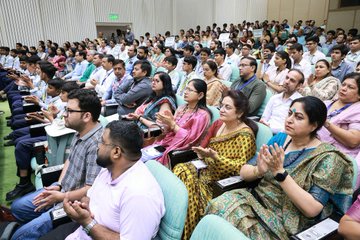
Ministry of Education holds a workshop in New Delhi (Image CBSE on X)
At the launch of CBSE’s new curriculum framework for Classes 9 and 10, the chairman offered a candid diagnosis of why students struggled — and why the examination system, not the children, bears much of the responsibility.
By AMIT KUMAR
New Delhi, April 3, 2026 — The controversy over this year’s CBSE Class 10 Mathematics paper — widely described by students and parents as containing questions that were “out of syllabus” — has drawn a direct response from CBSE Chairman Rahul Singh. Speaking at the release of the board’s new curriculum framework for Classes 9 and 10, Singh rejected the characterisation while simultaneously acknowledging the deeper structural problem the outrage has exposed.
“Everything was there in the material provided,” Singh said. “And yet children are saying it is out of syllabus. So this is something to be sad about. And it is not the children’s fault, mind you. It is the way we have been evaluating children. They are trained not to think beyond a straight answer.”
The statement is as close to a self-indictment of the examination system as a sitting chairman is likely to offer in a public setting.
The curriculum jump that catches students off guard
Central to Singh’s explanation was a structural problem that educators have flagged for years: the sudden and steep difficulty spike between Class 10 and Class 11, which leaves students feeling they have failed rather than simply encountered a new level of demand.
He traced the problem historically. When CBSE schools shifted away from older board structures, the change was welcomed because it relieved students of the burden of studying two years of material for a single Class 10 examination. Progressively, the board moved more conceptually demanding content — particularly in mathematics and science — into Class 9, where school-based assessment applies, and reserved the more accessible portions for the Class 10 board examination.
The unintended consequence: students were not being seriously evaluated on the harder conceptual material in Class 9 because school assessments tend not to carry the same pressure as board examinations. When Class 11 arrived with a syllabus of comparable difficulty to what the board had always targeted at that level, students experienced the jump as a wall.
“There is a very difficult jump in difficulty level at Class 11,” Singh said. “Children feel they cannot pass. This also has to do with our question paper design at Class 10, where we had imposed an artificial constraint on ourselves — that CBSE will only ask questions exactly as they appear in the NCERT book,” he added.
From Gurukul to NEP 2020: Has Indian education lost its soul?
The competency-based shift
The new curriculum framework, Singh said, is designed specifically to smooth the gradient between Class 9 and Class 12 — eliminating the cliff edge at Class 11 and ensuring that the difficulty progression is continuous rather than sudden.
The framework places competency-based questions at the centre of the evaluation design. Rather than testing recall of NCERT text, the new approach asks students to apply concepts to unfamiliar contexts — which is precisely what the contested mathematics questions in this year’s Class 10 paper did.
“Ideally, I would like 100% of questions to be competency-based,” Singh said. “What is an out-of-syllabus question in maths? Everything needed to solve it was provided. But children are still saying it is out of syllabus,” he added.
The point Singh was making is structural: when an examination system trains students for years to reproduce answers from a fixed text, the introduction of questions that require reasoning — even when all necessary information is supplied — registers as unfair. The problem, he argued, is not the question. It is the conditioning.
India’s Degree Mill Crisis: Education Boom Fails to Deliver Jobs
The NCERT textbook constraint
Singh also addressed the board’s historical self-limitation around NCERT textbooks, describing the practice of asking only questions that mirror NCERT content exactly as an “artificial constraint” the board had imposed on itself. The new textbooks being developed for Classes 9 through 12 are designed to move away from that model — introducing higher-level concepts within the syllabus, placing more difficult questions across Class 10 and Class 12, and building the kind of conceptual fluency that competency-based assessment requires.
“In Class 10 and Class 12, more difficult concepts should be included, high-level questions should be included,” he said, adding: “That is the direction we are moving.”
What this means for students and parents
For the students who sat this year’s Class 10 mathematics examination and felt blindsided, Singh’s comments offer acknowledgment but not relief. The board is saying, in effect, that the direction of travel was correct even if the communication around it was insufficient — and that the new curriculum framework will make the shift more transparent and more gradual going forward.
For parents, the more important message is about the nature of preparation. If competency-based questions are the future of CBSE evaluation — and Singh’s language suggests they are — then preparation strategies built around NCERT line-by-line revision will be progressively inadequate. The examination is moving toward reasoning. The preparation must follow.
The irony embedded in Singh’s statement is worth sitting with. A system designed to reduce student stress — by separating the two-year curriculum burden of the old board structure — has produced a generation trained to answer straight questions from a fixed text. The cure for that conditioning, the chairman suggested, is already in motion. Whether it arrives before the next controversy depends on how quickly the new framework reaches classrooms.
Follow The Raisina Hills on WhatsApp, Instagram, YouTube, Facebook, and LinkedIn




About The Author