Bihar’s Secret: How Caste, Scams & Strategy Built Power Game
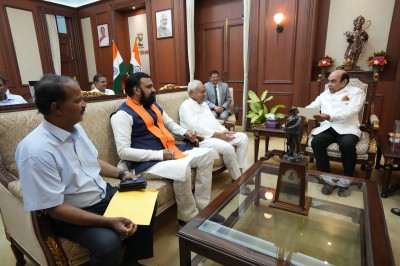
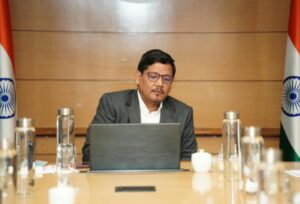
Bihar CM Nitish Kumar meets Governor Syed Ata Hasnain in Patna. (Image Bihar Info Dept)
From Lalu’s MY caste consolidation to Nitish’s governance model and the BJP’s rise, Bihar’s politics reflects a complex balance of identity, development, and shifting alliances.
By NIRENDRA DEV
New Delhi, April 14, 2026 — Bihar has come a long way in India’s democratic journey — perhaps farther than most states in terms of political experimentation. From the rise of caste-based mobilization to the calibrated balance of development and identity, the state has repeatedly redefined electoral politics. The emergence of the MY (Muslim-Yadav) combine under Lalu Prasad Yadav marked a watershed moment, heralding a new kind of social revolution that reshaped power structures in Patna.
The MY formula was not merely an electoral arithmetic; it was a sociopolitical assertion. It empowered backward classes and minorities, creating a durable vote bank that kept Lalu and later Rabri Devi in power for years—longer than similar caste experiments in states like Uttar Pradesh. Yet, this dominance also triggered counter currents.
One of the most consequential turning points came with the fallout between Lalu and George Fernandes. In 1994, Fernandes broke away from the Janata Dal to form the Samata Party, with Nitish Kumar as his key lieutenant. This split would alter Bihar’s political trajectory. The Samata Party’s alliance with the BJP laid the foundation for what later became the National Democratic Alliance (NDA) in 1996, with Atal Bihari Vajpayee as its face and Fernandes as convener.
Without George Fernandes, the BJP’s journey in Bihar might have been far more difficult. His credibility among socialists and backward classes helped bridge ideological divides, making the BJP more acceptable in a state deeply rooted in caste politics.
Parallelly, the Fodder Scam involving Lalu Yadav provided the BJP with a powerful political narrative. In a state weary of what critics described as “jungle raj,” the scam symbolized systemic decay. It allowed the BJP and its allies to pivot towards governance, law and order, and development.
However, Bihar was never fertile ground for pure Hindutva politics. While episodes like L. K. Advani’s arrest during the Rath Yatra in Bihar gave the BJP visibility, the party soon realized the limitations of religious polarization in the state. Instead, it crafted a hybrid strategy—blending identity with development, popularly framed as “bijli, sadak, paani.”
1, Anne Marg to 7, Circular Road: Nitish Kumar’s Final Power Move
This is where Narendra Modi at the Centre and Nitish Kumar in the state created the “double engine” narrative. Modi’s strong leadership complemented Nitish’s good governance image. Yet, Bihar voters consistently signalled that their electoral choices differ from states like Uttar Pradesh or Gujarat. Here, caste equations remain central, even as development gains traction.
Nitish Kumar’s political longevity—spanning over two decades—owes much to his ability to reconfigure caste coalitions. From nurturing Extremely Backward Classes (EBCs), a concept rooted in the legacy of Karpoori Thakur, to creating the Mahadalit category, Nitish used caste as a tool for targeted welfare. His alliances—alternating between the BJP and the RJD—often underscored the BJP’s dependence on regional partners in Bihar.
Even Ram Vilas Paswan, a master of coalition politics, acknowledged Bihar’s unique dynamics. He famously emphasized that caste combinations mattered more than religious identity in the state, even as bread-and-butter issues like welfare and infrastructure remained decisive.
Indeed, Bihar’s political discourse often reflects this duality. While there is admiration for Modi and a cultural resonance with broader Hindutva themes, assembly elections are fought on entirely different grounds. Voters frequently assert that Hindu-Muslim tensions are not as pronounced in everyday life, except in pockets like Seemanchal.
Field observations over the years reinforce this complexity. Across villages and small towns, voters from Dalits, EBCs, OBCs, and upper castes speak of roads, electricity, and law and order improvements under NDA regimes. The contrast with the 1990s—often associated with lawlessness and extortion—is stark in public memory.
Welfare has also played a decisive role. Schemes involving direct benefit transfers, free food grains, and financial assistance to women have influenced voting behaviour, especially among the most deprived communities such as Musahars. For many, material upliftment—not identity rhetoric—defines political choice.
Yet, caste remains deeply embedded—not just as a social category but as a marker of pride and assertion. Political mobilization in Bihar often channels caste identities into frameworks of empowerment rather than exclusion.
Historically, Bihar has been a crucible of transformative politics. From Mahatma Gandhi’s Champaran Satyagraha to Jayaprakash Narayan’s movement against the Emergency, the state has repeatedly shaped national narratives. The Mandal era, the MY consolidation, and the rise of coalition politics are all chapters in this long arc.
Today, as Samrat Chaudhary steps into a more prominent leadership role within the BJP, the challenge is to sustain this delicate balance. His own journey—from the RJD to JD (U) and finally the BJP—mirrors Bihar’s fluid political alignments.
The road ahead will test whether the BJP can harmonize “Samajwaad” (social justice politics) with “Sanghwaad” (Hindutva ideology) in a state that resists binaries. If history is any guide, Bihar will not conform easily.
From the MY revolution to the NDA’s development pitch, Bihar’s politics remains a story of constant negotiation—between caste and class, identity and aspiration, memory and change.
(This is an opinion piece. Views expressed are the author’s own.)
Post-Nitish, BJP Bets on Samrat Choudhary in Bihar’s Caste Chessboard
FAQ
Q1. What is the MY formula in Bihar politics?
The MY (Muslim-Yadav) formula refers to the electoral alliance of Muslims and Yadavs consolidated by Lalu Prasad Yadav, which dominated Bihar politics for years.
Q2. Why was George Fernandes important for BJP in Bihar?
George Fernandes helped bridge socialist and BJP ideologies, enabling alliances that led to the formation of the NDA and expanding BJP’s acceptability.
Q3. Why doesn’t Hindutva dominate Bihar politics like in UP?
Caste dynamics play a more decisive role in Bihar. While Hindutva has influence, electoral outcomes depend more on caste coalitions and development issues.
Q4. What is the “double engine” government in Bihar?
It refers to the BJP-led central government under Narendra Modi working in tandem with a state government, often led by Nitish Kumar, to deliver development.
Q5. What challenge does Samrat Chaudhary face?
He must balance caste-driven social justice politics with the BJP’s ideological framework while sustaining development momentum.
Nitish Kumar Resigns as Bihar CM, Signals Governance Transition
Follow The Raisina Hills on WhatsApp, Instagram, YouTube, Facebook, and LinkedIn




About The Author