B-52 Crash: America’s Deadliest Bomber Accident in Four Decades
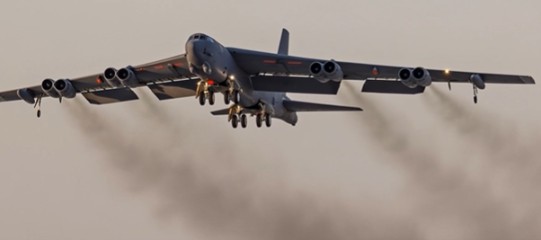
Eight crew members were killed when a B-52 Stratofortress crashed after takeoff (Image video grab)
By TRH World Desk
Eight crew members were killed when a B-52 Stratofortress crashed after takeoff at Edwards Air Force Base on June 15, 2026 — the deadliest B-52 crash since 1982.
New Delhi, June 16, 2026 — All eight people aboard a US Air Force B-52 Stratofortress were killed on Monday morning. The bomber crashed shortly after takeoff from Edwards Air Force Base in California’s Mojave Desert. This is the deadliest crash involving a B-52 since 1982. The incident also marks a catastrophic blow to one of America’s most ambitious military modernisation programmes.
The B-52 Stratofortress in Monday’s crash was on a routine test mission. It took off at 11:20 a.m. local time at the remote air base, northeast of Los Angeles. The airfield was closed. All inbound aircraft were diverted as emergency crews converged on the scene, where wreckage from the crash could be seen, with not much remaining of the military jet. A towering column of black smoke was visible for miles across the high desert, said reports by the US-based media.
At a press conference Monday afternoon, Air Force Colonel James Hayes, Deputy Commander of the 412th Test Wing, did not mince words. “It was tragic and unsurvivable,” Hayes said. He added, saying: “After reviewing the footage of the crash, it was deemed that this was an unrecoverable crash and unsurvivable. At that point, we went into the notification process.”
Hayes confirmed that the crew was a mix of uniformed military, government civilians and government contractors, and that names would be released 24 hours after next-of-kin notification.
Boeing released a statement Monday evening saying two of those killed in the crash were employees of the aerospace giant. “It is with great sadness that we confirm two Boeing employees were among those on board. We are in contact with their families and are offering support,” Boeing said in the statement.
The B-52 bomber was performing a test supporting the radar modernization program, Air Force officials said. That programme is at the heart of the Pentagon’s plan to keep the Vietnam-era bomber flying well into the next decade.
The Air Force is pursuing a sweeping modernization effort for the B-52 fleet, including new Rolls-Royce F130 engines, upgraded avionics and a new AN/APQ-188 radar intended to keep the bomber flying into the 2050s.
In January, the Air Force awarded Boeing a roughly $2 billion contract to modify and test two B-52s equipped with the new engines ahead of a planned fleetwide upgrade.
The specific aircraft involved, tail number 60-0061, had only recently arrived at Edwards for testing. In December 2025, Edwards Air Force Base said the aircraft had flown from Port San Antonio to the base after receiving a modernized radar system as part of the modernization program.
It is the deadliest crash involving a B-52 bomber since 1982. In that crash, nine crew members died in test training at the Mather Air Force Base near Sacramento. This may be the biggest loss out of Edwards since a fatal crash of a B-50D bomber with eight individuals on board near the base in 1951, according to The War Zone.
Military officials will start investigating what happened, but the exact details won’t be available to the public for around six months, Hayes said. The base has closed the airfield and said all inbound planes are being diverted. It will be standing down all operations on Tuesday.
Secretary of the Air Force Troy E. Meink and House Speaker Mike Johnson both shared their condolences on social media about the lives lost.
The B-52 typically operates with a crew of five, including two pilots, a radar navigator, navigator and electronic warfare officer. Monday’s flight carried eight — the maximum capacity, with two additional jump seats occupied — underscoring how fully crewed the radar modernisation test mission was, said CNN in a report.
The aircraft is one of 76 B-52s remaining in the Air Force inventory. The loss of a single airframe — and eight lives — deals a simultaneous blow to a fleet that America is counting on to anchor its strategic air power for another generation, and to the modernisation programme designed to make that future possible.
The investigation will determine whether Monday’s tragedy was mechanical, human error, or something yet unknown. What is already clear is that the cost, in lives, is irreversible.
Follow The Raisina Hills on WhatsApp, Instagram, YouTube, Facebook, and LinkedIn




About The Author