Adolescence Review: Netflix’s British Series Is Compulsory Viewing
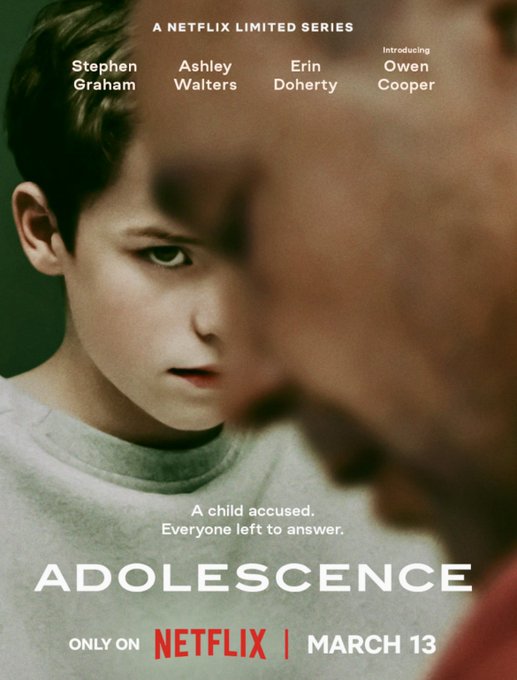
'Adolescence' is made from four perspectives — distinctly different from each other. (Image a still)
The four-part limited series about a 13-year-old murder suspect is more than gripping television — it is an urgent mirror held up to every family navigating the digital age.
By NIRENDRA DEV
New Delhi, April 5, 2026 — Let me say it plainly before anything else: Adolescence is a big hit, and everyone must watch it. It is all the more compulsory viewing for parents. It talks about the unfathomable pressures boys face — pressures that most fathers and mothers cannot see, and some will refuse to believe exist until it is far too late.
The four-part British Netflix series is an eye-opener with a path-breaking storyline. It centres on a knife murder committed by a 13-year-old boy. Four episodes. Four perspectives. One devastating truth.
Episode Four Will Break You
Perhaps because I have already crossed the teenage years of parenthood, I was most profoundly moved by the fourth and final episode. A word of fair warning: do not reach for your tissues at the midpoint of Episode Four. Save them. What unfolds is a raw, almost unbearable portrait of what happens to parents when their teenage boy is inside a prison — not as a visitor, but as a convicted killer.
The series is constructed brilliantly, told from four distinct and deliberately different vantage points: the cops, the school, the psychologist, and finally the parents — presented in reverse order of emotional proximity. By the time we reach the parents, we already know everything. And yet watching them process it is the most shattering thing of all.
What the Series Is Really About
Adolescence is a combo offer, in the best and most unsettling sense. It packages together three forces that are reshaping boyhood in the digital era: male rage, toxic masculinity, and online misogyny.
Let us define our terms, because the series itself never condescends to explain — it simply shows.
Adolescence, in its clinical sense, is the transitional period between childhood and adulthood, marked by rapid physical growth, biological change, and turbulent social and emotional development.
Toxic masculinity refers to the cluster of harmful, traditional male gender norms — dominance, aggression, emotional suppression — that damage not only men themselves but the women and communities around them.
Online misogyny is the expression of hatred or deep-seated prejudice against women, most often directed by men, amplified and normalised through social media ecosystems that reward outrage and punish softness.
It is generally accepted that misogyny is a consequence of patriarchy and male chauvinism. What Adolescence adds to that understanding is the terrifying speed with which online platforms can take an insecure, impressionable boy and accelerate that process into something murderous.
The Dialogue That Will Haunt You
The writing is extraordinary in its ordinariness. Some of the most cutting lines in the series are the most everyday: “All kids are like that these days…”
“You know, you do not know what they are watching in their room.” — the father to the mother, a line that lands like a verdict.
The father, Eddie Miller, played with devastating vulnerability by Stephen Graham, carries a guilt he cannot quite name. He asks himself and his wife: “Did I give them that?”
The mother — always sobbing, always right — says: “But I do sometimes think we should have stopped it.”
And then the quintessential male deflection: “We can’t blame ourselves.”
She counters: “But we made him, didn’t we?”
Eddie’s explanation for his own emotional shortcomings reaches back a generation: “When I was of his age… my father used to batter me. Sometimes he would take the belt at me.”
This reviewer felt the weight of that line personally. My mother did all that to my brother and me — she even wielded a bamboo-cane hockey stick in Mizoram’s Lunglei. We grew up believing the old proverb without question: spare the rod and spoil the child. That belief shaped us. It shaped our parents before us. It took years to unlearn.
The protagonist’s own resolution — “And I promised myself… when I have my own kids I will never do that” — is one of the series’ most quietly tragic moments. Eddie Miller wanted to be better than his father. He tried to be. That “spare the rod” syndrome is one of the most underexamined causes of the rupture between today’s parents and their children.
And then Eddie’s most heartbreaking line: “I just wanted to be better. But am I?”
I will not spoil any more. Watch it. Parents, sit together and watch it.
The “Manfluencer” Pipeline
What Adolescence does with rare precision is show how easily boys can be swayed by “manfluencers” — the Andrew Tates and their countless online imitators — before they are old enough to have developed the critical thinking to resist them. The series lays bare how an outwardly normal but inwardly self-loathing and susceptible youngster can be radicalised. Parents would hardly notice. They might not even be looking.
Jamie’s parents recall, after the damage is done, that he would come home from school, head straight upstairs, slam his bedroom door, and spend hours at his computer. They thought he was safe. They thought he was growing wiser. They thought they were doing the right thing.
It is a scenario that will ring bells — in Britain, in India, and in every corner of the globe.
The Numbers Behind the Fiction
This is not merely plausible drama. It is an unavoidable fact dressed in fiction. As The Guardian noted: over the past decade, the number of UK teenagers killed with a blade or sharp object has risen by 240%. On a cultural level, the crisis encompasses cyberbullying, the malign influence of social media, and the pressures faced by boys today that previous generations simply did not have to navigate at anywhere near this scale or speed.
The camera in Adolescence never leaves the action — each episode is filmed in a single continuous take, a formal choice that creates a relentless, real-time pressure. Neither can the audience look away. Nor should they.
A Word About What Comes Next
The challenge is only going to grow larger. As the world becomes more dependent on artificial intelligence, the online ecosystems that radicalise young boys will become more sophisticated, more personalised, and harder for parents to detect or understand. Adolescence is already a warning for today. It is an alarm for tomorrow.
The Verdict
Adolescence is not an easy watch. It is a necessary one. It belongs in that rare category of television that changes how you look at the people sitting across from you at the dinner table — especially if one of them is a teenage boy with a closed bedroom door and a screen you never check.
Watch it. Then talk about it. That conversation, however uncomfortable, may be the most important one your family has this year.
Women at the Centre of Crime: OTT Rewrite Female Protagonists
Follow The Raisina Hills on WhatsApp, Instagram, YouTube, Facebook, and LinkedIn




About The Author