Can West Bengal’s New Budget Revive Industry? SBI Research Sees Major Shift
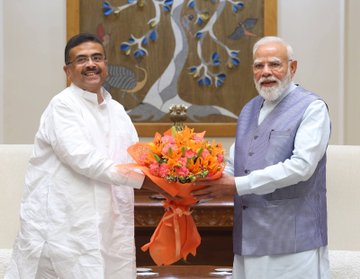
West Bengal Chief Minister Suvendu Adhikari with PM Narendra Modi. (Image Adhikari on X)
By S. JHA
SBI Research says West Bengal’s FY27 Budget marks a major shift from welfare-focused spending to investment-led growth. With higher capital expenditure, industrial revival plans, infrastructure projects and one lakh government jobs, the state is betting on long-term economic transformation.
Mumbai, June 25, 2026 — West Bengal’s FY27 Budget represents a significant strategic shift from a predominantly welfare-oriented framework toward investment-led growth, industrial revival, infrastructure development and employment generation, according to a detailed analysis released by SBI Research.
The report, titled “West Bengal FY27 Budget: A Bold Reset to Combine Social Welfare, Government Employment, Infrastructure Development and Revamping Industrialisation,” describes the state’s first full budget under the new government as a decisive attempt to balance social welfare commitments with long-term economic transformation.
The state has proposed a net budget allocation of ₹4.38 lakh crore for FY27, with capital expenditure expected to jump 42.3 percent to ₹86,306 crore. Revenue receipts are projected to rise 30.9 percent to ₹3.2 lakh crore, while the fiscal deficit is budgeted at 2.9 percent of Gross State Domestic Product (GSDP), down from 3.4 percent in FY26.
SBI Research’s analysis, which used Natural Language Processing (NLP) to compare budget speeches across administrations, found that FY27 places unprecedented emphasis on investment, governance, fiscal management, entrepreneurship, technology, tourism and climate resilience. The report noted that these themes had previously received limited attention in West Bengal’s budget discourse.
“Thematic analysis points to a decisive shift in the FY27 Budget towards investment-led growth and economic transformation,” the report said. It added that the budget signals “a transition from a predominantly redistributive policy framework towards a more capability-oriented strategy.”
Among the headline announcements are plans to fill one lakh vacant government jobs with 33 percent reservation for women, a 20 percent increase in dearness allowance for state employees and pensioners, a proposed greenfield airport in Kalyani, a deep-sea port in Purba Medinipur and a semiconductor manufacturing unit in Durgapur.
The budget also continues extensive welfare spending. The Annapurna Yojana has been allocated ₹36,000 crore to provide eligible women ₹3,000 per month, while unemployed youth are set to receive assistance under the Bhorsa Karmasathi scheme.
However, SBI Research highlighted persistent fiscal vulnerabilities. The report noted that West Bengal continues to rely heavily on central transfers, with tax devolution and grants from the Centre accounting for 56 percent of projected revenue receipts in FY27. Own non-tax revenue remains low at around 3 percent of total revenue receipts.
The study also pointed to the state’s long-standing debt challenge. West Bengal has consistently exceeded its debt-to-GSDP targets under the Fiscal Responsibility and Budget Management framework and remains one of India’s chronic revenue-deficit states. Outstanding debt stood at 38.57 percent of GSDP in FY25, well above the state’s target of 34.3 percent.
Despite these concerns, SBI Research argued that the FY27 Budget reflects a more optimistic and future-oriented development narrative, emphasizing productive capacity creation, industrialisation and infrastructure expansion alongside social welfare commitments.
Follow The Raisina Hills on WhatsApp, Instagram, YouTube, Facebook, and LinkedIn




About The Author