The Real Reason Uttarakhand’s Forests Keep Catching Fire
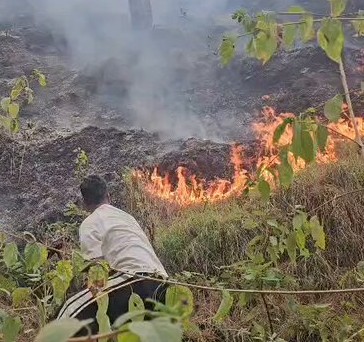
Uttarakhand’s Burning Forests Reveal a Deeper Ecological Crisis (Image The Himalayan on X)
By KUMAR VIKRAM
Uttarakhand’s forests are burning again — but the roots of the crisis go back nearly 200 years. From British-era pine plantations to climate change and collapsing local forest control, this is the deeper story behind the Himalayan fire disaster.
New Delhi, May 28, 2026 — Forest fires across Uttarakhand have damaged more than 144 hectares of land in over 220 incidents since February, triggering concern among hoteliers and tourism stakeholders. The Uttarakhand High Court is watching closely: it has been monitoring the issue since taking suo motu cognisance of forest fires in 2021, and in December 2025 requested environmentalist Ajay Rawat to assist in developing fire prevention strategies.
The numbers, when placed in historical context, are staggering. According to the Forest Survey of India (FSI), Uttarakhand recorded a 74% rise in forest fires between the 2022–23 and 2023–24 fire seasons. Satellite data recorded 21,033 fire counts from November 2023 to June 2024, compared to 5,351 during the same period the previous year. A total of 1,808.9 sq km of forest area was impacted.
The season itself is lengthening. Uttarakhand’s forest fire season, which usually starts from mid-February and goes on to mid-June, began as early as October 15 in 2020 — a creeping expansion that scientists attribute to a drying climate. Around 79% of fires in the Himalayan region occur during April and May, with April witnessing the highest frequency at 44.8%.
The Deep Past: A Colonial Crime Against the Forest
To understand why Uttarakhand burns, you must go back two centuries — to a deliberate ecological reordering carried out under the British Raj.
The region’s vulnerability to fire is caused in part by profound changes to forests that date to the 19th century and the British colonial period, when broadleaf oak forests were heavily logged by settlers and then replaced with fast-growing pine. That shift transformed northern India’s largely mixed forests into forests dominated by a single species.
The motivation was unapologetically commercial. The British were so aware of the commercial benefits of pine resin — used in turpentine oil, soap, paper, paint, and chemicals — that in the early 19th century they established a small factory unit in Kashipur, Uttarakhand. The British expanding its railway network across India in the 1850s then accelerated the destruction of Himalayan forests at industrial scale, as vast quantities of timber were felled for railway sleepers.
The British cut down oak forests and used the wood for various purposes, which provided free space for pine trees to spread easily and rapidly. Oak — known locally as banj — was the ecological anchor of the hills. The oak forests, by absorbing water gradually and releasing it slowly, had given rise to Uttarakhand’s springs, along which early villages were established. Pine’s inability to hold water began drying up those springs, intensifying both water scarcity and fire risk.
Today, more than 7,300 sq km — about 27.5% of Uttarakhand’s total forest cover — is occupied by Chir Pine forests, making them the largest segment of the state’s forest cover.
Adding to the colonial injury was the systematic erasure of community forest rights. After Independence, instead of returning control over forests to local communities, colonial trends of curtailing local rights and responsibilities continued. Today, over 80% of the total forests in Uttarakhand are under the control of the Forest or Revenue departments. Local autonomy over van panchayat forests was gradually reduced and eventually brought under the Village Forest Rules of 1927, instead of the independent Van Panchayat Act of 1931, placing Van Panchayats under control of the Forest Department. Communities who had managed these forests for generations were reduced to bystanders.
The Proximate Causes: Why Pine Burns
The Chir Pine (Pinus roxburghii) is not merely a passive bystander in the fires. It is structurally and ecologically a fire engine.
Chir pine forests are the most susceptible to forest fires, followed by dry deciduous scrub. This is due to the high availability of surface fuel in the form of dry needles, high temperature, and high char content. The needles — called pirul locally — carpet the forest floor in a thick, oil-rich layer that ignites easily and burns long.
The proliferation of highly flammable species like Chir Pine, which are prone to crown fires and create dense, uniform stands, increases the risk of catastrophic wildfires. The introduction of non-native plant species such as Lantana camara and Eucalyptus, as well as changes in land-use patterns including deforestation and monoculture plantations, have altered the composition and structure of Uttarakhand’s forests.
Ironically, pine thrives on fire. Pine itself is resistant to fire and these fires help in its regeneration by reducing coverage of broad-leaf trees, leading to an increase in the land covered by Chir Pine. It is, as The Tribune put it, “a vicious cycle” — pine needles catch fire easily, but because of its thick bark, the Chir tree is resilient against ground fires and grows better in the aftermath.
Meanwhile, climate change is tipping the balance further. Pine adapts well to the lack of moisture and thrives in dry conditions, which have been increasing in the Himalayan region. Unlike oak, its thin, needle-shaped leaves have less surface area and the tree loses less water. One study observed a substantial reduction of banj oak forest habitats in the Western Himalayas between 1991 and 2017, while pine forests expanded considerably.
The Human Hand
While the forest’s structure makes it combustible, according to the Forest Research Institute (FRI), 95% of forest fires in Uttarakhand are attributed to human activities. Common human-induced causes include grazers setting fire to dry grass, slash-and-burn agriculture, unattended campfires, and intentional arson.
Much of this is driven by survival economics. Evidence suggests that pre-monsoon burning results in a better flush of grass in the coming season. In a fodder-deficit region, it is difficult to maintain livestock, which has been an integral part of rural households for centuries. Uttarakhand is perhaps the only region in the world where women still have to climb trees for livestock fodder.
There is also an indirect mechanism: the blanket of pirul prevents the regeneration of grass, hampering the fodder supply for domestic animals. To get rid of this blanket and clear the ground for fresh grass growth, some locals set the pine needles ablaze — and unless this is in a controlled environment, it can give rise to forest fires of grand proportions.
State capacity has also been weak. India’s National Disaster Management Authority does not even recognise forest fires as natural hazards — a policy blindspot that has long hampered preparedness funding and response infrastructure.
The Catastrophic Benchmark: 2016
No discussion of Uttarakhand’s fires is complete without 2016, which set the modern benchmark for disaster. Forest fires surged 30% in 2016 — 20,667 incidents versus 15,937 in 2015. Some 4,433 hectares of land were ravaged. On April 26 alone, fires were reported from 1,200 places, forcing the deployment of two Indian Air Force Mi-17 helicopters.
An unprecedented wildfire in Uttarakhand in 2016 burnt 2,166 sq km within and outside the forest area — a scale that shocked scientists and administrators alike, and prompted the High Court monitoring that continues today.
The scale of the damage goes beyond land. According to the European Union’s Copernicus Atmospheric Monitoring Service (CAMS), the Uttarakhand forest fires emitted 0.2 megatons of carbon in just one month, the highest since 2003. Soot from the fires has also made its way to the high Arctic, sometimes in less than a week.
The Future: A Longer, Fiercer Fire Season
Science offers little comfort for what is coming.
A landmark study published in Communications Earth & Environment (Nature) modelled the impact of climate change on India’s forests. Days with severe fire weather danger will increase by up to 60% in dry forests. The fire season will be longer by 3–61 days across the country, and the pre-monsoon fire season will become more intense over 55% of forests.
Research published in the Journal of Earth System Science adds a crucial meteorological finding: reduced relative humidity markedly amplifies fire spread and further raises temperatures and vapour pressure deficit, highlighting the dominant role of relative humidity over temperature in fire dynamics. As the Himalayas dry out — a well-documented trend — this is precisely the condition that will prevail more often.
The predictions made through the IPCC’s AR6 and the heatwaves in Delhi give a fair indication of the future. Practices and policies need to be revised, the future strategy rewritten, and past mistakes corrected. Otherwise, these forests will continue to burn, possibly at larger intensities in the future.
What Can Be Done
There is no silver bullet, but the outlines of a solution are visible.
Faced with the growing intensity and spread of forest fires in recent years, the Uttarakhand forest department overhauled its preparedness strategy ahead of the 2025 fire season. The approach now combines advanced technology with deeper engagement of village communities and local institutions — aiming to make forest fire prevention a truly collective responsibility.
Community mobilisation is showing results. In May 2025, Chief Minister Pushkar Singh Dhami praised the role of Mahila and Yuva Mangal Dals, noting that in times of disaster, these groups act as first responders in villages, and announced a loan assistance policy to help make these groups self-reliant.
The deeper structural fix, however, requires confronting the colonial legacy head-on. Uttarakhand’s forest fires are a case study in the impacts of environmental colonialism and monoculture plantations. We can solve the problem only once we have rid ourselves of the western notion of forest management premised upon exploiting indigenous people. We need to give the forest back to its original inhabitants.
That means restoring oak where pine has taken over, incentivising communities to manage the forest floor, and finally — after nearly two centuries — treating the hill forests not as revenue extraction opportunities but as the living infrastructure that they are.
(Sources: Forest Research Institute (FRI); Forest Survey of India (FSI); India State of Forest Report 2021; Frontiers in Forests and Global Change; Nature Communications Earth & Environment; Journal of Earth System Science; National Geographic; Carbon Copy; Down to Earth / Earth Journalism Network; The Tribune; India Water Portal; The Bastion.)
Follow The Raisina Hills on WhatsApp, Instagram, YouTube, Facebook, and LinkedIn




About The Author