The Deal That Could Reset India’s Energy Future — If It Holds
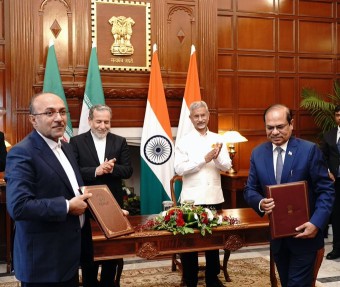
EAM S Jaishankar with Iran's FM Seyed Araghchi (Image credit MEA, X)
By S. JHA
US-Iran Deal 2026: What It Means for India’s Energy Security
Mumbai, June 15, 2026 — For three and a half months, the Strait of Hormuz — the narrow chokepoint through which roughly 20% of the world’s crude oil and LNG flows — was effectively closed. For India, a country that imports over 80% of its oil and draws nearly half its LNG from the Gulf, it was less a geopolitical drama than a domestic crisis.
Cooking gas prices spiked. Fertiliser plants ran at capped capacity. The average price of India’s crude basket surged from $69 a barrel in February 2026 to $113 in March, according to Rystad Energy senior vice president Pankaj Srivastava. Now, with the US and Iran agreeing to end the conflict and reopen the Strait, New Delhi is exhaling — cautiously.
The agreement, announced by US President Trump on June 14 with his characteristic theatrics (“Ships of the World, start your engines. Let the oil flow!”), includes Iran’s recommitment to not pursuing nuclear weapons and the lifting of the US naval blockade on Iranian ports, with formal nuclear talks to follow within 60 days. Pakistan, a key mediator, says the signing will take place in Switzerland this Friday.
For India, the immediate relief is real. The Strait closure had exposed, with brutal clarity, the fragility of New Delhi’s energy supply chains. As Business Standard noted in late May, the West Asia crisis “has exacerbated a different kind of shortage in the world’s most populous nation — of capital and ideas.” Oil was only the most visible wound.
But the deal also forces India to confront a more complicated strategic question: where does this leave it?
The last three months were strategically awkward for New Delhi. India had tilted toward Washington under pressure — cutting Russian oil imports and signing a framework trade deal that included commitments to diversify away from Moscow’s crude. Then the war broke out and disrupted the very Gulf supplies India had pivoted toward. In desperation, India resumed Iranian oil purchases after a seven-year hiatus, and Russian imports climbed back to 1.9 million barrels per day by late March, according to shipping analytics firm Kpler.
The Iran deal, if it holds, restores India’s room to manoeuvre. Tehran had already signalled its goodwill during the conflict, with Iranian Foreign Minister Abbas Araghchi confirming that India, China and Russia were permitted Strait access even as Western-linked ships were blocked, according to All India Radio’s news service. That preferential treatment was not charity — it reflected Iran’s recognition of India as a non-hostile partner. New Delhi, for its part, had quietly maintained the Chabahar Port project as a thread of connection to Tehran, even as US sanctions waivers for the port expired in April 2026.
The reopening of the Strait and the prospect of sanctions relief for Iran reopens another tantalising possibility: cheaper Iranian crude, direct again, without the sanctions-era discount deals through intermediaries. Before 2019, Iran was India’s third-largest oil supplier.
Yet Business Standard’s caution bears repeating: the deal “will only bring short-term relief.” India’s deeper problem — chronic underinvestment in energy alternatives, a ballooning import bill, and vulnerability to any future Gulf disruption — will not be resolved by this agreement. Nor will the geopolitical tightrope: India must balance its deepening partnership with Washington against its historic ties with Tehran, its dependence on Russian oil, and its ambitions in Central Asia via Chabahar.
Follow The Raisina Hills on WhatsApp, Instagram, YouTube, Facebook, and LinkedIn




About The Author