What’s in that packet? India needs food label literacy
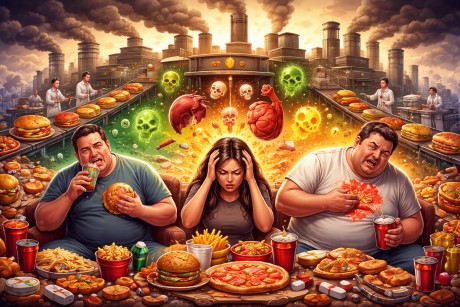
A representative image of processed food industries.
We are feeding our children a slow poison — and the ingredients are right there on the label, if only we knew how to read them
By Dr Rekha Harish
New Delhi, March 27, 2026 — Walk down any supermarket aisle in India today and you will find something that did not exist a generation ago: an overwhelming abundance of products that look like food, smell like food, and are engineered to taste better than food — but are, in the truest sense, industrial formulations dressed up in attractive packaging.
We call them ultra-processed foods. And we are consuming them at a rate that should alarm every public health professional in this country.
Between 2011 and 2021, retail sales of ultra-processed foods in India grew at a compound annual rate of 13.37 per cent. Per-capita sales increased more than fifty-fold in a single decade. This is not a gradual dietary shift — it is a nutritional avalanche. And it is happening precisely as India battles a cruel double burden: undernutrition on one side, rising obesity and non-communicable diseases on the other.
I have spent years in clinical practice watching this unfold. The patients are getting younger. The diagnoses — Type 2 diabetes, hypertension, dyslipidaemia, fatty liver — are arriving earlier. And when I ask families what they are eating, the answer increasingly involves packets, not kitchens.
The processing is the problem
We have long been told that nutrition is about nutrients — count your calories, watch your fat, limit your sugar. That framing, while not wrong, is incomplete.
A landmark randomised controlled trial by the US National Institutes of Health demonstrated something that should have changed the conversation permanently. Participants consuming ultra-processed foods consumed approximately 500 additional kilocalories per day, gained nearly a kilogram of body weight in just two weeks, and showed early adverse metabolic changes — even when the protein content of their diet was matched to those eating minimally processed food.
The degree of processing, independent of nutrient composition, affects health. The food matrix matters. What has been done to the food matters.
Ultra-processed foods, as defined by the NOVA classification, are not simply foods with added salt or sugar. They are industrial formulations — products made largely from substances extracted or synthesised in factories, containing ingredients you would never find in a home kitchen: high-fructose corn syrup, hydrogenated or esterified oils, hydrolysed proteins, and a long parade of additives serving as colours, flavour enhancers, emulsifiers, sweeteners, and foaming agents.
Several of these additives are now recognised as endocrine-disrupting chemicals. In children — whose metabolic and hormonal systems are still developing, and who consume more of these products per kilogram of body weight than adults — the implications for growth, immunity, neurodevelopment, and long-term cardiometabolic health are deeply concerning.
And yet we keep buying. Often because we do not know what we are buying.
The label is there. We just cannot read it.
India’s food labelling regulations, governed by the Food Safety and Standards Authority of India, are not absent. They exist. Food labels are legally mandated. But a regulation on paper and a regulation that meaningfully informs a consumer’s purchase decision are very different things.
Back-of-pack labels carry detailed nutritional information — but in fonts so small, with contrast so poor, and in language so technical that most consumers, including educated ones, cannot use them at the point of decision. Front-of-pack labels, where they exist, are often dominated by marketing claims rather than health information.
The ICMR–NIN Dietary Guidelines 2024 have given us clear thresholds for what constitutes a high-fat, high-sugar, high-salt — or HFSS — food. Total fat exceeding 30 per cent of total energy. Saturated fat above 5 per cent. Salt above 5 grams per day. Free sugars above 5 per cent of total energy. These are not abstract numbers. They are the line between a food that nourishes and one that, consumed routinely, harms.
But how many consumers know these thresholds? How many, standing in a shop with a packet in hand, can apply them?
This is where food label literacy becomes not merely a consumer skill, but a public health imperative.
What you must look for — every time
Let me be practical. Here is what I tell every patient, every parent, every family:
Start with the serving size. Manufacturers are permitted to define serving sizes, and they frequently define them unrealistically small — so that a product appears lower in calories, sugar, or sodium than it actually is for the quantity a normal person would consume. Always calculate what you are actually eating.
Never trust the tagline. “Diet.” “Light.” “Baked.” “Natural.” “Multigrain.” None of these terms are legally defined in ways that guarantee healthfulness. They are marketing words. Read the nutrition panel, not the front of the pack.
Look at the ingredient list and identify the first three ingredients — they typically constitute more than 70 per cent of the product. If sugar, refined flour, or a form of hydrogenated fat appears among them, you know what you are really holding.
Watch for sugar in disguise. Added sugars appear under at least a dozen names: sucrose, glucose, dextrose, malt syrup, fruit juice concentrate, honey. They are often listed separately, precisely to prevent any single form from appearing near the top of the ingredient list.
Check sodium, not just salt. Sodium hides in sweet foods too — in baking soda, in monosodium glutamate, in preservatives. The recommended limit is under 2 grams of sodium per day. Many single-serving packaged snacks breach it.
And look at the INS numbers — the codes for food additives. A product with fifteen additives listed as INS codes is telling you something important about how far it has travelled from anything resembling real food. Most of these are permitted within limits — but cumulative, daily, lifelong exposure, especially in children, is a question our regulatory science has not yet fully answered.
San Francisco vs Big Food: Lawsuit That May Blow Open Scandal
What India urgently needs
Globally, the evidence for interpretive front-of-pack warning labels is now strong and consistent. Chile introduced mandatory octagonal warning labels in 2016. Mexico, Brazil, Colombia, and Israel followed. The results — reduced purchase of labelled products, reformulation by manufacturers, and measurable shifts in consumption patterns — have been documented.
These warning symbols work precisely because they transcend language and literacy. A child who cannot read can understand a stop-sign-shaped warning. A first-generation urban consumer who has never studied nutrition can look at a label and know, instantly, that what they are holding is high in sugar.
India has not yet adopted a mandatory, strong warning-label system. The debate has been running for years — stalled, delayed, diluted by industry resistance. Meanwhile, the epidemiological clock keeps ticking.
I am not arguing against industry. I am arguing for transparency. If a product is high in sugar, the label should say so — clearly, prominently, in a form that requires no calculation. That is not an attack on business. It is the minimum that consumers in a democratic republic deserve.
Nature does not advertise
I will end with something I say often in my clinical practice, because I find it clarifying.
Nature does not advertise. A tomato does not come with a tagline. Dal does not have a mascot. The foods that have sustained Indian families across generations — the dal-chawal, the sabzi, the roti made at home — carry no packaging, no health claims, and no INS numbers.
The healthiest dietary pattern is also, in many ways, the simplest one: minimally processed, home-cooked, varied, and rooted in the agricultural traditions of this land.
Food label literacy is not a counsel to abandon all packaged foods forever. It is a tool — a means of navigating a food environment that has been deliberately engineered to bypass our better judgment. When we know what to look for, we can make genuinely informed choices. We can push back against misinformation disguised as marketing. We can protect our children.
India is already dealing with an NCD epidemic that will define the health burden of the next generation. We cannot afford to wait for the perfect policy before we start educating people. The label is on the packet. Let us learn to read it.
(Dr Rekha Harish is a public health physician and nutrition advocate. She has served as head of the department of paediatrics, HIMSR, New Delhi.)
Follow The Raisina Hills on WhatsApp, Instagram, YouTube, Facebook, and LinkedIn




About The Author