A Question About Costs Became a Masterclass in Trump’s Political Messaging
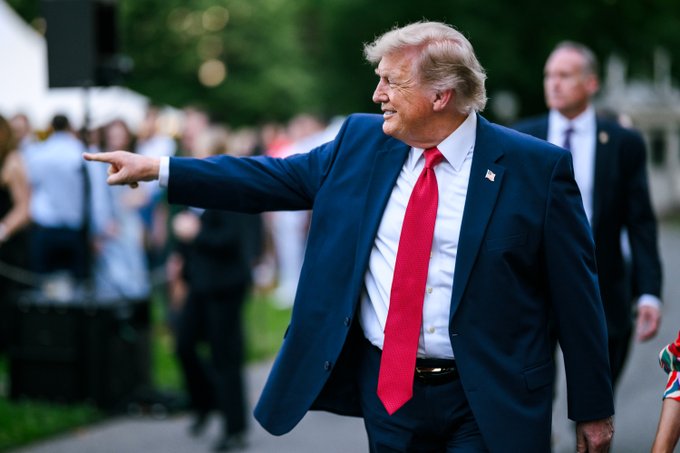
U.S. President Donald Trump speaking during a public address. (Image White House)
By TRH World Desk
A question about a Washington restoration project quickly became a broader argument about government waste, crime, immigration, and why Trump believes voters should compare his record with those of Obama and Biden.
New Delhi, June 23, 2026 — US President Donald Trump’s response to questions about the cost of restoring the Lincoln Memorial Reflecting Pool was about far more than a construction project. What emerged was a familiar political formula that has defined much of Trump’s public messaging: contrast his administration’s performance against that of his predecessors, attack the media, and present himself as a leader capable of delivering results faster and cheaper than the government establishment.
The exchange began with a straightforward question. A CBS reporter noted that Trump had initially suggested the project could be completed quickly and relatively inexpensively, but that costs had reportedly climbed to around $16.5 million over two months. Rather than focus on the specifics of the project, Trump immediately broadened the discussion.
His first move was to shift the comparison. Instead of defending the increase from the original estimate, Trump pointed to previous restoration efforts under Barack Obama and Joe Biden, claiming they had spent more than $100 million without successfully reopening the facility. This is a classic political tactic: move the debate away from whether a promise was fully met and toward whether opponents performed worse.
The second element of Trump’s strategy was to portray government bureaucracy as the problem and himself as the solution. He argued that officials had contemplated spending hundreds of millions of dollars and taking years to complete the work, whereas his administration delivered results in a matter of weeks. Whether or not every figure cited withstands scrutiny, the political message is clear: Trump wants voters to associate him with speed, efficiency, and decisive action.
A third feature of the response was the familiar attack on the media. Trump accused journalists of ignoring failures under previous administrations while focusing disproportionately on his own projects. This narrative has remained central to his political brand, reinforcing his long-standing argument that mainstream media organizations apply different standards to him than to his political rivals.
Perhaps most strikingly, Trump transformed a local infrastructure question into a broader discussion about crime, immigration, and urban governance. By the end of the answer, he was talking about crime rates in Memphis and New Orleans, immigration under Biden, and how he would tackle violence in Chicago. This reflects another hallmark of Trump’s communication style: almost every issue becomes an opportunity to return to the themes that energize his political base.
The Reflecting Pool itself may not be a major national issue. Yet Trump’s handling of the question offers insight into how he intends to frame his presidency. Rather than defending costs line by line, he is asking voters to judge him through a broader lens: Did he act faster? Did he spend less than previous administrations? Did he get results?
For supporters, the answer is likely yes. For critics, the claims invite fact-checking and scrutiny. But politically, Trump’s objective is not simply to win an argument about a pool in Washington. It is to reinforce a larger narrative that has powered his rise in American politics: government elites waste money, the media protects them, and he alone can cut through the inefficiency.
Follow The Raisina Hills on WhatsApp, Instagram, YouTube, Facebook, and LinkedIn




About The Author