‘The Living Declaration’ Traces 250 Years of Arguing Over Four Sentences
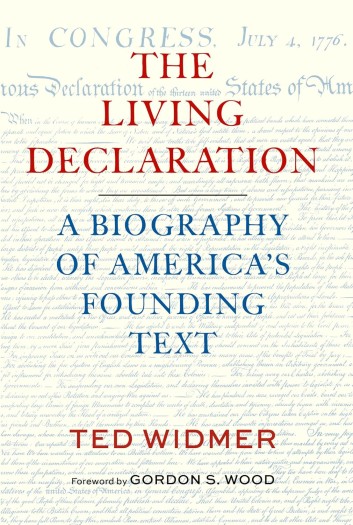
‘The Living Declaration’ Traces 250 Years of Arguing Over Four Sentences (Image book cover)
By TRH Book Desk
The Living Declaration: A Biography of America’s Founding Text By Ted Widmer, Foreword by Gordon S. Wood
Library of America, 393 pages, $29.95, Published June 23, 2026
A Biography of a Sentence, Not a Man
Most biographies follow a life from birth to death. Ted Widmer’s “The Living Declaration” does something stranger: it follows a document — really, a handful of its most famous phrases — from a hot Philadelphia summer in 1776 through two and a half centuries of people trying to claim it, weaponize it, live up to it, or tear it down.
Published to coincide with America’s 250th anniversary, the book is both a scholarly study and a commemoration of the Declaration of Independence, guiding readers through decades of the debates and demands the document has provoked.
The premise is disarmingly simple: rather than write a conventional history of the Declaration, Widmer lets the country’s response to it tell the story.
Structurally, this makes “The Living Declaration” closer to an anthology with a very opinionated table of contents than a traditional narrative history. The book weaves together more than sixty original texts, tracing how the words of Americans across generations — radicals and conservatives, revolutionary insurgents and civil rights leaders, presidents and philosophers — reveal why the founding document’s ideas have proven so durable.
The through-line isn’t Widmer’s voice so much as a curated argument that has been running, in public, since the ink dried.
Widmer as Curator, Not Narrator
That structural choice is the book’s most defining feature, and reviewers have noticed it functions almost as a limitation by design. One review observed that Widmer plays a comparatively minor role in his own book, since the bulk of it consists of historical speeches, essays, and declarations, with Widmer’s job largely reduced to supplying the context or sentiment behind each selected text.
That’s not necessarily a flaw — a lighter directorial hand lets Frederick Douglass, Elizabeth Cady Stanton, and Abraham Lincoln argue with each other across a century without an author’s thumb visibly on the scale. But it does mean readers hoping for a single sustained authorial argument, in the mode of a traditional monograph, will instead get something closer to a moderated debate stage.
The cast Widmer assembles for that debate is genuinely wide-ranging. Beyond the expected figures, the selections pull in voices as varied as the English Parliament, Haitian revolutionaries, Seneca Falls delegates, the Black Panther Party, and the United Nations — a list that treats the Declaration less as an American artifact than as a template borrowed and contested around the world.
That global reach is one of the book’s more persuasive moves: it makes the case, through accumulation rather than argument, that a document written to justify one rebellion became a template that other movements kept reaching for.
‘The Shampoo Effect’ by Jenny Jackson Is the Summer’s Buzziest Beach Read
Where the Book Earns Its Title
The most compelling material sits exactly where the title promises: the moments when the Declaration stopped being settled scripture and became contested ground. Widmer gives real space to the internal contradictions built into the founding text from the start.
He includes searing challenges to the Declaration’s philosophical claims from Frederick Douglass and Elizabeth Cady Stanton, alongside radically divergent readings of the document that helped drive the country toward civil war, culminating in Lincoln’s vision of a “new birth of freedom.”
Placed side by side, these selections do more to explain the Declaration’s staying power than any single essay could — the document endures precisely because it has been useful to people arguing opposite conclusions from the same eleven words about equality.
Widmer also has an eye for the odder corners of the historical record, which keep the book from feeling like a civics-class syllabus. Among the more unexpected inclusions is Noah Webster’s own surprising definition of “equality,” alongside the story of a fake declaration of independence supposedly “discovered” in Mecklenburg, North Carolina, in 1819.
Details like these are what separate a genuinely curious historian from a dutiful one, and they’re where Widmer’s editorial hand feels most alive.
A Fair Note of Caution
Not every choice lands cleanly, and at least one reviewer flagged a specific instance where Widmer’s framing tipped from context into interpretation. That review took issue with how Widmer characterized the reasons behind the Texas Revolution and its own declaration of independence from Mexico, calling it a misrepresentation, and noted that the document in question closely mirrors the structure of America’s own.
It’s a narrow complaint against a 393-page book built almost entirely from primary sources, but it’s a useful reminder that even a lightly-narrated anthology still makes interpretive choices in what it selects and how it’s introduced — choices a careful reader should weigh rather than take as neutral curation.
Timing Is Part of the Argument
It’s worth noting that this book didn’t arrive by accident. The Library of America’s decision to publish “The Living Declaration” for the nation’s 250th birthday was a deliberate one, made all the more resonant by the fractious state of the country’s current political debates.
Widmer seems aware of the parallel and leans into it rather than away from it; the book reads less like a nostalgia project than an argument that the Declaration’s history of being contested is precisely what makes it durable, not fragile.
That argument is stated most directly in the book’s closing pages. Widmer ends by expressing hope that the Declaration can once again unite a fractious people, noting that history offers some encouragement for that possibility.
Whether readers find that hopeful or naïve will likely depend on what they brought to the book in the first place — which, fittingly, is more or less the argument the book has just spent 390 pages making about the Declaration itself.
The Right Kind of Book
“The Living Declaration” isn’t a page-turner in the conventional sense, and readers looking for a single, propulsive argument about what the Declaration “really means” will need to supply more of that themselves than the format allows.
What it offers instead is rarer: a genuinely representative sample of how the document has actually been used, by people who agreed on almost nothing except that the text was worth fighting over.
For the 250th anniversary of the Declaration of Independence, that feels like the right kind of book — less a monument than a transcript of an argument that, by design, was never meant to end.
Recommended for: readers of American history, civics educators, and anyone who wants primary-source ammunition for (or against) the idea that the founding generation’s ideals still mean something today.
‘The Idea of China’: Xu Guoqi’s New History Asks Who Gets to Define Chineseness
Follow The Raisina Hills on WhatsApp, Instagram, YouTube, Facebook, and LinkedIn




About The Author