Grief and Redemption: Reviewing The Little Book of Goodbyes
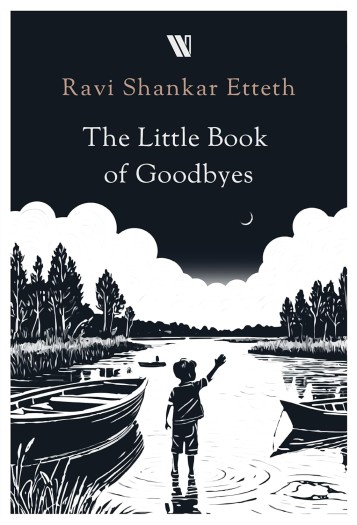
Cover image of The Little Book of Goodbyes (Image Amazon)
Blending memoir, history and fiction, Ravi Shankar Etteth explores grief, guilt and emotional survival in a deeply reflective and quietly powerful narrative.
By AMIT KUMAR
New Delhi, March 28, 2026 — In The Little Book of Goodbyes, Ravi Shankar Etteth crafts a deeply personal, quietly unsettling meditation on loss, memory, and the many ways in which human beings learn to let go—often imperfectly, and almost never completely. This is not a conventional memoir, nor is it strictly a collection of short stories. Instead, it exists in a fluid space between autobiography and reflective fiction, where lived experience merges seamlessly with narrative imagination.
The emotional core of the book is established early, with the author recounting the deaths of his parents during profoundly different circumstances—one in a pre-pandemic hospital setting, and the other during the isolating constraints of the COVID-19 lockdown. The contrast is telling: one death is shared, witnessed, fought against; the other is distant, mediated through a flickering phone screen. This duality sets the tone for the entire book—goodbyes are not singular events but layered experiences shaped by guilt, regret, love, and the passage of time.
Etteth’s strength lies in his ability to universalize deeply personal grief without diluting its specificity. His prose is intimate but never indulgent. He avoids melodrama, choosing instead a restrained, almost conversational tone that makes the emotional weight of his reflections more powerful. When he writes about not being able to look at his mother’s body directly, or about the lingering regret of not being present at his father’s final moments, the impact is subtle yet piercing.
The book is structured as a series of interconnected narratives, many of which revolve around family history. One of the most compelling strands involves the author’s grandfather, a commanding officer in the Malabar Special Police during the turbulent period of the Moplah rebellion. These episodes are rich in detail and carry a cinematic quality, blending colonial history with personal mythology. The figure of Fang, the loyal dog who ultimately sacrifices his life, becomes a recurring symbol of devotion and continuity—a bridge between past and present, memory and myth.
Animals, in fact, occupy a significant emotional space in the book. The story of Bosky, a beloved pet who dies saving the author from an oncoming car, mirrors the earlier tale of Fang, reinforcing the idea that love transcends time and form. Etteth suggests, without overt sentimentality, that certain bonds—especially those rooted in loyalty and instinct—defy the finality of death. This belief in emotional continuity gives the book a quiet philosophical depth.
Book on Vijay Raman, Pan Singh Tomar encounter fame, unveiled
Another standout thread is the enigmatic character of Ramaswamy, a man with a hidden past who moves between roles—caretaker, healer, confidant—with quiet dignity. His story unfolds gradually, revealing layers of guilt, sacrifice, and unresolved longing. Through him, Etteth explores themes of identity and redemption, raising questions about whether it is ever truly possible to escape one’s past. The narrative surrounding Ramaswamy also serves as a subtle critique of social hierarchies and moral hypocrisies, particularly in moments involving caste, religion, and gendered violence.
What makes The Little Book of Goodbyes particularly resonant is its refusal to offer easy answers. Etteth does not attempt to resolve the tensions he presents—between guilt and justification, love and abandonment, memory and forgetting. Instead, he embraces ambiguity. Goodbyes, he suggests, are not acts of closure but processes of transformation. They change us, often in ways we do not immediately understand.
Stylistically, the book is marked by its clarity and economy. Etteth’s background as a journalist is evident in his precise language and sharp observational detail. Yet there is also a lyrical quality to his writing, especially in passages that dwell on landscapes—Kerala’s lush countryside, moonlit roads, or the quiet interiors of memory. These descriptions are never ornamental; they serve to ground the emotional narrative in a tangible world.
However, the book is not without its limitations. At times, the episodic structure can feel uneven, with certain narratives more fully developed than others. Some transitions between personal reflection and historical anecdote are abrupt, potentially disorienting readers who prefer a more linear progression. Additionally, the introspective tone, while effective, may feel overly subdued for those seeking dramatic tension or narrative momentum.
Yet these are minor quibbles in an otherwise deeply affecting work. The book’s greatest achievement lies in its honesty. Etteth does not position himself as a moral authority; he is, instead, a witness—to his own life, to the lives of those around him, and to the inevitability of loss. His reflections are marked by a humility that invites readers to confront their own experiences of goodbye.
In the end, The Little Book of Goodbyes is less about endings and more about what persists after them. It reminds us that while we may part with people, places, and versions of ourselves, the emotional imprints of those connections remain. As Etteth suggests, a goodbye does not diminish us—it reshapes us, often making us stronger in ways we only come to understand much later.
This is a quiet, contemplative book that lingers long after it is finished—a testament to the enduring complexity of human attachment and the fragile, beautiful art of letting go.
New Book Tracks China’s ‘Total War’ amid Fentanyl, COVID Deaths
Follow The Raisina Hills on WhatsApp, Instagram, YouTube, Facebook, and LinkedIn




About The Author