The Handshake Deal: Big Headlines, Small Print, Bigger Stakes
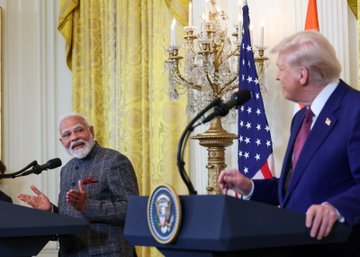
US President Donald Trump with PM Narendra Modi Image credit MEA
Why Trump’s India Trade Deal Is Less About Tariffs—and More About Quiet Clauses That Could Reshape Policy
By P. SESH KUMAR
New Delhi, February 3, 2026 — US President Donald Trump has announced (as is his wont, on social media) a “trade deal” with India, and Prime Minister Modi has responded in a notably guarded, statesmanlike tone. That contrast itself is a clue: one side is selling a victory lap, the other is reserving the right to read the fine print with a magnifying glass.
What we know so far is directionally clear—US tariffs on Indian goods are said to fall to about 18%, a punitive layer is said to be scrapped, and India is said to stop buying Russian oil while expanding purchases of US goods (figures as high as $500 billion are being floated).
What we do not know—yet—is the real “beyond-tariffs” bargain: agriculture quotas, GMO language, IPR “modernisation,” digital trade lock-ins (especially a permanent moratorium on customs duties on electronic transmissions), and government procurement access. Those are the quiet clauses that can outlive the loud handshake.
Let me attempt an uncomplicated and as simple an explanation as possible on the development and potential implications-short and long-term for us.
What’s actually been announced-and what’s still theatre
The public core, across credible reporting, is broadly this: the US moves India’s tariff line to around 18%, and a separate punitive tariff linked to Russian oil purchases is reportedly removed; in return, India reportedly commits to ending Russian oil purchases and to greater purchases of US goods.
Even here, the most important administrative detail is missing: the “deal” still needs to show up in the real world-notifications, tariff schedules, legal texts, and implementing timelines. Reuters explicitly notes that official detail is sparse and that formalisation steps are still awaited. In trade, a tweet is an appetite; the legal text is the meal.
Now, to a crucial point: if this deal truly “goes beyond tariffs,” the real negotiation is likely sitting in five pressure-points-each capable of turning a celebratory headline into a domestic policy headache.
- Quotas for corn, cotton, soybeans: the “farm math” that can break politics
If India is offering the US meaningful market access in corn, cotton and soybeans, the shape matters more than the slogan.
If it is a tariff-rate quota (TRQ)-low duty up to a fixed volume, high duty beyond-then the size of that quota is the whole story. A small quota is a diplomatic gesture; a large quota is a structural shift that immediately runs into India’s domestic farm economics and political sensitivities. And the most combustible detail: whether the quota quietly assumes US export realities-where major volumes of corn and soy are genetically modified-while India’s regulatory and political ecosystem remains deeply cautious. Reuters has already highlighted corn and soybeans as central flashpoints in the run-up to a deal, precisely because agriculture is where “trade” collides with livelihoods.
There is a second-order effect that rarely makes the headlines: quotas can become a “policy wedge.” Start with ethanol blending (import corn for fuel), then expand to animal feed, then suddenly the debate is no longer about volumes but about standards, labelling, traceability, and state-level enforcement. Our farm story is federal, emotional, and election-adjacent. A quota that looks “technical” in Washington can look “existential” in rural India.
What to watch for in the text: whether quotas are annual or multi-year; whether there is an automatic expansion clause; whether India retains safeguard triggers; and whether the quota is paired with language on standards that effectively pre-decides the GMO debate.
- Commitment on GMOs: the quiet clause with a loud aftertaste
International trade experts say that this is where trade negotiators become philosophers-because the fight is not only about science, but also about trust.
We have historically maintained tight restrictions on genetically modified food imports, and policy debates around GM crops have been politically sensitive. Analytical discussions on India’s agricultural trade note that some large US exports like GM soybeans and corn face strict restrictions in India.
So if the new deal includes any wording that resembles “science-based approvals,” “equivalence,” “streamlined SPS (sanitary and phytosanitary) procedures,” or—most telling— “time-bound decisions,” it could be interpreted as a backdoor commitment to faster approvals for GM consignments or GM-derived products.
And here’s the comedic tragedy: in trade texts, the word “streamline” often means “argue faster.” If we concede timelines without building domestic consensus and regulatory capacity, it risks importing not just corn-but controversy.
What a balanced approach would look like: explicit carve-outs preserving India’s regulatory autonomy, strong labelling and traceability, and a phased approach linked to domestic scientific review and public transparency. If the deal is silent on these safeguards, experts say that silence is not golden-it is suspicious.
India at a Crossroads As Global Moment Faces Tariffs Turmoil and Strategic Contradictions
- Weakening of IPR laws: the “modernisation” that sometimes modernises only somebody else’s profits
In many US trade templates, “stronger IPR” can mean TRIPS-plus commitments-longer terms, tighter patentability interpretations, data exclusivity, patent linkage, harsher enforcement provisions, and constraints on compulsory licensing flexibility.
Our IPR framework is not an accident; it is a policy choice shaped by public health needs, domestic innovation goals, and access-to-medicines considerations. Recent debate around our other trade negotiations shows that “stronger IP protections” can quickly become a contested political flashpoint, with advocacy groups warning against weakening local patent rules.
If this US–India deal tries to slip IPR changes into a “trade facilitation” wrapper, the biggest risk is policy irreversibility. Tariffs can be raised later; a rewritten patent ecosystem is much harder to unwind.
What to watch for in the text: commitments on pharmaceuticals (data exclusivity, patent linkage), digital copyright enforcement, damages provisions, and any “regulatory coherence” language that effectively requires us to harmonise with US-style standards.
- Digital commitments: the permanent moratorium trap disguised as “free trade”
The most under-appreciated line item, according to many trade experts is the “permanent moratorium on customs duties on electronic transmissions.”
At the multilateral level, the WTO has long hosted a moratorium discussion under its e-commerce work programme. The moratorium—renewed periodically—has been contentious, especially for developing countries concerned about revenue loss and policy space.
We, in particular, have repeatedly voiced concern about making such a moratorium permanent, arguing it constrains sovereign rights and potential revenues as more goods “go digital.” Contemporary policy commentary in India has noted the moratorium’s looming decision points and the broader sovereignty/revenue debate.
If we lock ourselves into a permanent commitment bilaterally, it effectively pre-commits our future negotiating position at the WTO—right when the world is rethinking how to tax value created through cross-border digital flows.
And here’s the irony: we can build world-class digital public infrastructure, export digital services, and still sensibly argue for fiscal policy space. A permanent moratorium is not “pro-digital.” It is “anti-optionality.”
What to watch for in the text: “permanent,” “binding,” “no customs duties on electronic transmissions,” plus adjacent clauses on cross-border data flows, source-code disclosure bans, and limits on domestic digital regulation.
- Government procurement: the moment trade knocks on the state’s front door
Government procurement is where trade agreements stop being about “exports” and start being about how the Indian state buys from infrastructure to IT systems to defence-adjacent supply chains.
The global reference point is the WTO Agreement on Government Procurement (GPA)-a plurilateral agreement that not all WTO members join. The US actively encourages participation; India has historically been outside full membership (often discussed as an observer historically), precisely because opening procurement can collide with domestic policy aims like MSME preference, Make-in-India goals, and strategic autonomy.
If the US-India deal includes procurement commitments, the key question is: are we talking about transparency norms (which are generally good), or market access rights (which are politically explosive)? Procurement chapters can include non-discrimination, bid challenge mechanisms, and coverage schedules listing which ministries/PSUs/sectors are opened. That schedule-again-is the real story.
What to watch for in the text: whether procurement commitments apply to central government only or also to states/PSUs; whether MSME/set-aside preferences are carved out; whether defence/railways/strategic sectors are excluded; and whether dispute-style remedies are imported into India’s procurement ecosystem.
So, we come to the real question- is it good or bad? Both-depending on what’s in the fine print.
The optimistic scenario: a pragmatic bargain with guardrails
In this version, the tariff reduction is real and stable, we secure breathing space for labour-intensive exports, and the energy pivot is managed without macro shocks. Agriculture access is modest and carefully phased via TRQs; GMO language preserves India’s regulatory autonomy; IPR language avoids TRIPS-plus traps; digital clauses remain aligned with India’s multilateral stance; procurement commitments focus on transparency and anti-corruption rather than full market opening.
Result: trade grows, supply chains diversify toward India, and the relationship becomes predictably transactional-in a good way.
The realistic/pessimistic scenario: tariffs down today, policy space sold tomorrow
We can say, in this version, that the headline tariff cut is immediate but the “purchases” target becomes a political stick later (“you promised $500 billion”). India’s Russian oil exit triggers domestic cost pressures or supply vulnerability. The deal’s hidden clauses expand agriculture quotas beyond comfort, create de facto GMO acceptance pathways, push IPR shifts that raise costs in sensitive sectors, lock India into a permanent digital moratorium, and open procurement in ways that collide with domestic preference policies.
Result: the agreement becomes a rolling controversy-excellent for prime-time shouting matches, less excellent for stable policymaking.
A cautious way forward: how India should “trust, but audit”
We should treat this as a framework announcement until the legal text is visible, and then run a disciplined, public-interest stress test.
First, would the Government publish a clean, readable summary of commitments with sectoral annexures-especially agriculture, digital, IPR, and procurement? So that Parliament, states, industry, and farmers’ groups are not forced to learn trade law from leaked screenshots.
Second, should we not insist on explicit safeguard architecture such as TRQ caps with trigger-based protections for sensitive farm sectors; clear regulatory autonomy language on GMOs; a firm red line against TRIPS-plus provisions that undermine access and domestic innovation strategy; digital commitments that preserve sovereign tax and regulatory space; procurement provisions that protect MSME policy objectives and strategic sectors while improving transparency?
Third, we need to build an implementation calendar that is realistic. Experts say that trade deals fail not in negotiating rooms but in customs houses, standards labs, appellate bodies, and procurement portals. The best deal on paper collapses if institutions cannot execute it cleanly.
Finally, we need to keep a Plan B. We have been diversifying trade relationships recently; strategic optionality is valuable precisely because global trade politics is moody and mercurial.
(This is an opinion piece. Views expressed are author’s own.)
Follow The Raisina Hills on WhatsApp, Instagram, YouTube, Facebook, and LinkedIn




About The Author