Sonny Rollins, Last Jazz Colossus, Dies at 95 — A Life in Music
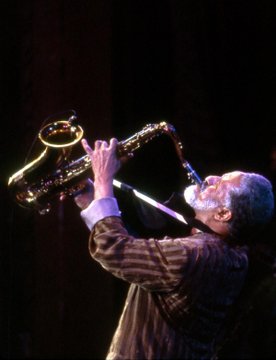
Sonny Rollins is gone. The last jazz giant was 95 — and he spent two years playing alone on a bridge to get better. (Image Rollins on X)
By TRH Features Desk
Sonny Rollins, the “Saxophone Colossus” and last surviving giant of jazz’s golden age, has died at 95. A profile of his life: from Harlem’s bebop streets, to the Williamsburg Bridge, to the ashrams of India.
The Man Who Played Alone on a Bridge: Remembering Sonny Rollins, the Last Jazz Colossus
Theodore “Sonny” Rollins — saxophonist, mystic, civil rights artist, and the last living link to the golden age of jazz — died Monday at his home in Woodstock, New York. He was 95.
The death
Sonny Rollins, the “saxophone colossus” who was widely considered America’s greatest living jazz musician and whose musical eloquence and inventiveness kept him at the creative forefront of jazz for six decades, died May 25 at his home in Woodstock, New York. “His death was confirmed in a statement by his publicist, Terri Hinte. A cause of death was not immediately available,” said Rolling Stone in a report.
He left behind no contemporaries. The era of jazz giants — Parker, Coltrane, Miles Davis, Monk, Clifford Brown — had been closing for decades. Rollins was its last living witness. Its last practitioner. Its last colossus.
The beginning: Harlem, bebop, and Bird
Walter Theodore Rollins was born on September 7, 1930 in New York City. “He grew up in Harlem not far from the Savoy Ballroom, the Apollo Theatre, and the doorstep of his idol, Coleman Hawkins,” said Sonny Rollins in a report.
He grew up within walking distance of the Apollo and Minton’s Playhouse, where Charlie Parker, Dizzy Gillespie, Thelonious Monk, and guitarist Charlie Christian held the all-night jam sessions — Ralph Ellison called them “a continuing symposium of jazz” — that were so central to the development of bebop, wrote The New York Times Book Review.
It was an education no conservatory could replicate. Rollins absorbed it all.
By his 18th birthday, Rollins had gained such a reputation in Harlem as a leading performer of bebop that in 1949, at the age of 19, he made his recording debut with vocalist Babs Gonzales. “In the same year he also recorded with J.J. Johnson and Bud Powell, the great bebop pianist,” wrote BlackPast.
Miles Davis, already a rising star himself, took notice early. In his autobiography, Davis wrote: “Sonny had a big reputation among a lot of the younger musicians in Harlem. People loved Sonny Rollins up in Harlem and everywhere else. He was a legend, almost a god to a lot of the younger musicians. Some thought he was playing the saxophone on the level of Bird. I know one thing — he was close. He was an aggressive, innovative player who always had fresh musical ideas. I loved him back then as a player and he could also write his ass off.”
The sound that set him apart
Sporting a burly tone, a tart sense of instrumental humour, and keen melodic and harmonic ingenuity, Variety said Rollins was acknowledged as a jazz voice as groundbreaking as that of his friend and contemporary John Coltrane, with whom he unforgettably locked horns on “Tenor Madness” in 1956
He penned such now-standard entries in the jazz book as “Airegin,” “Doxy,” “Oleo,” and “St. Thomas.” “St. Thomas,” which appeared on “Saxophone Colossus” and became his best-known song, incorporated Caribbean calypso that he had heard as a child — a nod to his Virgin Islands heritage that ran through his music like a warm current beneath the hard bop, added Variety.
Rollins ranks among the most influential jazz saxophonists, filling the musical and historical gap between Charlie Parker and John Coltrane. As a trendsetting saxophonist of the post-bebop and hard bop era, he established jazz waltz, calypso rhythms, and extensive “improvisatory stream of consciousness” solo technique, and other key styles.
The bridge: a myth made real
No story in jazz is more cinematic than the Williamsburg Bridge years. At the peak of his first wave of fame, Rollins simply disappeared.
Between 1959 and 1961, Rollins took a break from the performance scene. In his biography he recalled: “I was getting very famous at the time and I felt I needed to brush up on various aspects of my craft. I felt I was getting too much, too soon, so I said, wait a minute, I’m going to do it my way. I wasn’t going to let people push me out there, so I could fall down. I wanted to get myself together, on my own. I used to practice on the Bridge, the Williamsburg Bridge because I was living on the Lower East Side at the time.”
The then 28-year-old would practice up to 16 hours a day on the bridge’s pedestrian walkway, taking up a string of self-improvement measures including yoga, exercise, and giving up smoking. He played into the open sky, facing the river, serenading tugboats, wrote Brooklyn Post.
The very public sabbatical produced one of his best-known albums, 1962’s “The Bridge,” and has led to proposals to rename the Williamsburg Bridge in Rollins’ honour.
Freedom Suite: jazz as protest
A year before the bridge, Rollins had already made one of the bravest statements in American music. Rollins found a new purpose to music with “Freedom Suite,” his 1958 work that spoke to the rising struggle of African Americans for equal rights.
Rollins later wrote to Jazz Times that his 1958 “Freedom Suite” should have been included in their sidebar on jazz as social protest. “In the modern jazz era, that was the first record that reflected the civil-rights period,” Rollins wrote. “That was the first that I know of.”
It was a declaration at a time when such declarations carried real risk — and it pre-dated the civil rights album as an established form by years.
The second disappearance: India and the spirit
In a sequel to his Williamsburg Bridge years, Rollins took a second sabbatical starting in 1966, learning Zen meditation in Japan before spending several years in an ashram in India, where he arrived with just a bag and his saxophone. Under the guidance of Swami Chinmayananda on the outskirts of Mumbai, Rollins devoted his days to reading and discussing sacred Vedic texts.
He rarely performed during this period. But when he returned, he brought the inner life of those years back into his music.
Jazz artists “were trying to find a way to express life through our improvisations. The music has got to mean something,” Rollins later told NPR.
Follow The Raisina Hills on WhatsApp, Instagram, YouTube, Facebook, and LinkedIn




About The Author




Am delighted TRH is covering things like this. Super.