‘Sholay Was Never Rejected’: Ramesh Sippy Sets Record Straight
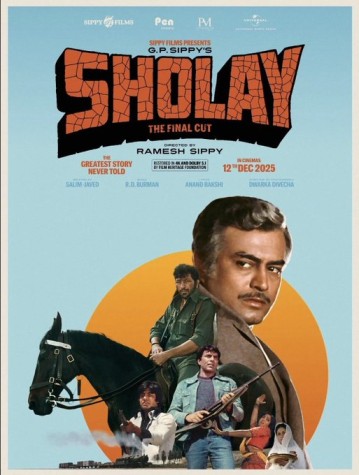
Poster of re-released film Sholay
In a rare interview with The Kathmandu Post, the legendary filmmaker reveals the truth about the opening week, the censored climax, and why the blockbuster was never a curse
By TRH Entertainment Desk
Mumbai, April 4, 2026 — Fifty years after it changed Indian cinema forever, Sholay remains a film that demands explanation — not of its greatness, which is settled, but of the myths that have grown around it. Director Ramesh Sippy, now in his eighties, is still correcting the record.
In a rare interview with The Kathmandu Post, Sippy pushed back against one of Bollywood’s most repeated legends: that Sholay was a slow starter, a disaster that audiences eventually rescued from obscurity.
“The idea that it didn’t get a strong opening is ridiculous,” Sippy said. “By the second week, I saw people repeating the lines because they were returning to theatres to see it again. Some newspapers did carry headlines calling it a ‘disaster’, but it took them a long time to retract those words. People loved it from the beginning,” he told the Kathmandu-based daily.
‘Angrezon ke zamaane ke jailor’ Asrani Leaves Laughter Legacy
The Making of a Masterpiece
Released on August 15, 1975 — Independence Day — Sholay was unlike anything Hindi cinema had produced. A dacoit revenge drama shot in the rocky terrain of Ramanagara in Karnataka, it fused the grammar of Italian spaghetti Westerns with the soul of Indian storytelling. Written by Salim-Javed — the legendary screenwriting duo of Salim Khan and Javed Akhtar — and scored by R.D. Burman, the film ran at Mumbai’s Minerva Theatre for five consecutive years, a record that has never been broken.
The cast was a constellation. Amitabh Bachchan and Dharmendra played Jai and Veeru, the roguish mercenary duo at the film’s heart. Hema Malini brought Basanti alive with irrepressible energy. Sanjeev Kumar delivered a performance of quiet, devastating grief as the amputated Thakur. And Amjad Khan, in his debut, created one of world cinema’s great villains — Gabbar Singh — with lines so embedded in the cultural memory that Indians still quote them daily.
Sippy was generous in crediting his ensemble. “I couldn’t have made this film without these actors; it simply wouldn’t be the same,” he told The Kathmandu Post. “From the leads to the smaller roles like Jagdeep and Asrani, every single person contributed something vital. It remains a milestone in all of our lives,” he added.
He spoke with particular warmth about those no longer alive. “Even those who are no longer with us, like the legendary Amjad Khan and Sanjeev Kumar, contributed immensely. Their work was no less significant than anyone else’s,” Sippy told the daily.
On whether Sholay made the careers of Bachchan, Dharmendra and Hema Malini, Sippy was measured. “I’m sure they would have succeeded regardless. Sholay was not their only success — they all had hits both before and after. However, Sholay became a masterpiece because of them.”
He recalled specific moments with the reverence of a filmmaker who still marvels at what his cast gave him. “Dharmendra on the water tank — the way he performed that scene was marvellous. Then there were Amitabh Bachchan’s touching moments, like the lamp-lighting sequence with Jaya Bhaduri.”
The Censored Climax — Now Restored
For the film’s 50th anniversary, an uncensored version is being screened in theatres — and the most significant difference is in the ending. In the version audiences saw in 1975, Thakur does not kill Gabbar. He beats him, but the police arrive before the kill. In Sippy’s original cut, Thakur completes his revenge.
“That was the original vision,” Sippy confirmed. “But the scene did not make it past the censorship. I am glad people can see it now,” he added. The censors in 1975 deemed the killing too violent and legally problematic — a vigilante murder that the board felt could not be endorsed on screen, even fictionally.
“There isn’t a huge difference, really,” Sippy said — before conceding the point when pressed. “Yes, it is a big difference.”
No Curse, Only Gratitude
On the question of whether Sholay’s towering shadow became a burden on everything that followed, Sippy was philosophical. “I don’t see it as a curse. The level of success Sholay achieved is a once-in-a-lifetime phenomenon; even if I wanted to replicate it, it wouldn’t be possible.”
He directed several notable films after Sholay, including Shaan (1980) and Saagar (1985), none of which matched his debut blockbuster’s cultural footprint. But Sippy said the comparison never troubled him.
“While my later films may not have matched the sheer scale of Sholay’s success, my personal satisfaction was equal across all of them. I’m very happy with the body of work I’ve created,” he added.
At fifty, Sholay is no longer just a film. It is a shared inheritance — the shorthand for a certain kind of epic, the benchmark against which every ambitious Hindi film still measures itself, and proof that some stories, told well enough, simply refuse to end.
Follow The Raisina Hills on WhatsApp, Instagram, YouTube, Facebook, and LinkedIn




About The Author