Regime Change: The Trump Book That Even Trump Was Waiting For — With Dread
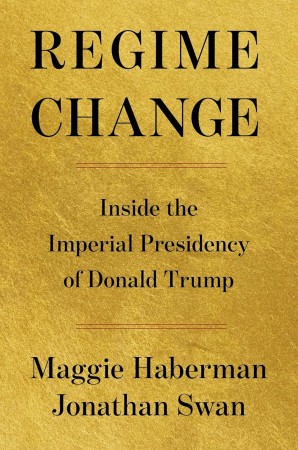
Regime Change: Inside the Imperial Presidency of Donald Trump (Image book cover, Amazon)
By TRH Book Desk
Regime Change Review: Haberman and Swan’s Trump Book Is Already Causing White House Panic
There is a well-worn genre in American political publishing: the Washington insider account, rushed to press while its subject is still in office, promising revelations that reshape the conventional wisdom. Most of these books deliver less than their cover art suggests.
Regime Change: Inside the Imperial Presidency of Donald Trump, by New York Times White House correspondents Maggie Haberman and Jonathan Swan, published by Simon and Schuster, is not one of those books. Based on what has already emerged, it is the rare entry in the genre that lives up — and then some — to its billing.
The title is the thesis. As Axios reported when the book’s existence was first revealed in April, Haberman and Swan concluded that for generations, American journalists had parachuted into foreign capitals to chronicle regime change.
They had come to believe they were covering one at home. That is not a provocative metaphor. It is a structural argument about what Trump’s second term has done to the American presidency as an institution — and the book, from its opening pages, makes clear it intends to sustain that argument with evidence, not assertion.
The authors are perhaps uniquely positioned to do so. Haberman and Swan have conducted something like 1,000 interviews, built over more than two years, reaching into the classified confines of Oval Office and Situation Room meetings.
The White House’s alarm about the book was visible well before publication. Senior administration officials had been privately discussing leaks from Oval Office and Situation Room meetings to Haberman and Swan — including recent 2026 discussions — suggesting panic at the depth of the authors’ sourcing.
Trump’s own behaviour confirmed what the White House was trying to conceal. Trump’s vicious mid-March attack on Haberman finally revealed what he was so desperate to suppress: the announcement of the book — a pre-emptive strike that succeeded only in alerting the world to its existence.
The first published excerpt, appearing in the New York Times Magazine on June 10, provided a preview of what Haberman and Swan’s access yields. Trump’s top aides so feared leaks about their handling of the Jeffrey Epstein files that they held multiple damage-control meetings in the classified confines of the Situation Room, the authors report — a detail that is both comic and chilling. The Situation Room, built for genuine national security crises, was being convened to manage a political embarrassment.
The scene the authors construct inside those meetings is extraordinary. Vice President JD Vance and Chief of Staff Susie Wiles gathered in the Situation Room last summer to debate how to manage the growing scandal. Vance, according to the authors, argued for full release of the Epstein files. Trump, they report, wanted the whole issue buried and was snapping at anyone who raised it. Swan and Haberman write that “relationships at the top of the Justice Department were by now beyond dysfunctional.”
The Epstein chapter alone — a single strand in what promises to be a vastly larger tapestry — illustrates why this book has generated what Axios called “high anxiety in Trumpworld.” It is not merely that the reporting is damaging. It is that it is granular, sourced, and cinematic in a way that suggests the authors were present, in spirit if not in body, in those very rooms.
The book’s larger architecture concerns what the publisher’s description calls a presidency “liberated from every constraint that defined his first.” The generals who once told him “no” are gone, and the lawyers who remain have learned to pick their battles.
His administration has flouted court orders and he has claimed powers that Congress once checked. That is the frame through which every revelation in the book — the Iran war deliberations, the border surge, the immigration agents’ deadly clashes with protesters, the Justice Department deployed as an instrument of personal retribution — is meant to be understood.
Haberman, the author of the acclaimed 2022 biography Confidence Man, and Swan, winner of an Emmy for his legendary 2020 Trump interview, bring complementary skills to a subject they have each tracked for a decade. Haberman’s intimacy with Trump’s psychology and Swan’s fluency with the mechanics of power combine into something that reads, based on the available excerpts, as both reported history and diagnostic portrait.
They reveal a second term propelled by a historical irony that Trump himself has come to understand: that the indictments, the convictions, the assassination attempts, and four years of exile made him not weaker but far more powerful, more vengeful, and more willing to gamble than any President in modern history.
Poynter, reviewing the book’s pre-publication impact, noted simply that the excerpt was “a doozy” — understated praise for reporting that sent the White House into its own damage-control spiral within hours of publication.
What makes Regime Change potentially the defining account of this presidency is not any single revelation. It is the cumulative weight of what a thousand interviews, conducted from inside the most closely guarded rooms of American power, can produce: a record of a government turning on itself, of a president governing on instinct alone, of institutions bending and breaking in real time. That is not a book review. That, if the excerpt is any guide, is the book itself.
Regime Change: Inside the Imperial Presidency of Donald Trump by Maggie Haberman and Jonathan Swan is published by Simon and Schuster.
★★★★½ / ★★★★★
(Advance assessment based on published excerpt and pre-publication materials)
Follow The Raisina Hills on WhatsApp, Instagram, YouTube, Facebook, and LinkedIn




About The Author